Categories
Newsletter

I hate the word content | Issue 155

Desk Notes

(Please excuse the mess…still building dreams) ✨

I hate the word content. Since the dot-com boom of the 90s, it’s become a catchall term for everything we make—words, video, audio—invading everyday talk and devaluing the creative process. 

“It’s like seeing a cereal box at a store labeled ‘Food (100 grams)’” – Mitch Trachtenberg on Medium. Yes!

I got my first journo job on Country Walking mag in 2000 when Emap was digitised. Many mags were rolling out websites, and they needed loads of copy. A golden era for online publishing—you could be paid well for your words and make decent money online. 

Along came CopyBlogger in 2006 (when Julieta was born), and I started blogging on the side. The Content Marketing Institute was set up in 2011 – a sexier and more relatable term than ‘custom publishing.’ Businesses saw the potential of marketing through email.

Twenty years on, everything and its dog is now labelled ‘content.’ 

I just checked how many Substacks have ‘content’ in the title/description – 100+.

I’ve struggled with this as a small business. How do you differentiate yourself when we all ‘work in content’? I’m still wrangling with taglines: ‘Smart, thoughtful content solutions’. ‘Copy solutions’ (sounds like a print shop). ‘Editorial solutions’ – not catchy. I might go back to saying ‘I’m a writer.’ I’ve taken it off my LinkedIn bio even though I’ve been hired for roles with content in the title. 

I write. 

I curate. I publish.

I write some marketing materials.

Let’s stop calling it content

I’ve seen many articles about this, across industries, so I’m not alone.

We’ve taken a term for websites and sprinkled it around on pretty much everything. Like a virus, it’s spread — and by definition, it cheapens everything we do. Because the word ‘content’ is just about as appealing as ‘principal substance’ or ‘filler’ or ‘Soylent.’ It sounds like disposable stuff that appears by happenstance, like plaque or lint.

  • 10 questions with… Cindy Gallop [The Drum]: “If you could ban one buzzword or piece of jargon, what would it be?” 

“Content.” 

  • Oscar-winning actor and screenwriter Emma Thompson at the RTS Conference [Variety], “To hear people talk about ‘content’ makes me feel like the stuffing inside a sofa cushion. It’s just a rude word for creative people.”
  • Writer Clive Thompson: Let’s stop calling it “content” – this got me thinking about the importance of words and how they shape our understanding of the world (and whether a term useful for referring to the whole detracts from the parts).

He says the word ‘content’ is widely used by designers and UX folk because it has an industrial meaning and a specific purpose. We have content design and content strategy as separate disciplines with some crossover. We have ‘content teams’. I can get on board with that.

What I can’t stand is how it’s crept into everyday use (especially in business) as a term to describe everything and all forms of creative expression. 

“Quentin, I just love your content!”

Where are we going with it all? I worry about the rise of ‘AI-generated content’ – being trained on trillions of tokens (carbon footprint!!) and the industry’s growing interest in writing via AI (one of the key issues of the writers’ strike).

Tech companies are so hungry for new data (the internet’s not big enough) that some are developing ‘synthetic’ info – i.e. systems learning from what they generate (this NYT piece went viral) #mindfuck.

So, time to put a stake in the ground! Keep up the fight for more clarity and specificity in language and life so we can better understand and relate to one another.

We live in a complicated, fast-moving world, and I get the need for simplicity, abstraction, and mental shortcuts. It’s convenient but lazy to lump all creative work as ‘content’. 

Spot on, Emma. We don’t wanna be stuffing in cushions! 

OK, so what should we call this stuff? 

John Long says be specific:

If you’re making social media, call it that. Or, to be more precise, social campaigns, social videos, and social posts. If you’re making short films, call them that. Copy for a website isn’t ‘content’—it’s website copy. Pictures are photography, images, photographs or illustrations. Podcasts are podcasts. Same goes for editorial, feature articles, white papers, brochures, and packaging copy.

Clive Thompson (replying to the VP of Content at Medium):

It’d probably be good – to, whenever possible, talk about the stuff that people write on Medium using the specific words that apply: Essays, memoirs, explainers, what have you. Even referring to a “post” and a “comment” is more specific than “content”! 

Language matters. I’m with Jason Bailey [NYT] on this:

The way we talk about things affects how we think and feel about them. So when journalists regurgitate purposefully reductive language, and their viewers and readers consume and parrot it, they’re not adopting some zippy buzzword. They’re doing the bidding of people in power and diminishing the work they claim to love.

What about you? Do you use the word ‘content’ or hate it too? 
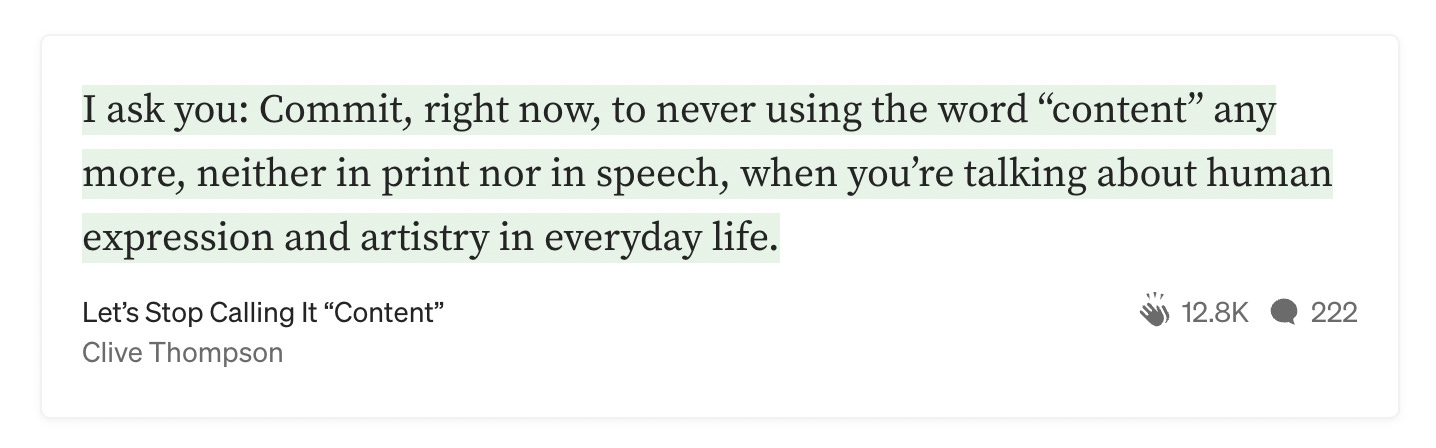
A quote from Clive Thompson asking us to stop calling all creative work 'content'

Other words I’m coming for: ‘Creator’—simplifies and minimises it. ‘Widget’—what the heck is it? ‘Sticky’ (usually content). ‘Consumer’ ugh. ‘Subscriber’. Too transactional. If I write marketing copy to sell something, it’ll be a separate email.

‘Slop’ – a new term for dubious AI content, is a keeper 😁
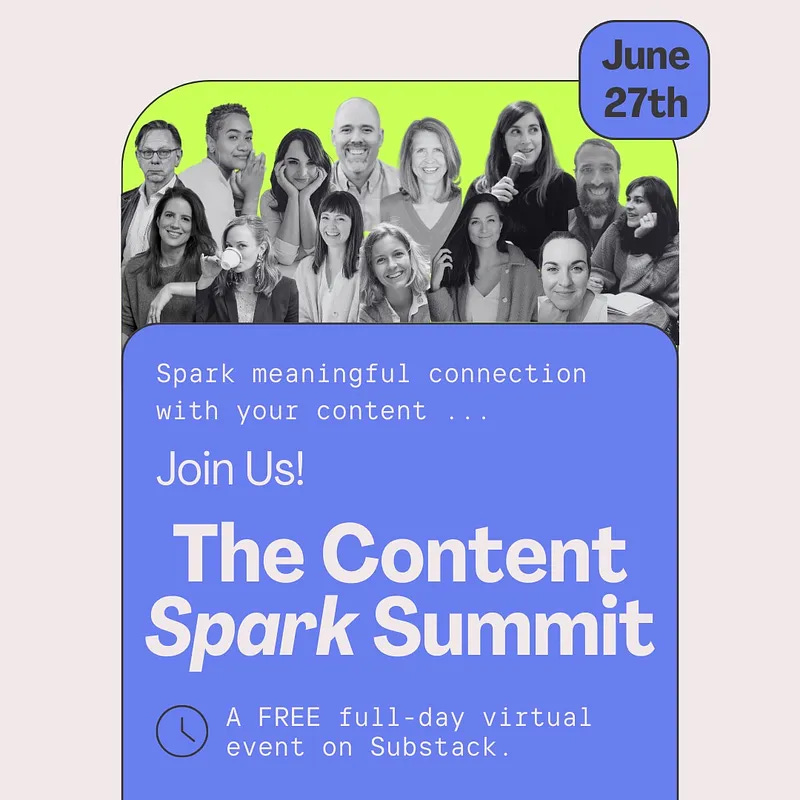
Something to discuss with the Substack crew at The Content Spark Summit with Christin Thieme—a FREE full-day virtual event on Substack June 27 to help you spark meaningful connection with your content. 

I’m doing a Q&A with Christin to get to know her better so will share that next week—can’t wait to hear her thoughts.

You can book your ticket here.

Nika ✨


My Internetland 

I help founders make a global impact with their stories. Life’s too short to play small. 

Interested in using writing to grow your business? Fill out this form to get started. 
Website | LinkedIn | Ko-fi | Newsletter Talent Directory 

Categories
Newsletter

Working-class writer?

Journalism needs writers from all walks of life

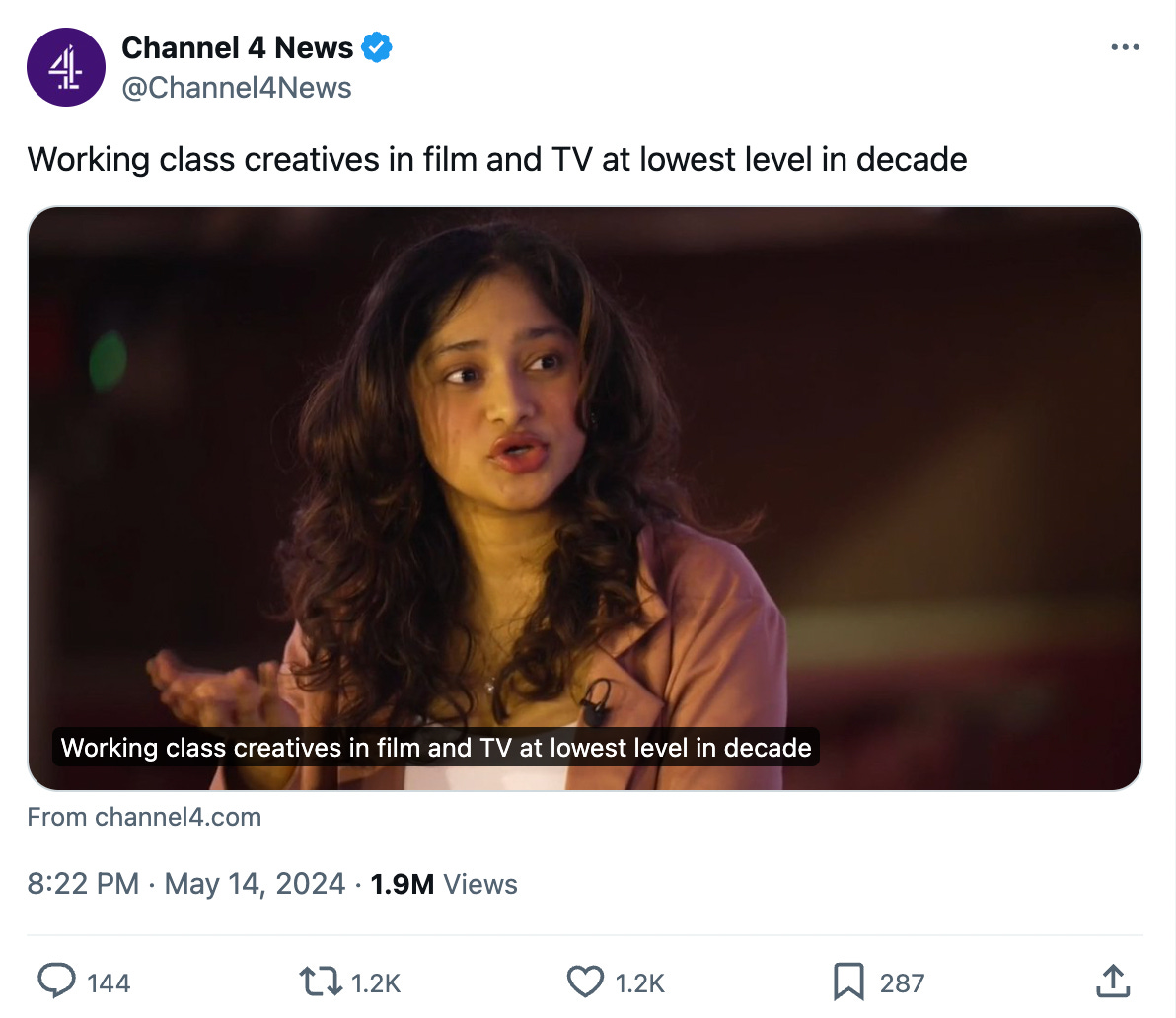
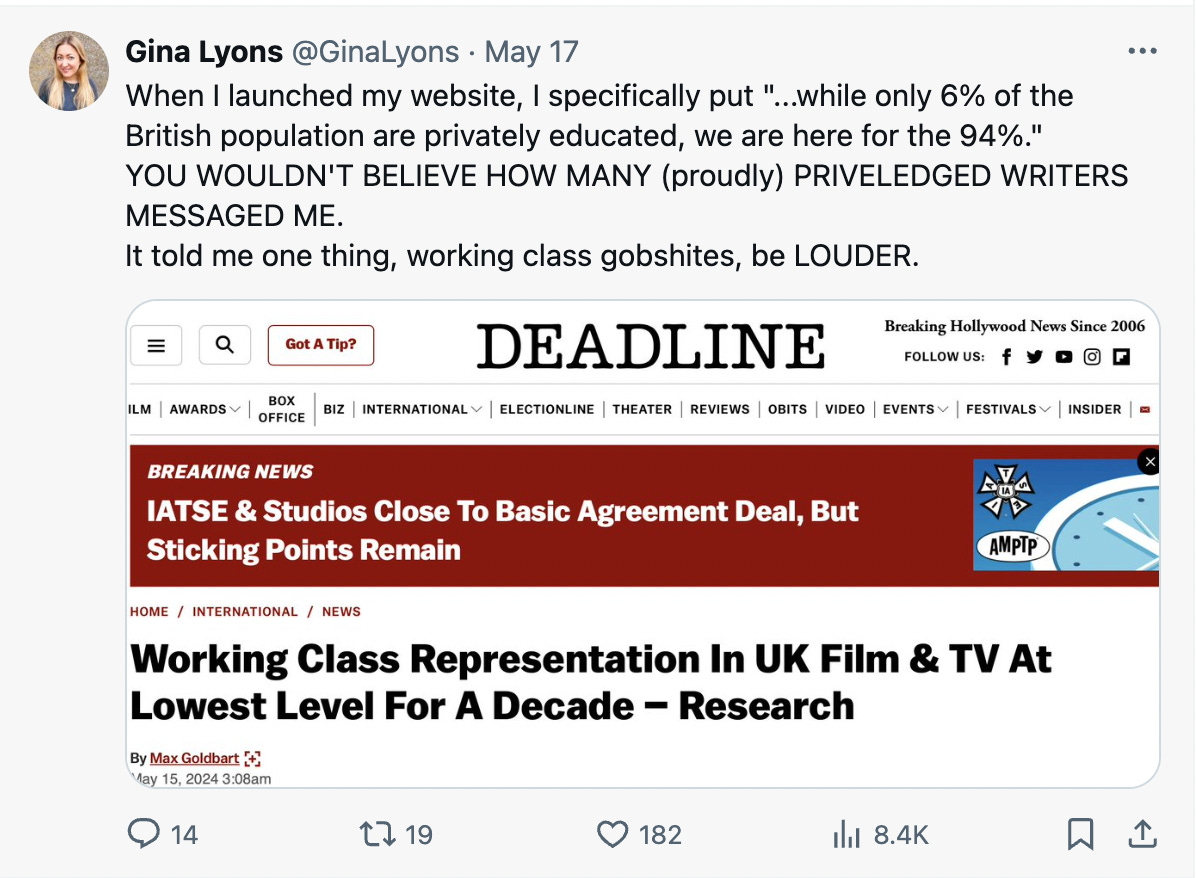
This week, CreativePEC shared new research revealing that the number of people from working-class backgrounds in film, TV, and radio has plummeted to just 8% of the workforce, the lowest level in a decade.

Channel 4 News platformed some young creatives to talk about it. I can relate to Sam Oddie’s comments on mindset and self-belief.

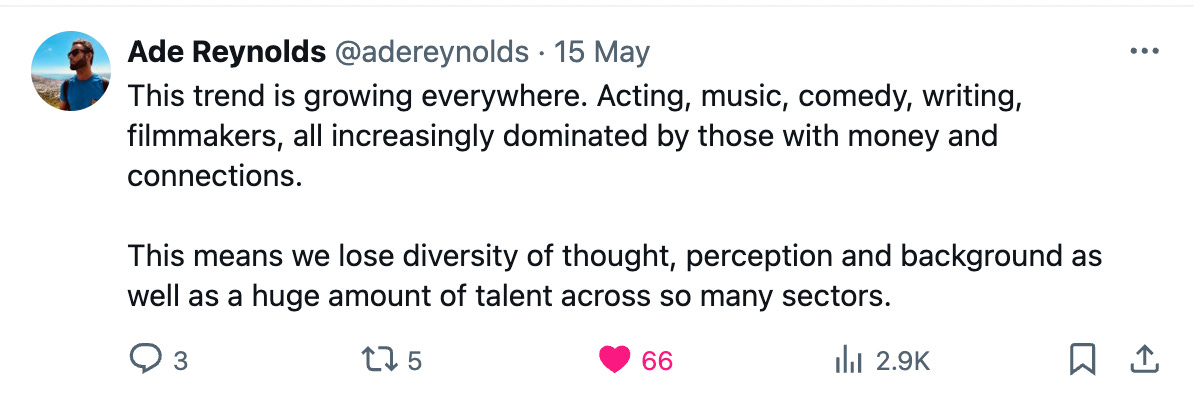
Just read through the comments on X and saw this piece by Tom Walter, Journalism: Occupation of the Privileged?, which he shared ten years ago!! 

Christ, it’s depressing.

Wrote this a decade ago, and I see no change. The idea of working-class lads from former Nottinghamshire mining villages, for example, taking unpaid work experience in London is becoming laughable. The same people again and again in the media. 

I remember being in Mansfield Library (my second home) while doing my A Levels and wondering whether to bother applying for an internship at ITN News. Inner Aggie: “What’s the point? You won’t get anywhere with it, being from round here. You’re at a state school.”

But I’m a stubborn bugger, so I did apply. I didn’t get shortlisted, but you’ve got to try and keep pushing. And that’s been my mindset ever since. 

After uni, I wrote 100 letters to production companies all over the UK and finally got my first job as a runner at Maidstone Studios for £80 a week. My bedsit was £40 a week – quids in! 

Later, I won a scholarship with Emap to study magazine journalism and was over the moon. This was 2000-2001, pre-digital boom, and I knew I had to move to London to get my dream job in women’s mags. But I couldn’t afford to move there without a job and had no family to stay with.

A friend from my Maidstone days had relocated to London, and she let me crash in her spare room in Waterloo for a bit while I was on unpaid work experience at the BBC, Emap and IPC Media. I’m super grateful for that opportunity. I couldn’t have done it otherwise.

Always a side hustle. I had a Saturday job at Penhaligon’s and temped between media jobs to keep myself afloat. But even though I was working all hours I still managed to get into debt in London and spent the next decade paying that off. 

Looking back, it’s a crazy life and a route to burnout. I can see how it’s shaped me: Working with writers’ orgs and a journo union to help freelancers survive and thrive in an expensive city and messed-up media industry. Here for the little guy!

It’s good to see lots of folks commenting on this report, sharing ideas, opportunities and trying to change the status quo. Jackie Oudney has just premiered a short film on exactly this from a female perspective (semi-autobiographical). Well worth watching; link below. 

The 98% Pod has started a chain of working-class creatives to uplift wc voices. Please share if you know someone who needs a leg up with their creative career. 

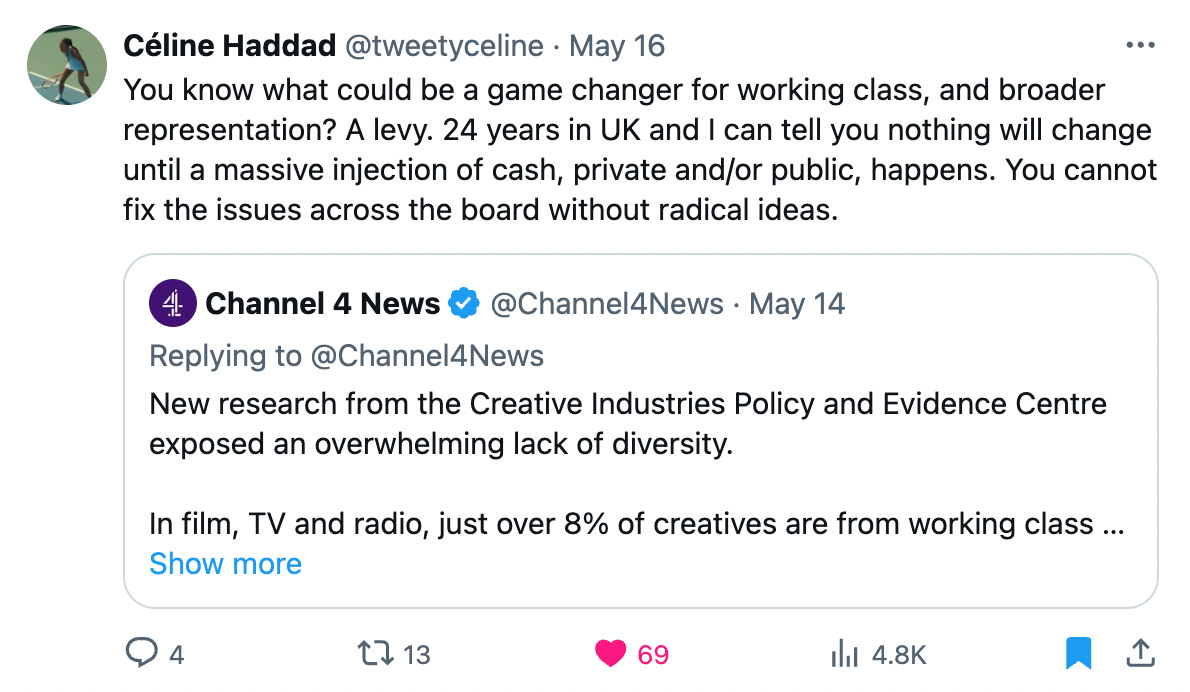
Levelling up? I am positive but I agree with Celine Haddad on the levy.

As always, it comes down to money.

Read, Watch, Listen

▶️What I Am — a short film written by award-winning director Jackie Oudney 

▶️How and why to make a / now page on your site — a public declaration of your priorities | Derek Sivers 

▶️Substack is completely gutting their business right now — followers vs subscribers | Jeanna Kadlec. And Simon Owens take on it

▶️Welcome to SmallStack! A brand new library for small publications | Robin Taylor

▶️Journalists Pay Themselves — how indie worker-owned outlets are making money to fund their work | Lex Roman 

Nika ✨

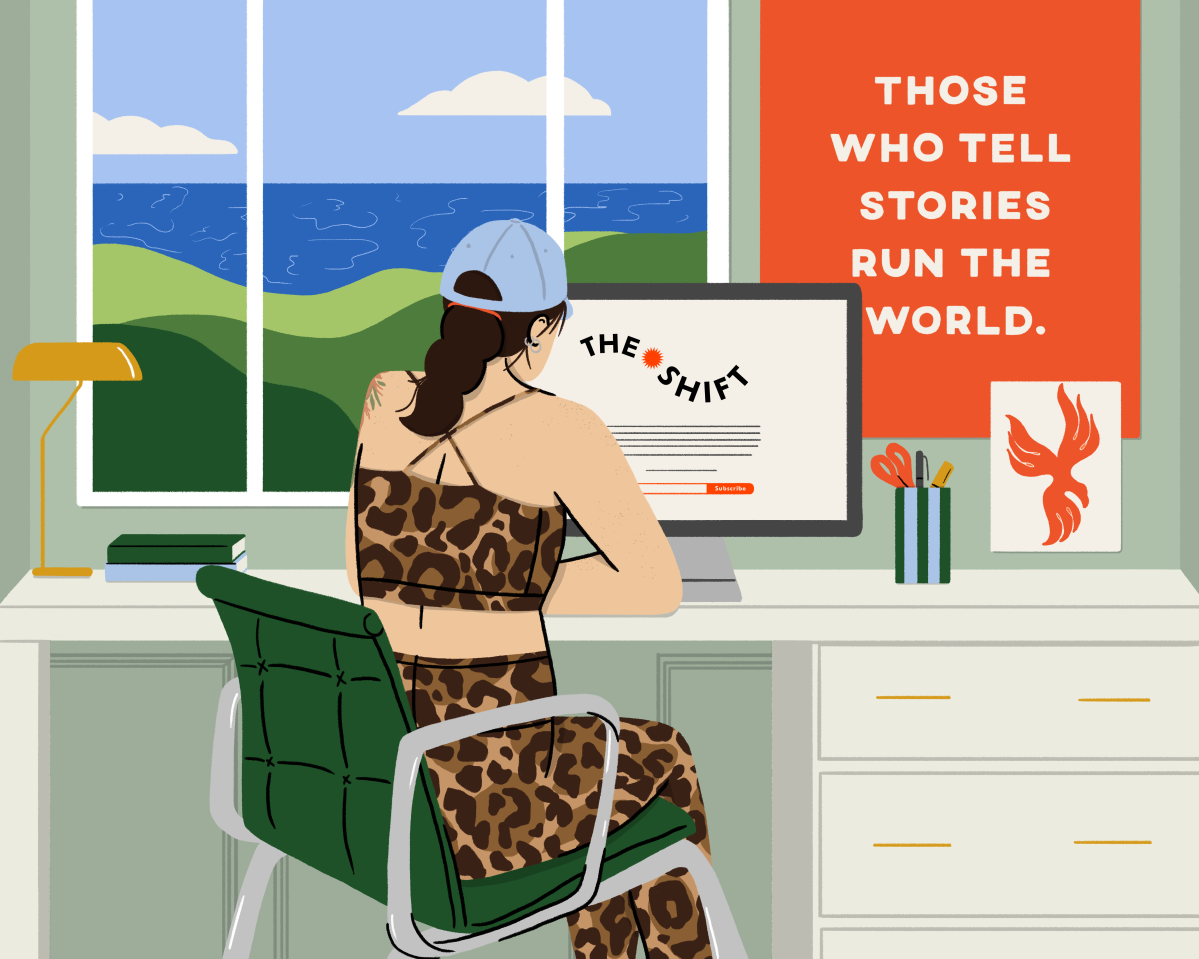
Thanks to Sophie Parsons for the fabulous illustration – it is me and I love it!


Work with me

I help entrepreneurs impact the world with their stories. Life is too short to play small. See my services.

▶️Newsletter Talent Directory! for creative collaborations.

Categories
Newsletter

🌟Celebrating creativity

The impossible takes just a little bit longer – Marci Segal, Creativity Crusader

Happy World Creativity and Innovation Week! I was curious about who founded this, so I looked at the backstory. Marci Segal began studying creativity in 1977 and thought, “Wouldn’t it be great if people knew how to use their natural ability to generate new ideas, make new decisions, take new actions and achieve new outcomes to make the world a better place and to make their place in the world better too?” 

So, she set off on a quest to make the world a better place for creativity and free people’s thinking to create new futures. It began in 2001, and 23 years later, it’s now a UN International Day of Observance to raise awareness of the importance of creativity and problem-solving.

“We have a day because the UN sees we need to have new kinds of thinking to face the challenges ahead of us,” – the 2030 Agenda & Sustainable Development Goals (worth thinking about how your biz is supporting these.)

Fabulous work by a fabulous woman! Listen to her story and the headline that inspired it here.

So, a request from Marci that we do something new and different today to keep the energy going. Yes, we’re always creative, but it’s nice to mark the day, April 21, and use it to set some goals for the year—this works better for me than new year resolutions as it’s spring, and I’m coming out of hibernation.

Imagine how powerful that creative energy will be if we think about it and do things simultaneously.

How does she express her creativity? “I just live. To me, creativity is just about living.”

I’ll go for a walk later – find somewhere I’ve not been before.

Giving and receiving ideas 

New ideas deserve better than to be swatted at as if they are pesky flies.

I like what she said in her TEDx Talk about strengthening and building ideas together. A reminder to give and receive ideas—yin and yang energy, i.e., make time to be as well as do.

When Julieta was small, we had an ‘Ideas Jar’ to leave notes in for things she wanted to do or fix. I’m not sure why I stopped doing this – they made me smile and a creative prompt when I’m not feeling inspired. I’ve bought a waterproof notepad and pencil for the shower so we can keep this going and leave little notes for each other – it’s a bit of fun, and I do my best brainstorming in the shower.

Animals are creatures of habit, too. My mum’s been gardening this week, and she’s got some homeless birds! Now that the big tree (their home for the past few years) has been chopped down, Mr. and Mrs. Bird don’t know what to do with themselves—flapping around the garden, trying to figure it out. I can’t wait to see where they move to next. It needs to be a penthouse apt. to stop the cats from killing all their babies—it’s just too sad!


Lions State of Creativity 2024 

Cannes Lions has released its annual State of Creativity. A biggish piece of research (3,000 global responses) designed to help marketers understand the creative landscape with advice on how to drive business growth using creativity.

People are outwardly optimistic about progress and investment, but there’s a communication breakdown. This year, senior leadership was a big barrier to creativity. People felt creativity suffered because of conservative leadership, company politics, and an aversion to risk. Most want to push the boundaries of their creative work, but ‘play-it-safe’ leaders make them feel like they can’t.

When budgets are tight, it’s easy to overlook creativity, but work without creativity is bad for business.

Our findings show that brands predicting higher growth for 2024 are 6x more likely to prioritise creativity, are 4.6x more likely to have a higher marketing spend than 2023, and put more investment into brand building. It’s consistent evidence for the business case for creativity.

Download it here.

Cannes Lions 2024

Not long now till the Cannes International Festival of Creativity | June 17-21. NEW for ’24 is Lions Creators – networking for creators and those in the creator economy on June 18-20. They’ve launched their first pass for the creator economy. Applications open on April 29; you can register your interest here.

What will marketing departments look like? More companies are working with creators these days, even hiring in-house creators for campaigns. Corporate social media handles struggle with engagement, and newsletters are more likely to be read when they come from a person rather than a company.

Writing Prompt ✍️

Wouldn’t it be nice if…?

Leave a comment or email me, and I’ll share your feedback next week. Feel free to leave your name and a link to your website so readers can check out your work.

Nika 🙂

PS I’ve changed the name of this newsletter to Life Work Shift to make it clearer. We had a title brainstorming session last night in Sarah Fay Writers at Work cohort and gave each other some feedback. A few folks said it was too broad, i.e., it works with context (writing & entrepreneurship); otherwise, it’s not obvious enough. I love this group – no impact is an island.

I’m looking for a designer to create a new banner/logo for me – recs are welcome!


Hi, I’m Nika!

I run Firebird, the content consultancy helping entrepreneurs impact the world with their stories. See my services here.

Newsletter Talent Directory! Feel free to add your deets here for collabs.

If you’re enjoying reading my newsletter, consider upgrading to paid to help me grow it and do more. Thanks to all my paying subscribers.

Categories
Newsletter

DCMS report: Creator remuneration

How are you doing?

I’ve been reading the new report on creator remuneration from the Culture Committee—a good summary of the issues and potential solutions, which the NUJ’s Freelance organisers have commented on here.

✅ A Freelance Commissioner to advocate for creative people and the self-employed, for legal protection & rights, and to address outdated copyright and IP regulations. Yep – it’s urgent.

✅ Tackling stagnant fees—some companies are paying the same rates they did 20 years ago and generally rubbish rates across the sector. I had to chuckle (and cry) at our Swedish colleagues’ cake celebrating ’20 years at the same pay rate.’ 

✅ A UK private copying scheme to remunerate creators such as the Smart Fund, which safeguards payments from abroad.

✅ AI and creators“The Government must ensure that creators have proper mechanisms to enforce their consent and receive fair compensation for use of their work by AI developers.” (You can block AI training on Substack, which “may limit your publication’s discoverability in tools and search engines that return AI-generated results.”)

Good stuff. Let’s share it about and fix it for freelancers! We have a manifesto at #FairDeal4freelances, which includes a charter of freelance rights that the self-employed should enjoy. Gov has two months to respond to the report.

Self-employed rockstars make up a significant part of the creative workforce. I read that more than one million over 50s now work for themselves despite the pandemic’s impact on self-employment [IPSE]. Folks who want to start their own biz or have had enough of the 9-5. 

Yet we lack a single voice to represent our interests in government. And support and biz training generally, which is why we have such active unions, small biz orgs and freelance communities. 

AI and creative work

This week, we had a lively meeting on AI and creative work with speakers Laurence Bouvard from Equity (actress and computer scientist) and John Sailing from the Writers’ Guild. Interesting to hear about Equity’s successful campaign #StopAIStealingtheShow. The NUJ is also developing an AI toolkit for writers; watch this space.

Laurence said part of the problem is that the gov doesn’t understand the tech/AI and that there’s a general malaise: “People just don’t care.” 

It’s not that we don’t care, but it feels futile; the horse has already bolted. AI is here to stay; the companies already have our data, and what’s depressing is they’re so hungry for new data (i.e running out) that they’re now developing ‘synthetic’ info—i.e. training AI on text generated by AI (this NYT article went viral).

They hope that bringing different AI models together will solve the data problem and that “it should be alright.”

Where will it end?

I agree with Laurence that it isn’t just about protecting jobs (AI will create new jobs—I’ve had recruiters reach out for help training AI systems for $15 an hour!) but about protecting what it means to be an artist and writer—and keeping the human at the heart of it.

And protecting our planet – can you imagine how much power these machines are using?


Things I enjoyed this week

▶️ Death of the follower & the future of creativity on the web with Jack Conte [SXSW]. Amazing keynote and storytelling. His thoughts on the arc of the internet, how it will continue to evolve, and Patreon’s place in it. A call to make beautiful things that light you up and go deeper with your ‘true fans’ rather than chasing followers/algos/other people’s agendas. Love his passion. Go Jack!

▶️ The #1 NeuroscientistAfter listening to this, your brain will not be the same [Mel Robbins]. Practical tips on how to trick your brain into manifesting your goals and desires and using manifesting as a tool for success, happiness, and better health. Dr. Tara has a knack for simplifying science and making it fun.

▶️ I’m analysing 49K Substack newsletters [Newsletter Circle]. Understand the newsletter space and other creators’ behaviours and strategies in this new report. I’m enjoying Ciler’s work and love that she’s dreaming big. Her goal is to create a full-fledged media company for newsletter creators.

▶️ Axios sees AI coming, and shifts its strategy [NYT]. “The premium for people who can tell you things you do not know will only grow in importance, and no machine will do that.” Spot on, Jim. Axios is focusing on live events, a membership program centring on its star journalists and an expansion of its high-end subscription newsletters. Can’t wait to see how this plays out.

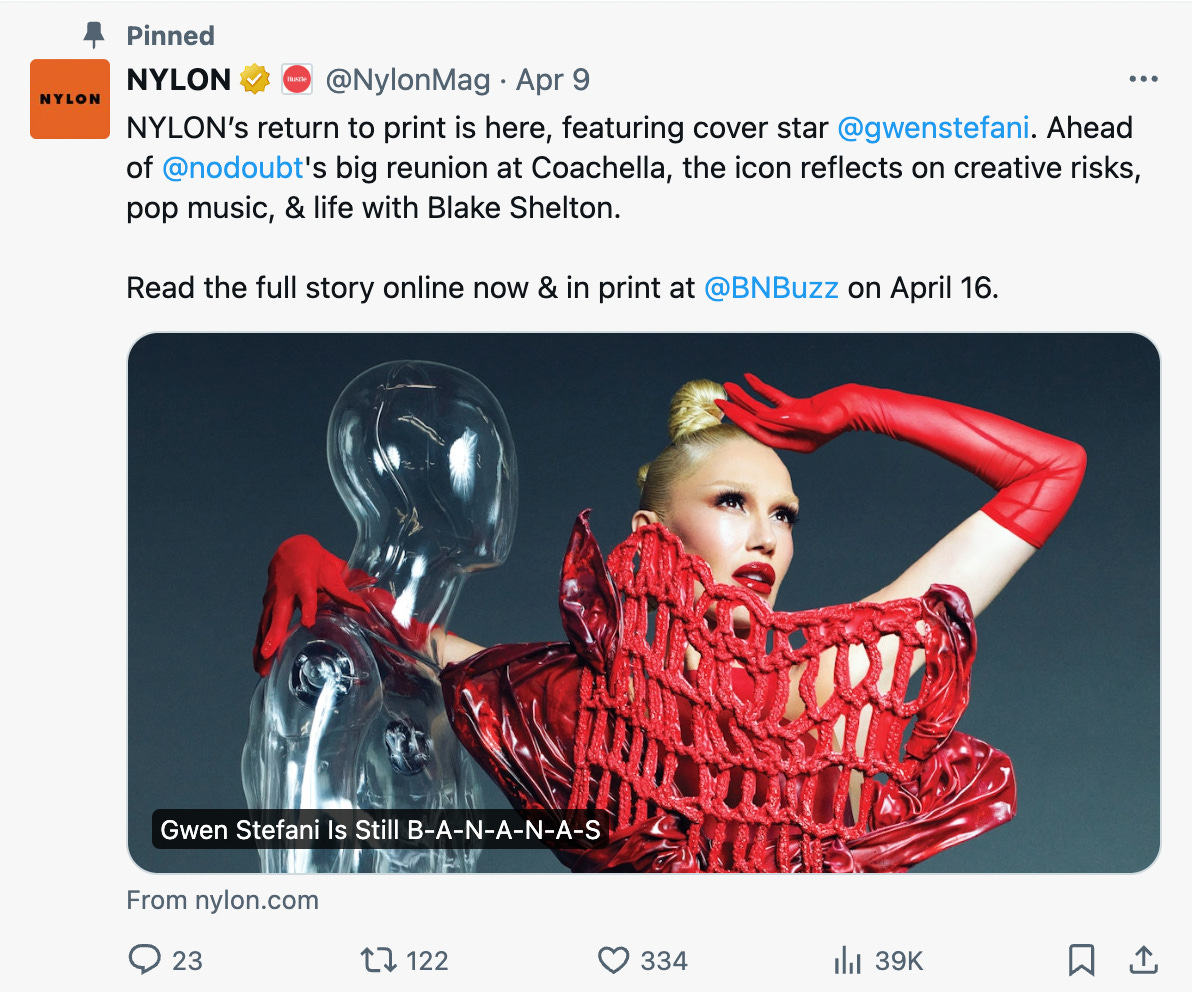
▶️ NylonMag is getting back into the print biz and relaunching its physical magazine for the first time since 2017. Back on the newsstand on April 16 with cover star Gwen Stefani to celebrate their 25th birthday.

It may be less frequent (bi-annual) and more of a coffee table magazine, but that’s not a bad thing. Quality over quantity is better for the planet. A keeper!

I’ve been enjoying reading physical magazines lately—I have to give my eyes a break. Seriously, I look up, and I can’t see! 😱 We’re not built to sit and stare at a screen all day.

Have a great week.

Nika 🙂

PS. I’m compiling a list of niche media events – newsletter conferences, creator events etc. If you have any recs, let me know.


Hi, I’m Nika! 👋

I run Firebird, the content consultancy helping entrepreneurs impact the world with their stories. Life is too short to play small.

See my services here.

If you enjoy reading this newsletter and want to get more involved in the community, consider upgrading to paid. My offering for paid peeps is here.

Categories
Newsletter

Diversity #1: Female Creatives – Tips & Resources

I did an interview recently with the Data & Marketing Association (DMA) for a new diversity series. It’s packed with tips and resources for female creatives. Read it here.

Our new diversity series seeks out creatives who’re making positive contributions around recognising, understanding, embracing, and encouraging individual differences. Our first interview features Nicci Talbot, a freelance journalist, copywriter, and author of 11 books on women’s health & lifestyle. Find out how her company is helping female creatives, and download our PDF packed with tips and resources.

Data & Marketing Association (DMA)