AI or DIE was the theme at #FixFest (copywriting festival) in London this week. Just looking at what people have been saying online, how they’re feeling about all things AI, and what side of the fence they’re on.
AI is having a massive impact on the industry. Some clients want you to embrace it, others don’t want you using it at all – it’s hard to know where to position yourself. Leif Kendall at ProCopywriters is working on a ‘Code of Ethics’ for the community.
The hypothesis was this…. Could generative AI be used to bypass the years it takes for a poet to find their voice and actually go one step further in creating a democratised mass poetic voice from a room of copywriters?
Since 1999, I’ve been writing online and interviewing creative folks I admire about courage and craft. I love learning from others’ journeys & experiences and want to help more ambitious solo entrepreneurs—especially women—impact the world with their personal stories. And make a shit ton of money!
Inspired by the book ‘Bold Types: how Australia’s first women journalists blazed a trail’ in the fight for gender equality, I’ve launched the Bold Types Q&A series.
Christin is editor-in-chief of The Salvation Army in the western US, where she tells stories about people making an impact for good and prompts others to action. She holds a master’s degree in specialized journalism from the University of Southern California, has taught journalism, and helps creatives simplify their content strategies on Substack.
Welcome, Christin! ✨
What problem is ‘The Content Brief’ solving?
I help creatives simplify their content. Anything we create and share is an invitation to connect, and I want people to have a plan and a workflow that is exciting to show up for.
I hold a master’s in specialized journalism, have worked for nearly two decades leading a content marketing team for an international nonprofit, and taught journalism and communications as an adjunct professor. Content is what I eat, sleep and breathe if you will.
After helping friends strategize how they could better connect with the right people online around their makeup artistry, barbershop and even psychology practice, I saw how overwhelming this world of content is to people who aren’t necessarily in it daily. I enjoy helping people break it down into something more tangible, sustainable, and real-life approved, so I’ve taken up doing so here on Substack.
If you’re feeling overwhelmed, frazzled, and frustrated with how you show up online… If you want to better connect (and convert) people to your ideas and your work…
The Content Brief is for you. I’ll help you take control of your content so you can stay in your zone of genius.
What’s always on your desk?
At my full-time gig, coffee, water, a Blackwing and my Airpods. At home, I’m often typing straight into my Notes app between baseball practice or bath time.
With three boys under six, I love and live by the Julia Cameron quote:
The ‘if I had time’ lie is a convenient way to ignore the fact that novels require being written and that writing happens a sentence at a time. Sentences can happen in a moment. Enough stolen moments, enough stolen sentences, and a novel is born—without the luxury of time.
I also printed out a screenshot of my first-ever paid subscription and put it in a little frame to remind myself I might be onto something, to keep going, and to keep finding ways to be helpful as I build this community.
What are you struggling with right now?
Time! I have so many ideas, but we all only have so much time, so I’m constantly reminding myself to focus on what moves the needle. This week, I am largely wrestling with delivering a virtual summit I’m hosting: The Content Spark Summit.
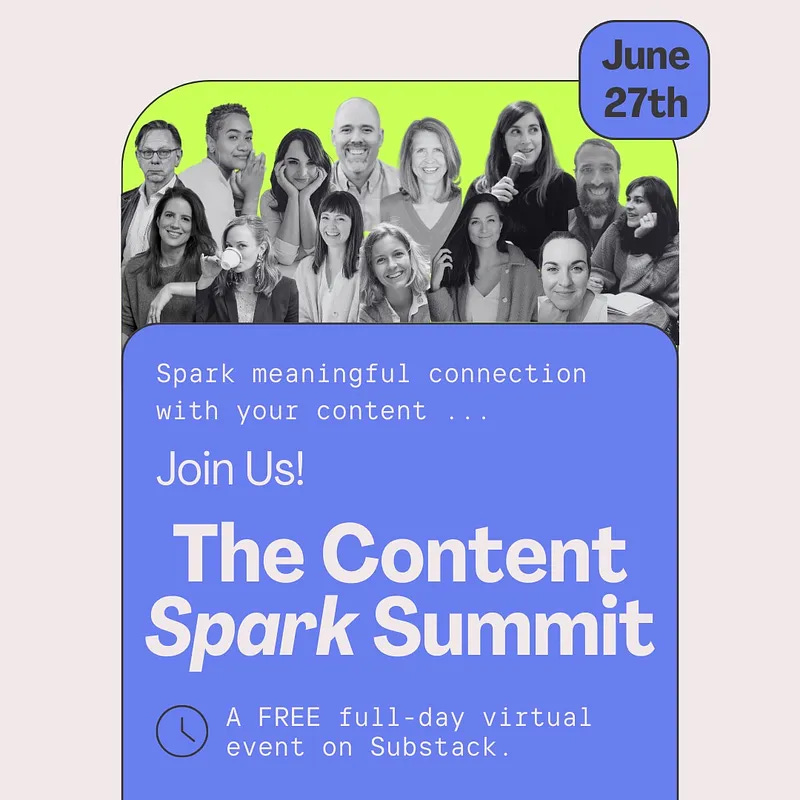
This free full-day event on Substack June 27 is meant to help you spark meaningful connection with your content. From understanding the importance of engagement to creating a content strategy you can’t wait to show up for to fostering genuine connection and leveraging your unique expertise and experience, 14 expert speakers will share what they know.
Just this other day, I saw this quote from Seneca: “You must match time’s swiftness with your speed in using it, and you must drink quickly as though from a rapid stream that will not always flow.”
He may have been a Roman philosopher, but the advice holds today:
Keep a bias toward action. It’s easy to hide behind planning, plotting, and perfecting (I know!), but the impact you want to make can never take hold until you actually take action.
Tell me about your newsletter strategy, its value to your business, and how you measure success.
Right now, I’m in an awareness-building phase, focusing on free subscribers, which is part of the strategy behind the summit.
There are three ways to engage with me at The Content Brief:
As a paid member, you get access to my quarterly content planning party, where I’ll help you plot out your next three months of content. The next one happens in August and will help you create a plan to show up consistently, with intention.
And as a paid member of The Briefing Room (the founding member tier), which I’m just about to launch, you get exactly what you need to design or redesign your newsletter content strategy with ease, including my exact simple content system, an all-in-one dashboard workspace, and a monthly brief on one specific thing to reset to keep your strategy fresh. It’s all designed to save you a lot of time and frustration so you can have a bigger impact with your newsletter.
I’m also building in ways to collaborate and share with other creatives. I hope The Content Brief becomes a vibrant community that supports each other in what can sometimes be a lonely endeavor.
What important truth do very few people agree with you on? Or your ‘spiky point of view,’ Wes Kao calls it.
Providing value doesn’t mean having all the answers.
Creative work that inspires an audience and builds a community (and business) doesn’t require anything stunt-like, viral or wildly innovative.
We don’t have to show up as “experts,” with all the answers ready to guide others to the big transformation. Trying to do so often leads to becoming another faceless creator of tips & tricks and *value* in some Wikipedia-esque, robot-generated “I have it all figured out” status quo.
And the problem is…that says nothing of the journey.
You could have the most well-researched writing in the world, but if it feels like nothing more than a robot production, it won’t get read.
Conversely, you could write about your life as a dog walker, and if you’re asking questions that take us on a journey and leading a conversation from your perspective, every word will get read.
To provide value, you need curiosity, questions, and a yearning to explore. It means being willing to lead the conversation and invite us on the journey of an idea in real time through your content. People don’t want to see processes, deliverables, skills. We want to see perspective, relationship, transformation—and that means your point of view, personality and perspective.
Last week, I wrote about why I hate the word ‘content’. It’s become a catchall term for everything we make—words, video, audio—invading everyday talk and devaluing the creative process. What’s your take on it?
This is SUCH an interesting question and a sentiment I’ve seen pop up recently. I’ve never thought of it negatively. I think of it like the word “box”—a catchall term that encompasses so many different specific things but one word that gives you the gist.
I’m sure some of the negative vibes toward the word come from the push for “top ranking” and “click-worthy” content that doesn’t deliver, but for me, it’s just a succinct way to describe the many ways we invite people to connect with us.
That’s what content is, in my view, whether it’s a newsletter, podcast, social post, and so on.
When you create and share something, you invite others to connect with you about your ideas and work. Of course, if you are specifically a podcaster or a novelist, say that. Lean into concrete specifics over summary words whenever you can.
How have you shifted from ‘creating content’ to ‘building community’ on Substack?
With a relatively new newsletter on Substack, I came in knowing I wanted to build a community. I love to plan parties. I love to build everything around a specific purpose. To carefully word the invite. To think through the menu. To find the right party favor. To design the table. To welcome everyone in. To surprise and delight. To make them feel loved.
I feel the same about crafting my own little club right here on Substack. Building a newsletter and community is the ultimate gathering. And I’m here to party. 🎉
Can you recommend some resources for entrepreneurs?
The Elements of Style by Strunk & White—I love this illustrated version of the classic go-to guide for writers on how to “make every word tell.” (It’s also one of my favorite gifts for the creative types!)
Building a Storybrand by Donald Miller—The best how-to I’ve seen on using words to talk about your product or service. It’ll help you define a clear message on how you can help potential customers. Worth re-reading annually. (Here’s my full list of favorite books to improve your writing for more.)
Hype Yourself, for learning how to generate your own buzz.
Are you using AI tools? If so, how are they helping you work better/save time?
Yes! I call Chat GPT my intern. I love using it to prompt my thinking, research subjects, synthesize interviews, and spot holes in them. It also helps repurpose my hero content into supporting pieces.
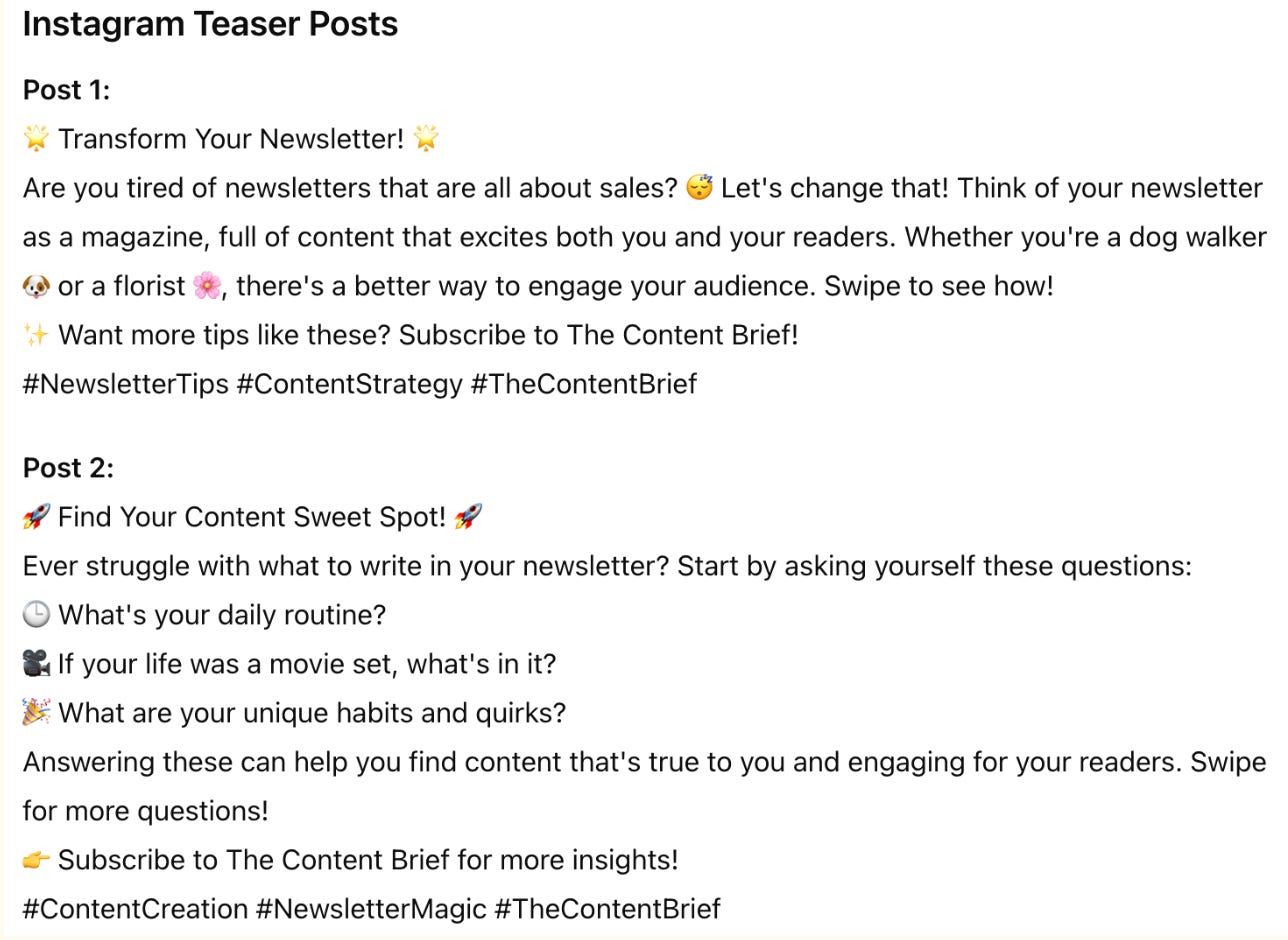
My goal is to create one Substack post a week and then repurpose it into snippets and teasers for my supporting platforms. To help save time prepping those shorter pieces, here’s a basic starter prompt I use:
I am a [what do you do], and I need to create a social media post based off a newsletter I previously wrote. The audience is composed of [your audience.]
Use this text to write 3-5 short-form teaser pieces of content for [platform] that highlight the main points, benefits or offers of this newsletter. Ensure the tone is [your tone].
Include a CTA at the end to subscribe to my newsletter, [your newsletter name].
Not bad for a first pass. I always edit the intern’s work for quality and to sound more like me, but the beauty is you’re not starting from scratch.
Best coffee & coworking in your town?
I haven’t done any local coworking, but my favorite coffee shop to work in is The Boy & The Bear in Redondo Beach, California. It has an aesthetically pleasing dark, earthy, “let’s get to work” vibe and good coffee. Win-win.
I hate the word content. Since the dot-com boom of the 90s, it’s become a catchall term for everything we make—words, video, audio—invading everyday talk and devaluing the creative process.
“It’s like seeing a cereal box at a store labeled ‘Food (100 grams)’” – Mitch Trachtenberg on Medium. Yes!
I got my first journo job on Country Walking mag in 2000 when Emap was digitised. Many mags were rolling out websites, and they needed loads of copy. A golden era for online publishing—you could be paid well for your words and make decent money online.
Along came CopyBlogger in 2006 (when Julieta was born), and I started blogging on the side. The Content Marketing Institute was set up in 2011 – a sexier and more relatable term than ‘custom publishing.’ Businesses saw the potential of marketing through email.
Twenty years on, everything and its dog is now labelled ‘content.’
I just checked how many Substacks have ‘content’ in the title/description – 100+.
I’ve struggled with this as a small business. How do you differentiate yourself when we all ‘work in content’? I’m still wrangling with taglines: ‘Smart, thoughtful content solutions’. ‘Copy solutions’ (sounds like a print shop). ‘Editorial solutions’ – not catchy. I might go back to saying ‘I’m a writer.’ I’ve taken it off my LinkedIn bio even though I’ve been hired for roles with content in the title.
I write.
I curate. I publish.
I write some marketing materials.
Let’s stop calling it content
I’ve seen many articles about this, across industries, so I’m not alone.
We’ve taken a term for websites and sprinkled it around on pretty much everything. Like a virus, it’s spread — and by definition, it cheapens everything we do. Because the word ‘content’ is just about as appealing as ‘principal substance’ or ‘filler’ or ‘Soylent.’ It sounds like disposable stuff that appears by happenstance, like plaque or lint.
10 questions with… Cindy Gallop [The Drum]: “If you could ban one buzzword or piece of jargon, what would it be?”
“Content.”
Oscar-winning actor and screenwriter Emma Thompson at the RTS Conference [Variety], “To hear people talk about ‘content’ makes me feel like the stuffing inside a sofa cushion. It’s just a rude word for creative people.”
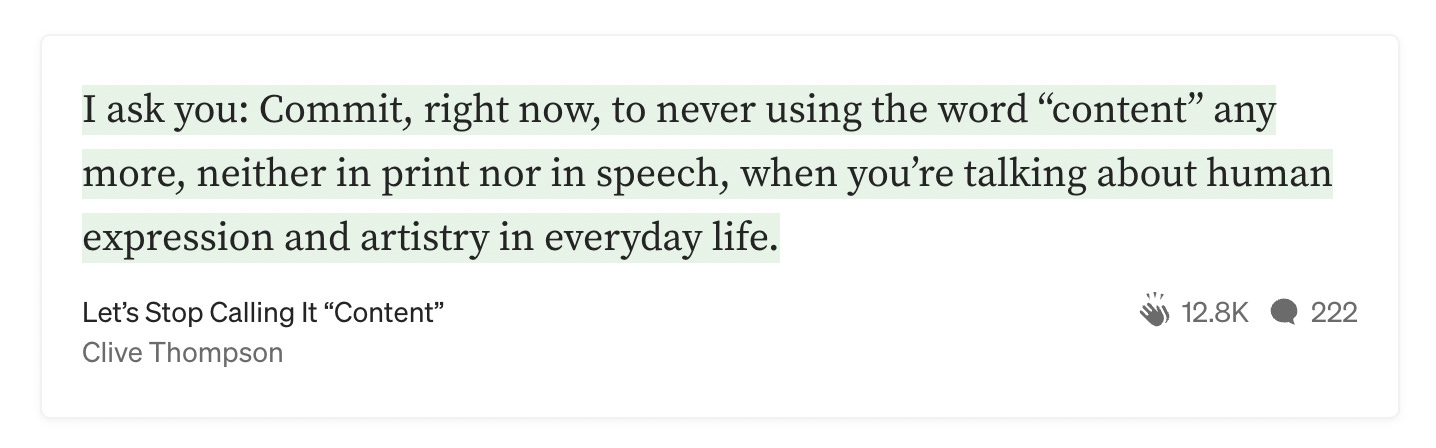
Writer Clive Thompson: Let’s stop calling it “content” – this got me thinking about the importance of words and how they shape our understanding of the world (and whether a term useful for referring to the whole detracts from the parts).
He says the word ‘content’ is widely used by designers and UX folk because it has an industrial meaning and a specific purpose. We have content design and content strategy as separate disciplines with some crossover. We have ‘content teams’. I can get on board with that.
What I can’t stand is how it’s crept into everyday use (especially in business) as a term to describe everything and all forms of creative expression.
“Quentin, I just love your content!”
Where are we going with it all? I worry about the rise of ‘AI-generated content’ – being trained on trillions of tokens (carbon footprint!!) and the industry’s growing interest in writing via AI (one of the key issues of the writers’ strike).
Tech companies are so hungry for new data (the internet’s not big enough) that some are developing ‘synthetic’ info – i.e. systems learning from what they generate (this NYT piece went viral) #mindfuck.
So, time to put a stake in the ground! Keep up the fight for more clarity and specificity in language and life so we can better understand and relate to one another.
We live in a complicated, fast-moving world, and I get the need for simplicity, abstraction, and mental shortcuts. It’s convenient but lazy to lump all creative work as ‘content’.
Spot on, Emma. We don’t wanna be stuffing in cushions!
OK, so what should we call this stuff?
John Long says be specific:
If you’re making social media, call it that. Or, to be more precise, social campaigns, social videos, and social posts. If you’re making short films, call them that. Copy for a website isn’t ‘content’—it’s website copy. Pictures are photography, images, photographs or illustrations. Podcasts are podcasts. Same goes for editorial, feature articles, white papers, brochures, and packaging copy.
Clive Thompson (replying to the VP of Content at Medium):
It’d probably be good – to, whenever possible, talk about the stuff that people write on Medium using the specific words that apply: Essays, memoirs, explainers, what have you. Even referring to a “post” and a “comment” is more specific than “content”!
Language matters. I’m with Jason Bailey [NYT] on this:
The way we talk about things affects how we think and feel about them. So when journalists regurgitate purposefully reductive language, and their viewers and readers consume and parrot it, they’re not adopting some zippy buzzword. They’re doing the bidding of people in power and diminishing the work they claim to love.
What about you? Do you use the word ‘content’ or hate it too?
Other words I’m coming for: ‘Creator’—simplifies and minimises it. ‘Widget’—what the heck is it? ‘Sticky’ (usually content). ‘Consumer’ ugh. ‘Subscriber’. Too transactional. If I write marketing copy to sell something, it’ll be a separate email.
‘Slop’ – a new term for dubious AI content, is a keeper 😁
Something to discuss with the Substack crew at The Content Spark Summit with Christin Thieme—a FREE full-day virtual event on Substack June 27 to help you spark meaningful connection with your content.
I’m doing a Q&A with Christin to get to know her better so will share that next week—can’t wait to hear her thoughts.
We ran a Pitching Clinic with Dr Lily Canter this week. If you want something done, ask a busy mum! Her portfolio career encompasses freelance journalism, running coaching, lecturing, awards, and podcasting.
Top takeaways (some useful tips here across industries)
Niche: She started as a generalist, specialised, then changed specialism. It took her 5-6 years to find a niche she enjoyed and wanted to stick to (running and fitness).
Format: Now 70% online clients, 30% print.
Diverse portfolio: 5-7 clients on her roster and always seeking new ones. Look beyond traditional media to online outlets, trade publications, in-house mags. “Nationals can pay well for commissioned features but their rates for shifts are poor. I’ve found they sit on copy for ages and a lot of them do payment on publication so I rarely write for them now. With Metro being the exception.” (One took nine months to pay her!)
Be open to new types of work as it can come from unexpected places when you least expect it. Get out of your comfort zone.
Social media: Set up a Hootsuite – one list for freelance media accounts and at least five search columns relating to areas of interest, e.g. “call for submissions” and “freelance writers.”
Networking: Contact editors you’ve worked with and ask how they use freelancers – ask for shift work. “You’ll be surprised how few people actually do this!”
Email signature: Say what you specialise in.
Be entrepreneurial: Podcasting, journalism, copywriting, journo education, newsletters, awards, running coaching. She’s teamed up with her friend and colleague Emma Wilkinson to grow the Freelancing For Journalists book, pod and community.
Having a portfolio career is the key to security.
I love that. What struck me is that despite all the shiny tech and remote working freelancing is still very old-school. Talent yes, but success depends on the strength of your relationships and network (many commissioning eds still use Facebook groups!)
“You’ve got to pitch, hustle and network to get work.” She said 70% of her work comes from pitching, which is a lot – time-intensive work that might go nowhere. Nor do media orgs make it easy to cold pitch – you have to hunt down the right contacts.
No mention of AI so I asked her afterwards if she’s using it to save time. “Ooo, great idea! It’s not something we’ve tried out yet, but we will add it to the podcast ideas list. Thanks!”
Someone asked if there’s a ‘directory of commissioning editors’ and where to find content/digital agencies to offer your services. ChatGPT gave me a list of 15 agencies and seven editors in seconds.
Kudos to Lily for juggling a busy career with two boys. She’s found a good balance – desk work vs active adventures that feeds into the writing and keep her fit!
Collaborating with a friend and colleague makes life more fun as you can bounce off each other and share opportunities.
Check out their podcast, Freelancing For Journalists for deep dives into specific topics (just listened to this one on Newsletter publishing). So refreshing to have a writer’s perspective on it rather than a marketer’s.
▶️Destination Thailand: New visa allows digital nomads to stay for five years (you must leave and re-enter the country every 180 days + pay a fee), but there’s no strict income requirement with this one – you just need 10K savings.
Tim, I do. Though doing dishes is my brain yoga, it calms me down. Unlike knowledge work, you can finish the job and see the results immediately!
I’m experimenting with a new (shorter) format because a) I respect your time and b) I need to get outside and enjoy the early days of summer. There might not be much of it in the UK. And it’s my birthday month!
1️⃣ Went to a Leading Expert talk on the Sorry State of Social Media with Brian Clark – an overview of the evolution of social media from a helpful audience-building tool (Digg and Delicious) to a dopamine-fueled distraction and time suck—with more emphasis on ‘influencers’ and attention than community and connection.
From a business perspective, it’s hard to justify spending time on social media. He’s been experimenting with LinkedIn and succeeding, but “there’s no aspect of fun on LinkedIn.” (I agree—it’s boring AF—what can we do about that?)
Some thoughts on how to fix it: Focus on building your email list and a deeper psychological understanding of your prospects. Test paid ads in other newsletters and/or write guest posts for folks in your niche. The business basics: People and relationships power everything, and that won’t change. He says he’s “lost all techno-optimism,” – noooo! BUT there will be something else—we can’t predict it.
The Mill, which has just reached a six-figure reader milestone. Exciting to hear they’ve announced a major hiring round (hiring 11 staff in FIVE cities) and are expanding into Glasgow and London (making hay as the Evening Standard goes from daily to weekly). Love the ambition! Bringing deeper narrative journalism to local news. What local news to you read/need? Let me know and I’ll ask him.
3️⃣ Went to a Scaling Paid Subs Mind Meld with Lex Roman. I love her new project, Journalists Pay Themselves, for reader-funded journalists. Sharing tiny experiments and helpful resources in her newsletter and hosts free monthly meets to help folks grow their paid readership. We discussed pricing and tiers and tried to work out why anyone would pick the middle tier!? Plus, a hot-seat publication rundown is super useful. I’m hosting the next session on Monday, July 1. RSVP here. Interview with Lex coming soon!
PS It’s the Publisher Podcast & Newsletter Summit / Awards on Wednesday. Esther Kezia Thorpe shared this post on what burnout feels like and how challenging event marketing is as a part-time gig and full-time parent. They’re open to ideas re partnerships, investment, or refocusing to work smarter, not harder. The lineup is insane – last chance to grab a ticket here.
▶️ Tiny Marketing Actions: The Six-Week Experience [Pam Slim on Maven] Like this concept. How to execute TMAs on a daily/weekly basis to grow your business with a community of small biz owners.



 Nika
Nika 