I went to The Portfolio Collective’s Portfolio Career Festival at the Ministry of Sound this week.
A one-day event to explore the challenges and opportunities of portfolio work with talks on:
How to land work as a portfolio professional.
Ignite your personal brand with the power of storytelling.
What does the future hold for portfolio professionals?
Fantastic light show to kick things off and wake us all up. Put your headphones on and listen to this. We love a light show!
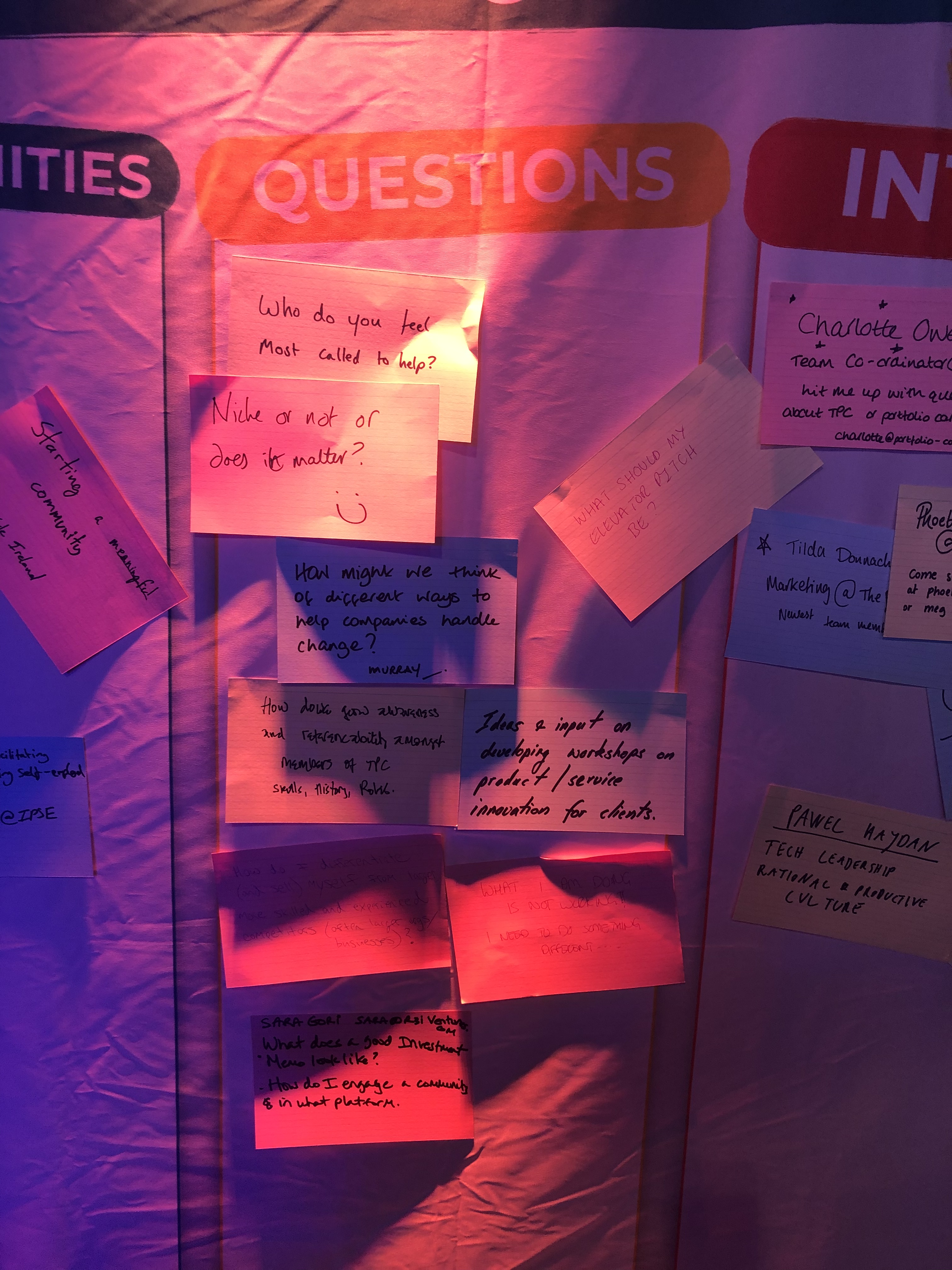
We had a bit of fun with gamified tribe quests and prizes to be won (I was with the ‘Arty Hearts’). Post your asks/offers on the activity board and connect with others. A nice ice-breaker when you’re on your tod.
Got chatting to Yalin Solmaz: Gen AI Advisor to Creators 🤖 Great energy!
Here are my takeaways from the main stage.
#1 How to land work as a portfolio professional
w/Mike Anderson, Mary Agbesanwa, Faris Aranki, Fiona Chorlton-Voong. Hosted by Lexi Radcliffe-Hart.
Welcome to Bold Types, where I chat with successful newsletter creators about courage, craft, and creative living.
Today’s guest is Lex, a newsletter writer and subscription marketing expert. With over 10 years of experience leading growth projects for tech startups like Gusto, Prosper, and Burner, she helped pioneer growth design. Lex also founded the Growth Designers community, where she educates tech teams on using data to guide product decisions.
In 2019, Lex started her own growth design consultancy and, by 2021, shifted her focus to marketing for creatives. She’s now on a mission to help journalists and indie newsrooms grow their audience and income through subscription marketing.
Her new venture, Journalists Pay Themselves, does what it says on the tin! With the rapid decline of journalism jobs, she’s exploring ways to support those transitioning to independent work.
It’s written for journalists but applies to most media subscription businesses.
We chatted about growing your list and building community, Substack v Beehiiv, how much she’s earning from her newsletters, and the benefits of niching down.
AI or DIE was the theme at #FixFest (copywriting festival) in London this week. Just looking at what people have been saying online, how they’re feeling about all things AI, and what side of the fence they’re on.
AI is having a massive impact on the industry. Some clients want you to embrace it, others don’t want you using it at all – it’s hard to know where to position yourself. Leif Kendall at ProCopywriters is working on a ‘Code of Ethics’ for the community.
The hypothesis was this…. Could generative AI be used to bypass the years it takes for a poet to find their voice and actually go one step further in creating a democratised mass poetic voice from a room of copywriters?
Since 1999, I’ve been writing online and interviewing creative folks I admire about courage and craft. I love learning from others’ journeys & experiences and want to help more ambitious solo entrepreneurs—especially women—impact the world with their personal stories. And make a shit ton of money!
Inspired by the book ‘Bold Types: how Australia’s first women journalists blazed a trail’ in the fight for gender equality, I’ve launched the Bold Types Q&A series.
Christin is editor-in-chief of The Salvation Army in the western US, where she tells stories about people making an impact for good and prompts others to action. She holds a master’s degree in specialized journalism from the University of Southern California, has taught journalism, and helps creatives simplify their content strategies on Substack.
Welcome, Christin! ✨
What problem is ‘The Content Brief’ solving?
I help creatives simplify their content. Anything we create and share is an invitation to connect, and I want people to have a plan and a workflow that is exciting to show up for.
I hold a master’s in specialized journalism, have worked for nearly two decades leading a content marketing team for an international nonprofit, and taught journalism and communications as an adjunct professor. Content is what I eat, sleep and breathe if you will.
After helping friends strategize how they could better connect with the right people online around their makeup artistry, barbershop and even psychology practice, I saw how overwhelming this world of content is to people who aren’t necessarily in it daily. I enjoy helping people break it down into something more tangible, sustainable, and real-life approved, so I’ve taken up doing so here on Substack.
If you’re feeling overwhelmed, frazzled, and frustrated with how you show up online… If you want to better connect (and convert) people to your ideas and your work…
The Content Brief is for you. I’ll help you take control of your content so you can stay in your zone of genius.
What’s always on your desk?
At my full-time gig, coffee, water, a Blackwing and my Airpods. At home, I’m often typing straight into my Notes app between baseball practice or bath time.
With three boys under six, I love and live by the Julia Cameron quote:
The ‘if I had time’ lie is a convenient way to ignore the fact that novels require being written and that writing happens a sentence at a time. Sentences can happen in a moment. Enough stolen moments, enough stolen sentences, and a novel is born—without the luxury of time.
I also printed out a screenshot of my first-ever paid subscription and put it in a little frame to remind myself I might be onto something, to keep going, and to keep finding ways to be helpful as I build this community.
What are you struggling with right now?
Time! I have so many ideas, but we all only have so much time, so I’m constantly reminding myself to focus on what moves the needle. This week, I am largely wrestling with delivering a virtual summit I’m hosting: The Content Spark Summit.
This free full-day event on Substack June 27 is meant to help you spark meaningful connection with your content. From understanding the importance of engagement to creating a content strategy you can’t wait to show up for to fostering genuine connection and leveraging your unique expertise and experience, 14 expert speakers will share what they know.
Just this other day, I saw this quote from Seneca: “You must match time’s swiftness with your speed in using it, and you must drink quickly as though from a rapid stream that will not always flow.”
He may have been a Roman philosopher, but the advice holds today:
Keep a bias toward action. It’s easy to hide behind planning, plotting, and perfecting (I know!), but the impact you want to make can never take hold until you actually take action.
Tell me about your newsletter strategy, its value to your business, and how you measure success.
Right now, I’m in an awareness-building phase, focusing on free subscribers, which is part of the strategy behind the summit.
There are three ways to engage with me at The Content Brief:
As a paid member, you get access to my quarterly content planning party, where I’ll help you plot out your next three months of content. The next one happens in August and will help you create a plan to show up consistently, with intention.
And as a paid member of The Briefing Room (the founding member tier), which I’m just about to launch, you get exactly what you need to design or redesign your newsletter content strategy with ease, including my exact simple content system, an all-in-one dashboard workspace, and a monthly brief on one specific thing to reset to keep your strategy fresh. It’s all designed to save you a lot of time and frustration so you can have a bigger impact with your newsletter.
I’m also building in ways to collaborate and share with other creatives. I hope The Content Brief becomes a vibrant community that supports each other in what can sometimes be a lonely endeavor.
What important truth do very few people agree with you on? Or your ‘spiky point of view,’ Wes Kao calls it.
Providing value doesn’t mean having all the answers.
Creative work that inspires an audience and builds a community (and business) doesn’t require anything stunt-like, viral or wildly innovative.
We don’t have to show up as “experts,” with all the answers ready to guide others to the big transformation. Trying to do so often leads to becoming another faceless creator of tips & tricks and *value* in some Wikipedia-esque, robot-generated “I have it all figured out” status quo.
And the problem is…that says nothing of the journey.
You could have the most well-researched writing in the world, but if it feels like nothing more than a robot production, it won’t get read.
Conversely, you could write about your life as a dog walker, and if you’re asking questions that take us on a journey and leading a conversation from your perspective, every word will get read.
To provide value, you need curiosity, questions, and a yearning to explore. It means being willing to lead the conversation and invite us on the journey of an idea in real time through your content. People don’t want to see processes, deliverables, skills. We want to see perspective, relationship, transformation—and that means your point of view, personality and perspective.
Last week, I wrote about why I hate the word ‘content’. It’s become a catchall term for everything we make—words, video, audio—invading everyday talk and devaluing the creative process. What’s your take on it?
This is SUCH an interesting question and a sentiment I’ve seen pop up recently. I’ve never thought of it negatively. I think of it like the word “box”—a catchall term that encompasses so many different specific things but one word that gives you the gist.
I’m sure some of the negative vibes toward the word come from the push for “top ranking” and “click-worthy” content that doesn’t deliver, but for me, it’s just a succinct way to describe the many ways we invite people to connect with us.
That’s what content is, in my view, whether it’s a newsletter, podcast, social post, and so on.
When you create and share something, you invite others to connect with you about your ideas and work. Of course, if you are specifically a podcaster or a novelist, say that. Lean into concrete specifics over summary words whenever you can.
How have you shifted from ‘creating content’ to ‘building community’ on Substack?
With a relatively new newsletter on Substack, I came in knowing I wanted to build a community. I love to plan parties. I love to build everything around a specific purpose. To carefully word the invite. To think through the menu. To find the right party favor. To design the table. To welcome everyone in. To surprise and delight. To make them feel loved.
I feel the same about crafting my own little club right here on Substack. Building a newsletter and community is the ultimate gathering. And I’m here to party. 🎉
Can you recommend some resources for entrepreneurs?
The Elements of Style by Strunk & White—I love this illustrated version of the classic go-to guide for writers on how to “make every word tell.” (It’s also one of my favorite gifts for the creative types!)
Building a Storybrand by Donald Miller—The best how-to I’ve seen on using words to talk about your product or service. It’ll help you define a clear message on how you can help potential customers. Worth re-reading annually. (Here’s my full list of favorite books to improve your writing for more.)
Hype Yourself, for learning how to generate your own buzz.
Are you using AI tools? If so, how are they helping you work better/save time?
Yes! I call Chat GPT my intern. I love using it to prompt my thinking, research subjects, synthesize interviews, and spot holes in them. It also helps repurpose my hero content into supporting pieces.
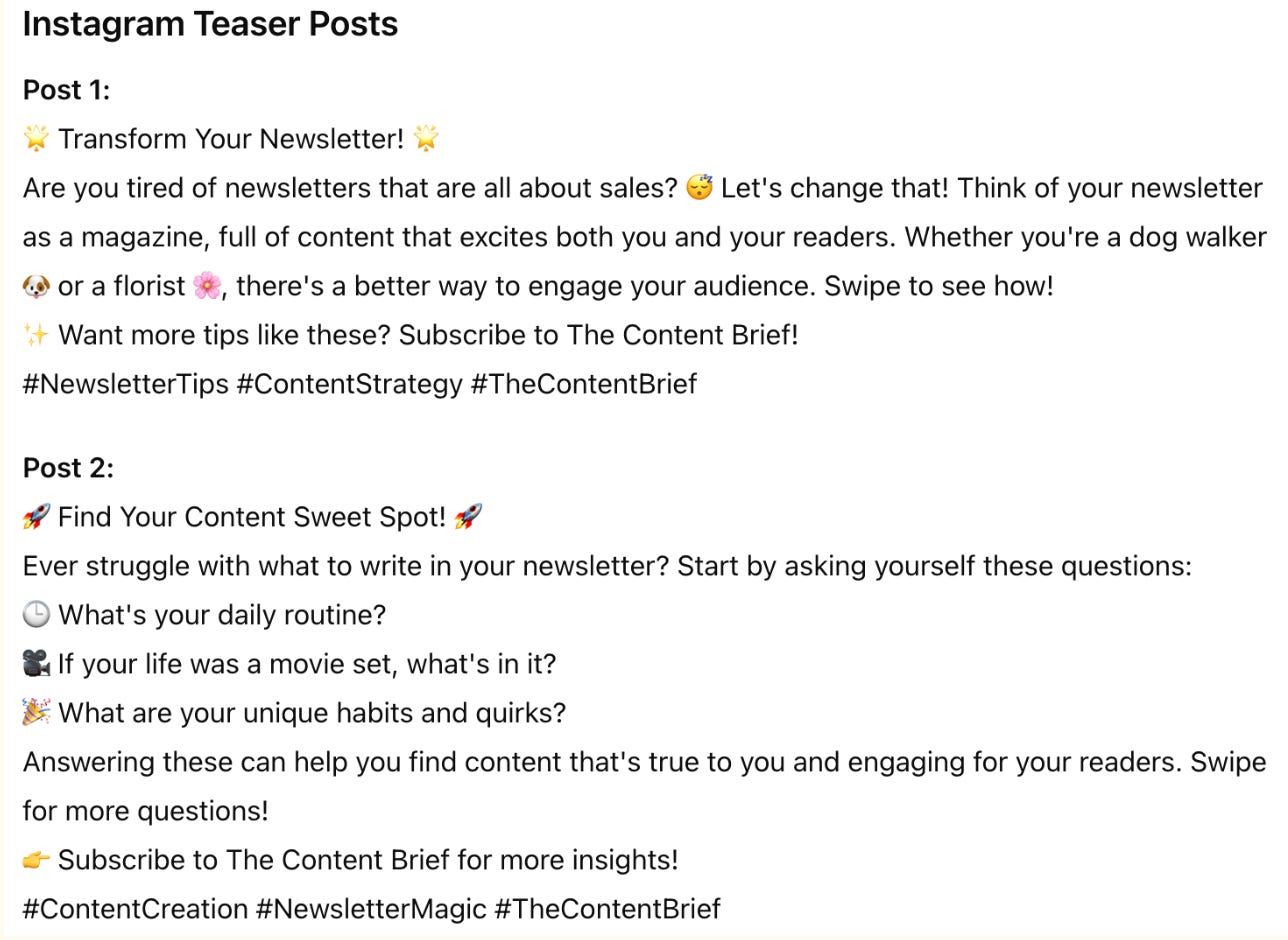
My goal is to create one Substack post a week and then repurpose it into snippets and teasers for my supporting platforms. To help save time prepping those shorter pieces, here’s a basic starter prompt I use:
I am a [what do you do], and I need to create a social media post based off a newsletter I previously wrote. The audience is composed of [your audience.]
Use this text to write 3-5 short-form teaser pieces of content for [platform] that highlight the main points, benefits or offers of this newsletter. Ensure the tone is [your tone].
Include a CTA at the end to subscribe to my newsletter, [your newsletter name].
Not bad for a first pass. I always edit the intern’s work for quality and to sound more like me, but the beauty is you’re not starting from scratch.
Best coffee & coworking in your town?
I haven’t done any local coworking, but my favorite coffee shop to work in is The Boy & The Bear in Redondo Beach, California. It has an aesthetically pleasing dark, earthy, “let’s get to work” vibe and good coffee. Win-win.
We ran a Pitching Clinic with Dr Lily Canter this week. If you want something done, ask a busy mum! Her portfolio career encompasses freelance journalism, running coaching, lecturing, awards, and podcasting.
Top takeaways (some useful tips here across industries)
Niche: She started as a generalist, specialised, then changed specialism. It took her 5-6 years to find a niche she enjoyed and wanted to stick to (running and fitness).
Format: Now 70% online clients, 30% print.
Diverse portfolio: 5-7 clients on her roster and always seeking new ones. Look beyond traditional media to online outlets, trade publications, in-house mags. “Nationals can pay well for commissioned features but their rates for shifts are poor. I’ve found they sit on copy for ages and a lot of them do payment on publication so I rarely write for them now. With Metro being the exception.” (One took nine months to pay her!)
Be open to new types of work as it can come from unexpected places when you least expect it. Get out of your comfort zone.
Social media: Set up a Hootsuite – one list for freelance media accounts and at least five search columns relating to areas of interest, e.g. “call for submissions” and “freelance writers.”
Networking: Contact editors you’ve worked with and ask how they use freelancers – ask for shift work. “You’ll be surprised how few people actually do this!”
Email signature: Say what you specialise in.
Be entrepreneurial: Podcasting, journalism, copywriting, journo education, newsletters, awards, running coaching. She’s teamed up with her friend and colleague Emma Wilkinson to grow the Freelancing For Journalists book, pod and community.
Having a portfolio career is the key to security.
I love that. What struck me is that despite all the shiny tech and remote working freelancing is still very old-school. Talent yes, but success depends on the strength of your relationships and network (many commissioning eds still use Facebook groups!)
“You’ve got to pitch, hustle and network to get work.” She said 70% of her work comes from pitching, which is a lot – time-intensive work that might go nowhere. Nor do media orgs make it easy to cold pitch – you have to hunt down the right contacts.
No mention of AI so I asked her afterwards if she’s using it to save time. “Ooo, great idea! It’s not something we’ve tried out yet, but we will add it to the podcast ideas list. Thanks!”
Someone asked if there’s a ‘directory of commissioning editors’ and where to find content/digital agencies to offer your services. ChatGPT gave me a list of 15 agencies and seven editors in seconds.
Kudos to Lily for juggling a busy career with two boys. She’s found a good balance – desk work vs active adventures that feeds into the writing and keep her fit!
Collaborating with a friend and colleague makes life more fun as you can bounce off each other and share opportunities.
Check out their podcast, Freelancing For Journalists for deep dives into specific topics (just listened to this one on Newsletter publishing). So refreshing to have a writer’s perspective on it rather than a marketer’s.
▶️Destination Thailand: New visa allows digital nomads to stay for five years (you must leave and re-enter the country every 180 days + pay a fee), but there’s no strict income requirement with this one – you just need 10K savings.
Tim, I do. Though doing dishes is my brain yoga, it calms me down. Unlike knowledge work, you can finish the job and see the results immediately!





 Nika
Nika 