Categories
Newsletter

I hate the word content | Issue 155

Desk Notes

(Please excuse the mess…still building dreams) ✨

I hate the word content. Since the dot-com boom of the 90s, it’s become a catchall term for everything we make—words, video, audio—invading everyday talk and devaluing the creative process. 

“It’s like seeing a cereal box at a store labeled ‘Food (100 grams)’” – Mitch Trachtenberg on Medium. Yes!

I got my first journo job on Country Walking mag in 2000 when Emap was digitised. Many mags were rolling out websites, and they needed loads of copy. A golden era for online publishing—you could be paid well for your words and make decent money online. 

Along came CopyBlogger in 2006 (when Julieta was born), and I started blogging on the side. The Content Marketing Institute was set up in 2011 – a sexier and more relatable term than ‘custom publishing.’ Businesses saw the potential of marketing through email.

Twenty years on, everything and its dog is now labelled ‘content.’ 

I just checked how many Substacks have ‘content’ in the title/description – 100+.

I’ve struggled with this as a small business. How do you differentiate yourself when we all ‘work in content’? I’m still wrangling with taglines: ‘Smart, thoughtful content solutions’. ‘Copy solutions’ (sounds like a print shop). ‘Editorial solutions’ – not catchy. I might go back to saying ‘I’m a writer.’ I’ve taken it off my LinkedIn bio even though I’ve been hired for roles with content in the title. 

I write. 

I curate. I publish.

I write some marketing materials.

Let’s stop calling it content

I’ve seen many articles about this, across industries, so I’m not alone.

We’ve taken a term for websites and sprinkled it around on pretty much everything. Like a virus, it’s spread — and by definition, it cheapens everything we do. Because the word ‘content’ is just about as appealing as ‘principal substance’ or ‘filler’ or ‘Soylent.’ It sounds like disposable stuff that appears by happenstance, like plaque or lint.

  • 10 questions with… Cindy Gallop [The Drum]: “If you could ban one buzzword or piece of jargon, what would it be?” 

“Content.” 

  • Oscar-winning actor and screenwriter Emma Thompson at the RTS Conference [Variety], “To hear people talk about ‘content’ makes me feel like the stuffing inside a sofa cushion. It’s just a rude word for creative people.”
  • Writer Clive Thompson: Let’s stop calling it “content” – this got me thinking about the importance of words and how they shape our understanding of the world (and whether a term useful for referring to the whole detracts from the parts).

He says the word ‘content’ is widely used by designers and UX folk because it has an industrial meaning and a specific purpose. We have content design and content strategy as separate disciplines with some crossover. We have ‘content teams’. I can get on board with that.

What I can’t stand is how it’s crept into everyday use (especially in business) as a term to describe everything and all forms of creative expression. 

“Quentin, I just love your content!”

Where are we going with it all? I worry about the rise of ‘AI-generated content’ – being trained on trillions of tokens (carbon footprint!!) and the industry’s growing interest in writing via AI (one of the key issues of the writers’ strike).

Tech companies are so hungry for new data (the internet’s not big enough) that some are developing ‘synthetic’ info – i.e. systems learning from what they generate (this NYT piece went viral) #mindfuck.

So, time to put a stake in the ground! Keep up the fight for more clarity and specificity in language and life so we can better understand and relate to one another.

We live in a complicated, fast-moving world, and I get the need for simplicity, abstraction, and mental shortcuts. It’s convenient but lazy to lump all creative work as ‘content’. 

Spot on, Emma. We don’t wanna be stuffing in cushions! 

OK, so what should we call this stuff? 

John Long says be specific:

If you’re making social media, call it that. Or, to be more precise, social campaigns, social videos, and social posts. If you’re making short films, call them that. Copy for a website isn’t ‘content’—it’s website copy. Pictures are photography, images, photographs or illustrations. Podcasts are podcasts. Same goes for editorial, feature articles, white papers, brochures, and packaging copy.

Clive Thompson (replying to the VP of Content at Medium):

It’d probably be good – to, whenever possible, talk about the stuff that people write on Medium using the specific words that apply: Essays, memoirs, explainers, what have you. Even referring to a “post” and a “comment” is more specific than “content”! 

Language matters. I’m with Jason Bailey [NYT] on this:

The way we talk about things affects how we think and feel about them. So when journalists regurgitate purposefully reductive language, and their viewers and readers consume and parrot it, they’re not adopting some zippy buzzword. They’re doing the bidding of people in power and diminishing the work they claim to love.

What about you? Do you use the word ‘content’ or hate it too? 
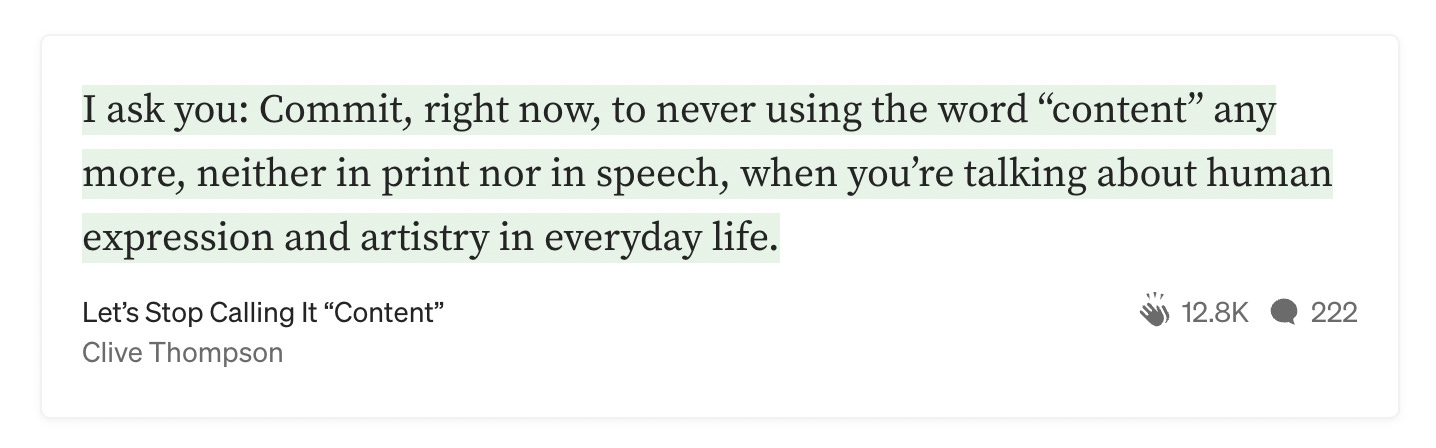
A quote from Clive Thompson asking us to stop calling all creative work 'content'

Other words I’m coming for: ‘Creator’—simplifies and minimises it. ‘Widget’—what the heck is it? ‘Sticky’ (usually content). ‘Consumer’ ugh. ‘Subscriber’. Too transactional. If I write marketing copy to sell something, it’ll be a separate email.

‘Slop’ – a new term for dubious AI content, is a keeper 😁
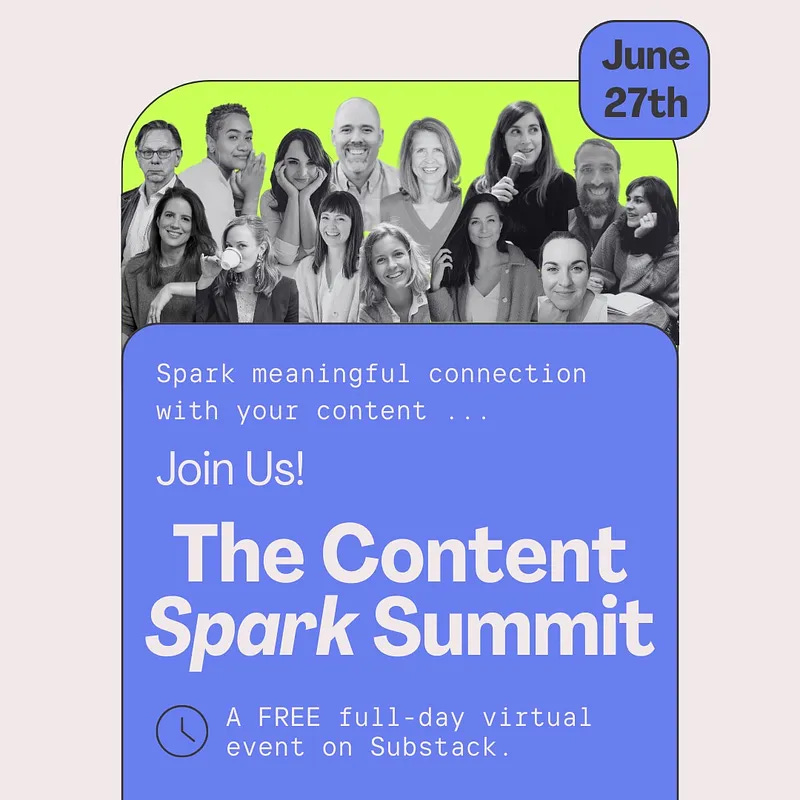
Something to discuss with the Substack crew at The Content Spark Summit with Christin Thieme—a FREE full-day virtual event on Substack June 27 to help you spark meaningful connection with your content. 

I’m doing a Q&A with Christin to get to know her better so will share that next week—can’t wait to hear her thoughts.

You can book your ticket here.

Nika ✨


My Internetland 

I help founders make a global impact with their stories. Life’s too short to play small. 

Interested in using writing to grow your business? Fill out this form to get started. 

Website | LinkedIn | Ko-fi | Newsletter Talent Directory 

Categories
Newsletter

The blueprint for building your 7-figure newsletter business

Learn from some of the top minds in the creator space 🔥

Here’s an inside look at how 7-figure newsletters make money from Trends.co.

It’s packed with lessons they’ve learned from growing their email list to 2m+ readers and millions of $$ in annual revenue.

And the wisdom of many other successful newsletter publishers – from Morning Brew to Axios to AppSumo and more.

The goal is to demystify the newsletter business and teach you what works through a visual method they call ‘The Newsletter Engine.’

How to stand out, grow, profit, and influence like never before.

Thanks to Ethan Brooks, lead researcher, for your hard work on this. It’s an absolute gem! 🤗

It was meant to be a premium report for Trends subscribers, but the project was shelved when they got acquired by Hubspot.

Hubspot doesn’t need the money, so it’s now FREE for you to download here, in glorious PDF chapters – part 4 is just out.

I heard about it on the Content is Profit podcast (fun, high energy!) – listen to the 3-part interview with Ethan here. Scroll down recent episodes, and you’ll see them all.

One thing Ethan said blew me away: size doesn’t matter.

He mentioned a niche newsletter that’s turning over 6-figures with a 1K audience. 

Farming? Nope. Fish? Nope.

It’s a newsletter for photo booth business owners. There can’t be that many of those!

The riches are in the niches. You will be the trusted source when “these people don’t have that many options.”

Good to start with content strategy. If you don’t have good content, nothing else will happen. Storytelling, personality, research and reporting. Your brand needs a heart and a soul to move hearts and souls – and to inspire and empower readers.

There’s no growth hack or pricing strategy that can overcome bad content.” 💯

Know your niche and audience value (and get to 10K subs!!) before you even think about paid growth strategies.

Thanks to the Trends team for making this free and accessible.


What else? I’m working on my content diet because Inbox Hell. 30K emails 😱 I can’t get out of the abyss – calendar invites, press releases, newsletters, random links I send myself.

Send me your tips and I’ll include them next time – just found a fantastic tool that might save me!

I’m setting up a website for TS. Substack is great, but it sucks re SEO. I don’t see many Substacks on Google search. I want to get everything on to my own site and build my content library. SEO, search, opportunity.

As Joe Pulizzi says: “Don’t build your content house on rented land.

Speaking of Joe, he’s offering a fantastic discount for the Creator Expo Show (CEX) in May. I have an affiliate code, but his deal is much better – you can get $200 off via his newsletter here.

I’m buying a virtual ticket, but next year it has to be in person. The magic happens in the room 💫

Keep moving!

Nika 🙂


🔥5 things to know

What’s inspired me this week.

Submit your publication RSS feed to the Google Publisher Center. It’s an interface that helps publishers submit, manage and monetise their content in Google News through Subscribe with Google. Speaking of search and SEO – just done it.

Learn how to build an email list – a proven system for getting 1K+ subscribers from Brian Harris at Growth Tools. The strategy around newsletters and some promotion tactics. Long but worth it. A little challenge for the next eight weeks!

Read newsletters for newsletters. Yes, it’s meta, but if you run a newsletter, there are a growing number of places to find out what’s happening on Planet Newsletter—roundup from Paul Metcalfe, the founder of Lettergrowth and Newsletter Blueprint.

Join YATM Creator Day 2023 at Lighthouse, Poole, on Thursday 27 April. A day for direction focused on your content and message. Audience building, personal brand, creativity, biz growth and cheerleading. This time others are paying for (most) of it 😉

Collaborate with Scott Britton, a tech entrepreneur who has just set up Creator Experiments on Substack. He sent me his newsletter growth experiment and would love your feedback and help. And some quick wins to help you reach more people.


Thoughts, questions, or topic suggestions?

Get in touch. I’d love to hear from you! Email nika@nikatalbot.io or DM @nikatalbot

Need my copywriting chops? Check out my services

Categories
Newsletter

1729: The first newsletter that pays you

Weekly curated tools for thought and ideas to share ✍️

I signed up to 1729.com this week, the first newsletter that pays you. Daily bitcoin bounties for completing paid tasks and tutorials with $1000+ in crypto prizes every day. It’s also a platform for distributing a new free book app called The Network State. 

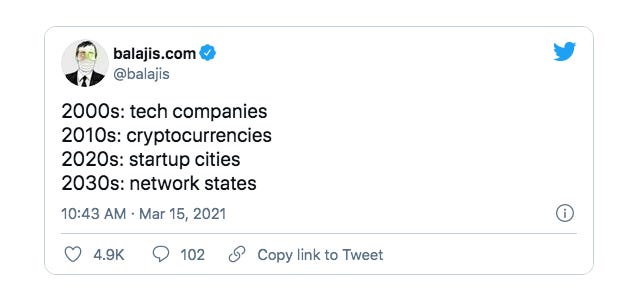
Earn crypto, learn new skills and join a community of tech progressives. ‘That means people who are into cryptocurrencies, startup cities, mathematics, transhumanism, space travel, reversing ageing (bring it on!), and initially-crazy-seeming-but-technologically-feasible ideas,’ says the founder, Balaji – see his past work here. You can subscribe for updates and follow @oneseventwonine on Twitter. 

Truth, health and wealth 

Here’s how it differs from a regular newsletter or website. Firstly, it has tasks – e.g. the latest is to learn how to make a Discord bot with Replit for $100-$1000 in BTC. The first challenge posted in March was to set up a newsletter for tech progressives at your own domain to incentivise the decentralisation of media. They paid $100 BTC each for the 10 best sites. See the winners here.

Secondly, it has tutorials – bitesize learning with incentives to complete. Thirdly (love this!) a focus on digital health and the body. Startup culture can lead to burnout as we sacrifice health for business. This is false economy ‘because missing daily workouts is a physical debt that’s even harder to pay than technical debt, and fitness is as good for cognition as it is for health.’ So you can submit a proof-of-workout to earn a little crypto. Stay fit today and contribute to age reversal tomorrow. 

Fourth, it’s international and Indian to show how you build a global operation from an Indian base and expand to the rest of the world. Much as Silicon Valley started as ‘American’ and is now in the Cloud. They’ve named the project 1729 after Ramanujan, India’s greatest mathematician known for his contribution to number theory which underpins crypto. So exploring how we can use technology to help talent rise in developing countries around the world as Ramanujan did. 

Bootstrapping voices

It’s a global talent search to invest in diverse, unreported voices around the world. Enabling anyone with an internet connection to improve their knowledge and bank account through paid microtasks. Learning, earning and burning.

I like the ethos – earning recordable crypto credentials for completing and creating tasks, open-source education, and bootstrapping talent around the world. Balaji says he uses Twitter to hire people as you get a sense of their values and potential from their online content.

Imagine if we applied this process to job boards – rather than stating your skills, education or interest, you could prove it by gaining badges or rewards for mini tasks completed on a site. So you could log in and start working immediately. There’s also a focus on quality content – the tasks require some thought, time and writing skill – raising the value of online content to be on par with design.

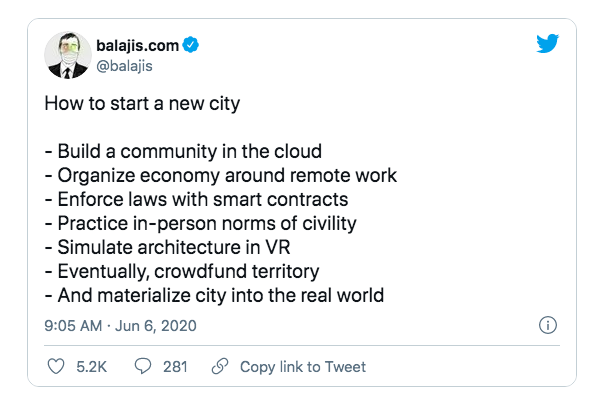
Finally, building a ☁️ 👋 Cloud Community – a network of tech progressives interested in exploring things like startup cities, online communities, organising economies around remote work, enforcing laws with smart contracts, and simulating architecture in VR. A global, mobile social network with ‘digital bylaws, crowdfunding capability, a track record of collective bargaining on behalf of its members, and a numerically quantifiable level of social capital’.

It’s a step up from the organic online communities like subreddits and Facebook groups forming for the last 20 years. More on that here.  

It’s the most exciting media project I’ve come across lately. I love the ambition and focus on giving you content that strengthens rather than depletes you (clickbait, social media where there’s no reward for your posts, likes and shares). They’ve allocated enough money to fund a full year of daily tasks, and the goal is to build a scalable business and find individuals and companies that want to post sponsored projects for the community. 

Here’s Tim Ferris’ interview with Balaji about the project. It’s by far the longest podcast I’ve listened to (almost four hours!) but worth it. A deep dive into the future of media, founding vs inheriting (‘own a media company or be owned by one), podcasting, citizen journalism vs corporate journalism, and how the media scripts human beings. ‘If code scripts machines, media scripts human beings, even in ways we don’t fully appreciate.’ His point is that once we’re equal on distribution (a decentralised media), we can speak to each other as peers. 

I agree that journalism’s greatest blind spot is it draws from a limited pool of people with a similar background and class who can’t see the perspectives of people who aren’t like them, and it drives out people who don’t fit in. Is the answer radical decentralisation of media? Citizen journalism instead of corporate journalism – the notion that ‘everybody writes’ – drawing on local expertise, e.g. nurses writing about nursing, and writing as a duty rather than for-profit. But we’ll still need editors and proofreaders.

I want to build up those citizen journalists, those content creators. Second, I want to invest in a cumulative form of education, open-source education, where these folks are doing tutorials. So that people get paid for creating educational tasks others can do. Bootstrapping talent all over the world. Anywhere there’s a phone, there’s a job. 

It’s the digital native solution to education

Other ideas – if you want financial independence, you need to radically reduce your expenses. ‘Check Nomadlist or Teleport, do a spreadsheet and optimise your personal runway.’ (not easy for families to do this, but not impossible) – check out Reddit groups like r/leanfire and r/FIREUK (financial independence, retire early). Find a remote job that pays well and move to a cheaper location to stop the burn and save money over time, i.e. so you can work for a year and then take time out to pursue other things. 

How we’re going back to a hunter/gatherer way of life, but with technology. Relocation and digital nomadism will be huge – taking over from traditional tourism for long-term economic migration.

The best quality of life will actually be available to the digital nomad who has a minimum number of possessions, can pick up and move stakes at any point because mobility is leveraged against a state. 

New politics will form, and ways of self-governance that are network-based rather than state-based. How the virtual world dominates our lives, and the physical world comes second – something we’ve had a glimpse of over the last year with Covid, though not for everyone. Lots of emphasis on our virtual lives here, but we can’t underestimate the physical world. I understand the appeal of Miami as a startup city. We’re social beings and want to be around and work with like-minded peers.

If you’re constantly on the move as a nomad, you’ll struggle to maintain relationships and build community. And what about people getting left behind with technology?

Super interesting chat with lots of positive takeaways about building and shaping the future with a global vision, which he’s also exploring in his book. By changing the media narrative around big tech as evil and seeing technology as a force for good, we can work together across borders to solve problems. And all this work means A LOT of content creation – writing, podcasts, video so opportunities for creators everywhere to learn, earn and burn 💪

I’m excited to see where this goes – here’s to our decentralised and interconnected future.

It’s time we started funding community founders as well as company founders.

Interested? Sign up here.

– Nicci 


Goings-On(line) 

Projects + pieces from around the web.

🏙 The Network State – the Start of Startup Cities. Miami demonstrates that the era of startup cities is now underway. It was the first city to buy Bitcoin and put a BTC whitepaper on Miami.gov. What mayor Suarez has done is being studied by cities around the world. 

👨🏽‍💻 Remote work and the tech-enabled exit – where to live? And why? Doug Antin on the rise of the sovereign individual class and how freedom of movement will become a luxury good.

📬 Newsletter OS by Janel – a cross between an ebook, a project manager, a dashboard and a wiki. 130 resources to help you write, grow and learn with your writing.

🏝Work Travel Summit, 9-12 June. How to thrive in remote work and the new normal. Free 4-day virtual event for networking and learning.

✍️Open notes from this week’s Freelance Business for Writers event.

🎙Plumia’s Speaker Series, an ongoing series of public conversations with academics, policy-makers, and founders who are reimagining democracy and policy in the internet world.


Playlist of the week →


The future of work is now

Let’s build it. The Shift is a newsletter exploring remote work, internet culture, technology, creativity, and writing. If you enjoy the content, please share it with friends or on social media.

Work Better. Live Smarter. Be Happier 🙂

Question or comment? Email nicci@niccitalbot.io
Was this helpful? I run on caffeine and Amaretti biscuits
You can listen to this post here

Thanks for visiting my digital home.