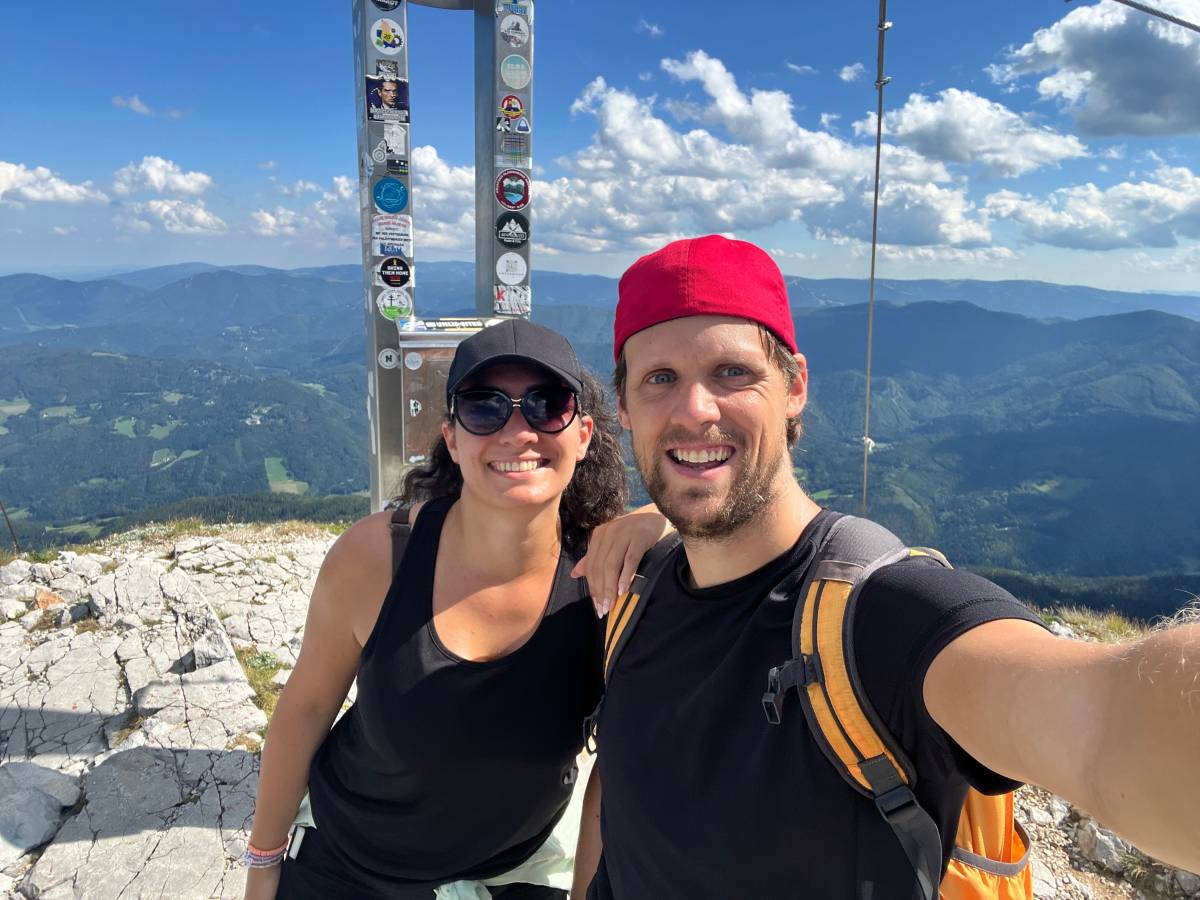
Happy hikers at the top of the beautiful Rax mountain in the Viennese Alps.
Bold Types: conversations with creators on courage, craft, and creative living.
Today’s guest is Philip, a passion-driven entrepreneur from Vienna who helps online writers make more money through their expertise.
Philip created his first online course on Skillshare in 2015 and has been serving students since. He loves to explore digital business models and is passionate about community-building – creating cosy spaces where people stay.
Community is the future of learning. People seek connection, accountability, and support, so investing in a community now is one of the smartest long-term moves you can make.
During the lockdown, he and his fiancée and business partner, Sinem Günel, started two digital projects that have since grown into multiple six-figure businesses annually.
Their latest venture is the Write • Build • Scale Mastermind, where he, Sinem & Jari support writers through actionable resources, weekly live coaching and a private community.
We chatted about growing your list and community, his income and influences, and what ‘success’ means to him.
At 33, I’m super impressed with what he’s achieved and how he and Sinem play to their strengths. “She’s the typewriter in our relationship, and I’m the calculator.” I like this sensible approach to the ‘creator economy’, that your ‘creator business should be boring’. 💯 Save the drama for life!
Congrats to you both on your engagement! They’re getting married in 10 months.
Enjoy our chat!
Cheers, Nika 🥂
This is an excerpt from my business and creativity newsletter The Shift. For the full experience, sign up here.
The Shift is here to help you live a life well-lived. If you enjoy my work, consider supporting it by becoming a paid member—and enjoy these community perks!
I just read about Dax Shepard’s estimated $80M deal with Amazon Wondery for the ‘Armchair Expert’ interview podcast. It’s been exclusive to Spotify since 2021, so good to see it available on other platforms again.
The deal, valued at an estimated $80 million, also includes plans to develop two new podcasts, a first look deal for future podcast ideas, plans to host livestreams, and rights to develop and sell Armchair Expert merch. The company will also launch video episodes of the podcast. [Hollywood Reporter].
No mention of his co-host Monica Padman in any of the headlines (she’s not on the cover art either), so I wonder what’s going on there. I’d be peed off if I were her unless it’s deliberate and she’s planning on branching out. Read the full post.
This was originally published on The Shift newsletter. For the full experience and to join the community, subscribe here.
I’m experimenting with a new (shorter) format because a) I respect your time and b) I need to get outside and enjoy the early days of summer. There might not be much of it in the UK. And it’s my birthday month!
1️⃣ Went to a Leading Expert talk on the Sorry State of Social Media with Brian Clark – an overview of the evolution of social media from a helpful audience-building tool (Digg and Delicious) to a dopamine-fueled distraction and time suck—with more emphasis on ‘influencers’ and attention than community and connection.
From a business perspective, it’s hard to justify spending time on social media. He’s been experimenting with LinkedIn and succeeding, but “there’s no aspect of fun on LinkedIn.” (I agree—it’s boring AF—what can we do about that?)
Some thoughts on how to fix it: Focus on building your email list and a deeper psychological understanding of your prospects. Test paid ads in other newsletters and/or write guest posts for folks in your niche. The business basics: People and relationships power everything, and that won’t change. He says he’s “lost all techno-optimism,” – noooo! BUT there will be something else—we can’t predict it.
The Mill, which has just reached a six-figure reader milestone. Exciting to hear they’ve announced a major hiring round (hiring 11 staff in FIVE cities) and are expanding into Glasgow and London (making hay as the Evening Standard goes from daily to weekly). Love the ambition! Bringing deeper narrative journalism to local news. What local news to you read/need? Let me know and I’ll ask him.
3️⃣ Went to a Scaling Paid Subs Mind Meld with Lex Roman. I love her new project, Journalists Pay Themselves, for reader-funded journalists. Sharing tiny experiments and helpful resources in her newsletter and hosts free monthly meets to help folks grow their paid readership. We discussed pricing and tiers and tried to work out why anyone would pick the middle tier!? Plus, a hot-seat publication rundown is super useful. I’m hosting the next session on Monday, July 1. RSVP here. Interview with Lex coming soon!
PS It’s the Publisher Podcast & Newsletter Summit / Awards on Wednesday. Esther Kezia Thorpe shared this post on what burnout feels like and how challenging event marketing is as a part-time gig and full-time parent. They’re open to ideas re partnerships, investment, or refocusing to work smarter, not harder. The lineup is insane – last chance to grab a ticket here.
▶️ Tiny Marketing Actions: The Six-Week Experience [Pam Slim on Maven] Like this concept. How to execute TMAs on a daily/weekly basis to grow your business with a community of small biz owners.
I couldn’t make it to CEX this year, so I’ve compiled a post-event summary from socials. Got my piggy jar and am saving for next year!
Here are the big ideas and themes that shaped this year’s event, plus some practical things you can do right now to grow your biz.
Big topics tackled? Algorithm chaos in Google and socials, the genius/evil of AI (including creating your digital doppelganger – thanks, Andrew Davis, for your sticky presentation phrase that, UGH, I can’t shake!), owning your own land/community, showing your humanity, REALLY understanding your customer and adding VALUE before jumping to monetization. — Wendy Covey
1. Using AI to survive and thrivein a competitive market (automating content production, personalising user experience, analysing audience data). AI was top of mind, but as a tool to streamline and organise content production rather than for organic copy. The hype around AI is starting to die down a bit because it’s becoming part of our everyday lives.
Just looking at this map from Visual Capitalist, which shows the number of AI startups by country. The US has 5,509, and the UK is third with 727. It’s mind-blowing. I’m using GPT Plus as a helpful agent and trying to figure out how it can help with distribution and discoverability. How do we develop our own distribution?
AI doesn’t have feelings. You need to tell your unique story. — Latasha James (her keynote on the importance of human stories)
Always say, “Take your time” after inputting the prompt. You’ll get better results that way. — Brian Piper (loving how he’s using AI for meal planning for his family of 8!)
2. Building revenue streams independent of big tech – strategies to help you make sustainable revenue streams without relying on tech platforms, e.g. direct revenue through subscriptions and memberships.
3. Community engagement and the importance of nurturing and building online communities as a growth strategy. Strong community ties can lead to a more robust business model in the content space.
Community can feel complicated and heavy, so I always think about Rosie Sherry, who talks about being kind and caring as a business strategy. “To care, over time, becomes your difference.” I love that. And with newsletters, you have a community of readers.
Solve small problems, then big problems. Then people will trust you. That’s how expertise is built. — Justin Welsh
Reminds me of Paul Graham on building world-class products that people love. “Focus on making a small group of people super happy.”
4. The value of networking and collaboration and how you can grow faster and achieve more by teaming up with other entrepreneurs. The Content Entrepreneur book was a group project that worked – conceived at last year’s CEX and written over the year to be released ahead of this year’s event.
More from The Tilt on that experiment here. Pamela Muldoon’s chapter is on content strategy and planning, which is her passion topic, and she narrates the audiobook.
They say two heads are better than one. So, imagine how powerful a book by 30-something content experts is! — Diane Burley
It’s also a brilliant distribution tactic—most of the posts I found on LinkedIn #CEX24 were about the book.
5. Diverse content platforms from traditional blogs and newsletters to newer formats like podcasts and video series. Good to hear Jay Clouse talking about prioritising trust over attention—long-form content over short-form.
Julia McCoy says it also has SEO benefits. “One of them is that long-form, well-researched content, with all the right schema and link profiles, is still the best way to rank on search engines.”
Roundup posts
▶️ Go Forth and Do: 5 ideas from 5 presenters you can do right now [The Tilt]
▶️ Best video on what she learned from other speakers [Latasha James]
▶️ Insights on solopreneurship + ‘opposite thinking’ from B.J Novak [Austin L Church]
▶️ Throwback from CEX ’23: Killer newsletter editorial and operational tips [Ann Gynn]
Love this tip from B.J. Novak about his writing process. He carries a notebook everywhere and then transfers his thoughts to his laptop (the bit I’m not very good at) so he can group similar ideas and themes to create from.
You can do the virtual thing, but really, the magic is in meeting other content creators, getting inspired, and even finding a few to collaborate with. — Mary Rose ‘Wildfire’ Maguire
I agree, that would carry me along for the rest of the year.
Kudos to the team and their mad event skills – three days is a big job 🥂
Tilt Your Business: Lessons and takeaways from Content Entrepreneur Expo, May 14 – register here.
Did you go? If so, let me know, I’d love to hear your insights.
Nika ✨
Work with me
Wanted to be Jane Bond but ended up in journalism 🤷🏻♀️
I run Firebird, the content consultancy helping entrepreneurs impact the world with their personal stories. Life is too short to play small. See my services here.
Newsletter Talent Directory! for creative collaborations—feel free to add your deets here.
I’ve been tinkering around with my Google Knowledge Panel this week. I have an old one from 2007 when I wrote my first book, which is outdated now and looks a bit sparse.
Google still dominates online search results, so I’m keen to grow and improve my KP – it’s your digital business card and the first thing people see when they look you up online.
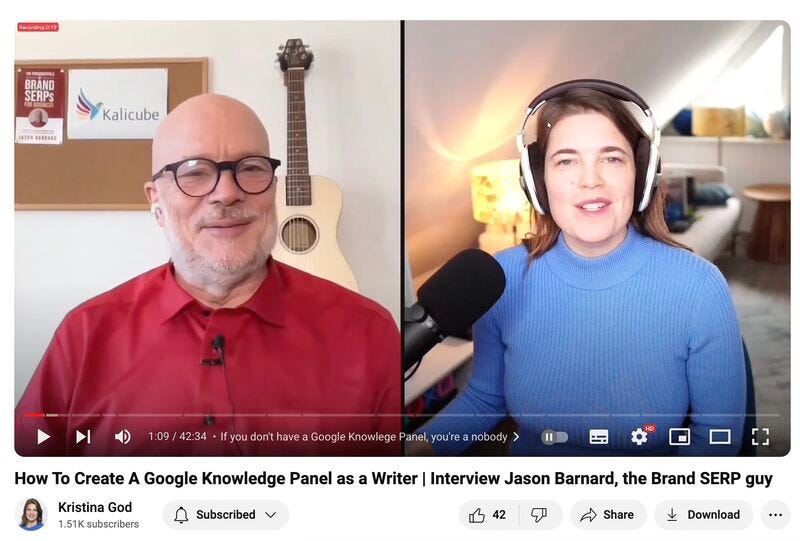
If you don’t have a Knowledge Panel, you look like a nobody. So, it’s a really good way to push yourself up the career ladder as it were, to be recognised as a leader in your field.
Jason Barnard, the Brand SERP Guy.
I clicked on the dots next to my name and suggested an edit. I added a a short bio, but they rejected it. That info comes from the Knowledge Graph, Google’s information collection about people, places, and things.
So, back to the drawing board. I have to educate Google!
Google is actually a child, thirsty for knowledge who wants to understand the world. It doesn’t care about notability; it just wants to understand everything.
I’m working through this free guide from Kalicube (Jason’s agency specialising in KP). I’ve updated my website bio (Home/About page) and social profiles (Crunchbase, Journolink, Response Source, Haro, Muck Rack, Substack, and LinkedIn).
He says your bio needs to be clear and consistent (who you are, what you do, who you help), and preferably written in the 3rd person. I’m not keen on that; it’s too formal for me, but I’ll try it for now. I can tweak it later.
Repurpose the same bio across all your social platforms and link back your website to “create an infinite loop of self-corroboration that Google understands”.
I checked it this morning, and it’s now updated my name and added my social profiles, but there’s no pic of me or bio, so I still have some work to do.
It could take months so I need to be patient, but at least I’ve made a start.
Thanks to Jason and team for this resource!
I enjoyed his interview with Kristina God on how to create a KP as a writer (Kristina writes on Substack and Medium), plus they touch on other stuff – how Google is explicitly looking for writers, multimedia content, the importance of visual branding (often overlooked) and whether we should let AI crawl our content (we now have that option on Substack).
If the future of search is about how we educate these smart machines, then we need to understand the knowledge algos and how they function. This is a good place to start!
Also, check the information about you on ChatGPT, etc, to make sure it’s correct. Joe Pulizzi asked it what his favourite colour is, and it said ‘purple’ when we all know it’s orange! 🚩
If you make videos, check the auto-generated captions on YouTube, as they can be inaccurate.
Let me know how you’re growing your Knowledge Panel.
Congrats to Kristina on becoming a Substack Bestseller and getting 100 paid subscribers! 🥳
Good Reads
▶️It’s not just you. It’s harder now to make a living as a creator. An excellent essay on how the sea has shifted when building an online business. Those who are killing it are mainly marketers selling courses about marketing. I agree; it’s very meta (more Substacks about how to succeed on Substack). I’m in this space, too, and struggling with it. Some advice on how to look forward and innovate. [Alexis Grant]
▶️Google’s Helpful Content update – reflecting on what happened. The September ’23 HCU caused thousands of sites to lose organic (SEO) traffic from Google in a few days (there seem to be NO recoveries from this), and the March core update rolls on. Here’s Lily Ray on patterns she’s seen in her work, research, and advice for smaller indie publishers. [Lily Ray]
▶️Time to Act. What are publishers doing now? Some industry leaders in the blogging and publishing space have joined forces to create a collective non-profit association, the Web Publishers Association, to inspire change. Tony Hill shares his thoughts on it here [Amy Aitman]
▶️Joe Pulizzi’s new book, The Content Entrepreneur, is out in the next few weeks. I love the cover of the proof copy – very Gatsby! Direct sales only via their websites, not Amazon etc, so a bold move. I’m interested to see how the experiment goes – not sure how it differs from Content Inc. [Joe Pulizzi]


 Nika
Nika 