Categories
Interviews

Bold Types Q&A #10: Christin Thieme 🇺🇸

Since 1999, I’ve been writing online and interviewing creative folks I admire about courage and craft. I love learning from others’ journeys & experiences and want to help more ambitious solo entrepreneurs—especially women—impact the world with their personal stories. And make a shit ton of money!
Inspired by the book ‘Bold Types: how Australia’s first women journalists blazed a trail’ in the fight for gender equality, I’ve launched the Bold Types Q&A series.
Here’s the 10th interview, featuring Christin Thieme, creator of The Content Brief and host of The Content Spark Summit – Nika 

Christin is editor-in-chief of The Salvation Army in the western US, where she tells stories about people making an impact for good and prompts others to action. She holds a master’s degree in specialized journalism from the University of Southern California, has taught journalism, and helps creatives simplify their content strategies on Substack.
Welcome, Christin! ✨

What problem is ‘The Content Brief’ solving?

I help creatives simplify their content. Anything we create and share is an invitation to connect, and I want people to have a plan and a workflow that is exciting to show up for.

I hold a master’s in specialized journalism, have worked for nearly two decades leading a content marketing team for an international nonprofit, and taught journalism and communications as an adjunct professor. Content is what I eat, sleep and breathe if you will. 

After helping friends strategize how they could better connect with the right people online around their makeup artistry, barbershop and even psychology practice, I saw how overwhelming this world of content is to people who aren’t necessarily in it daily. I enjoy helping people break it down into something more tangible, sustainable, and real-life approved, so I’ve taken up doing so here on Substack.

If you’re feeling overwhelmed, frazzled, and frustrated with how you show up online… If you want to better connect (and convert) people to your ideas and your work… 

The Content Brief is for you. I’ll help you take control of your content so you can stay in your zone of genius.

What’s always on your desk?

At my full-time gig, coffee, water, a Blackwing and my Airpods. At home, I’m often typing straight into my Notes app between baseball practice or bath time.

With three boys under six, I love and live by the Julia Cameron quote:

The ‘if I had time’ lie is a convenient way to ignore the fact that novels require being written and that writing happens a sentence at a time. Sentences can happen in a moment. Enough stolen moments, enough stolen sentences, and a novel is born—without the luxury of time.

I also printed out a screenshot of my first-ever paid subscription and put it in a little frame to remind myself I might be onto something, to keep going, and to keep finding ways to be helpful as I build this community.

What are you struggling with right now?

Time! I have so many ideas, but we all only have so much time, so I’m constantly reminding myself to focus on what moves the needle. This week, I am largely wrestling with delivering a virtual summit I’m hosting: The Content Spark Summit.

This free full-day event on Substack June 27 is meant to help you spark meaningful connection with your content. From understanding the importance of engagement to creating a content strategy you can’t wait to show up for to fostering genuine connection and leveraging your unique expertise and experience, 14 expert speakers will share what they know.

And I’m working on getting the word out…so please come! Grab your free ticket here.

Best business advice received this year?

Just this other day, I saw this quote from Seneca: “You must match time’s swiftness with your speed in using it, and you must drink quickly as though from a rapid stream that will not always flow.”

He may have been a Roman philosopher, but the advice holds today:

Keep a bias toward action. It’s easy to hide behind planning, plotting, and perfecting (I know!), but the impact you want to make can never take hold until you actually take action.  

Tell me about your newsletter strategy, its value to your business, and how you measure success.

Right now, I’m in an awareness-building phase, focusing on free subscribers, which is part of the strategy behind the summit.

There are three ways to engage with me at The Content Brief:

  1. As a free subscriber, you get each of my posts to help you create a newsletter you love *without* the overwhelm. Things like: What to do with your story, questions to find your content sweet spot, and a template to write your personal bio. Plus, my monthly content report of things I’ve digitally dog-eared and Creator Briefing Q&As with other creatives, like this recent one with Lucy Werner.
  2. As a paid member, you get access to my quarterly content planning party, where I’ll help you plot out your next three months of content. The next one happens in August and will help you create a plan to show up consistently, with intention.
  3. And as a paid member of The Briefing Room (the founding member tier), which I’m just about to launch, you get exactly what you need to design or redesign your newsletter content strategy with ease, including my exact simple content system, an all-in-one dashboard workspace, and a monthly brief on one specific thing to reset to keep your strategy fresh. It’s all designed to save you a lot of time and frustration so you can have a bigger impact with your newsletter.  

If you Join The Briefing Room before September, you get a bonus 1:1 Content Strategy Session with me!

I’m also building in ways to collaborate and share with other creatives. I hope The Content Brief becomes a vibrant community that supports each other in what can sometimes be a lonely endeavor.  

What important truth do very few people agree with you on? Or your ‘spiky point of view,’ Wes Kao calls it. 

Providing value doesn’t mean having all the answers. 

Creative work that inspires an audience and builds a community (and business) doesn’t require anything stunt-like, viral or wildly innovative.

We don’t have to show up as “experts,” with all the answers ready to guide others to the big transformation. Trying to do so often leads to becoming another faceless creator of tips & tricks and *value* in some Wikipedia-esque, robot-generated “I have it all figured out” status quo.

And the problem is…that says nothing of the journey.

You could have the most well-researched writing in the world, but if it feels like nothing more than a robot production, it won’t get read.

Conversely, you could write about your life as a dog walker, and if you’re asking questions that take us on a journey and leading a conversation from your perspective, every word will get read.

To provide value, you need curiosity, questions, and a yearning to explore. It means being willing to lead the conversation and invite us on the journey of an idea in real time through your content. People don’t want to see processes, deliverables, skills. We want to see perspective, relationship, transformation—and that means your point of view, personality and perspective.

Last week, I wrote about why I hate the word ‘content’. It’s become a catchall term for everything we make—words, video, audio—invading everyday talk and devaluing the creative process. What’s your take on it?

This is SUCH an interesting question and a sentiment I’ve seen pop up recently. I’ve never thought of it negatively. I think of it like the word “box”—a catchall term that encompasses so many different specific things but one word that gives you the gist. 

I’m sure some of the negative vibes toward the word come from the push for “top ranking” and “click-worthy” content that doesn’t deliver, but for me, it’s just a succinct way to describe the many ways we invite people to connect with us. 

That’s what content is, in my view, whether it’s a newsletter, podcast, social post, and so on.

When you create and share something, you invite others to connect with you about your ideas and work. Of course, if you are specifically a podcaster or a novelist, say that. Lean into concrete specifics over summary words whenever you can.

How have you shifted from ‘creating content’ to ‘building community’ on Substack?

With a relatively new newsletter on Substack, I came in knowing I wanted to build a community. I love to plan parties. I love to build everything around a specific purpose. To carefully word the invite. To think through the menu. To find the right party favor. To design the table. To welcome everyone in. To surprise and delight. To make them feel loved.

I feel the same about crafting my own little club right here on Substack. Building a newsletter and community is the ultimate gathering. And I’m here to party. 🎉

Can you recommend some resources for entrepreneurs?

The Elements of Style by Strunk & White—I love this illustrated version of the classic go-to guide for writers on how to “make every word tell.” (It’s also one of my favorite gifts for the creative types!) 

Building a Storybrand by Donald Miller—The best how-to I’ve seen on using words to talk about your product or service. It’ll help you define a clear message on how you can help potential customers. Worth re-reading annually. (Here’s my full list of favorite books to improve your writing for more.)

And I’ve truly been loving 

Lucy Werner‘s community, 

Hype Yourself, for learning how to generate your own buzz.

Are you using AI tools? If so, how are they helping you work better/save time?

Yes! I call Chat GPT my intern. I love using it to prompt my thinking, research subjects, synthesize interviews, and spot holes in them. It also helps repurpose my hero content into supporting pieces.

My goal is to create one Substack post a week and then repurpose it into snippets and teasers for my supporting platforms. To help save time prepping those shorter pieces, here’s a basic starter prompt I use:

I am a [what do you do], and I need to create a social media post based off a newsletter I previously wrote. The audience is composed of [your audience.]

Use this text to write 3-5 short-form teaser pieces of content for [platform] that highlight the main points, benefits or offers of this newsletter. Ensure the tone is [your tone].

Include a CTA at the end to subscribe to my newsletter, [your newsletter name].

Here’s the newsletter: [paste copy]

Using that prompt on this recent post of mine, here’s the first two of the five posts it generated:
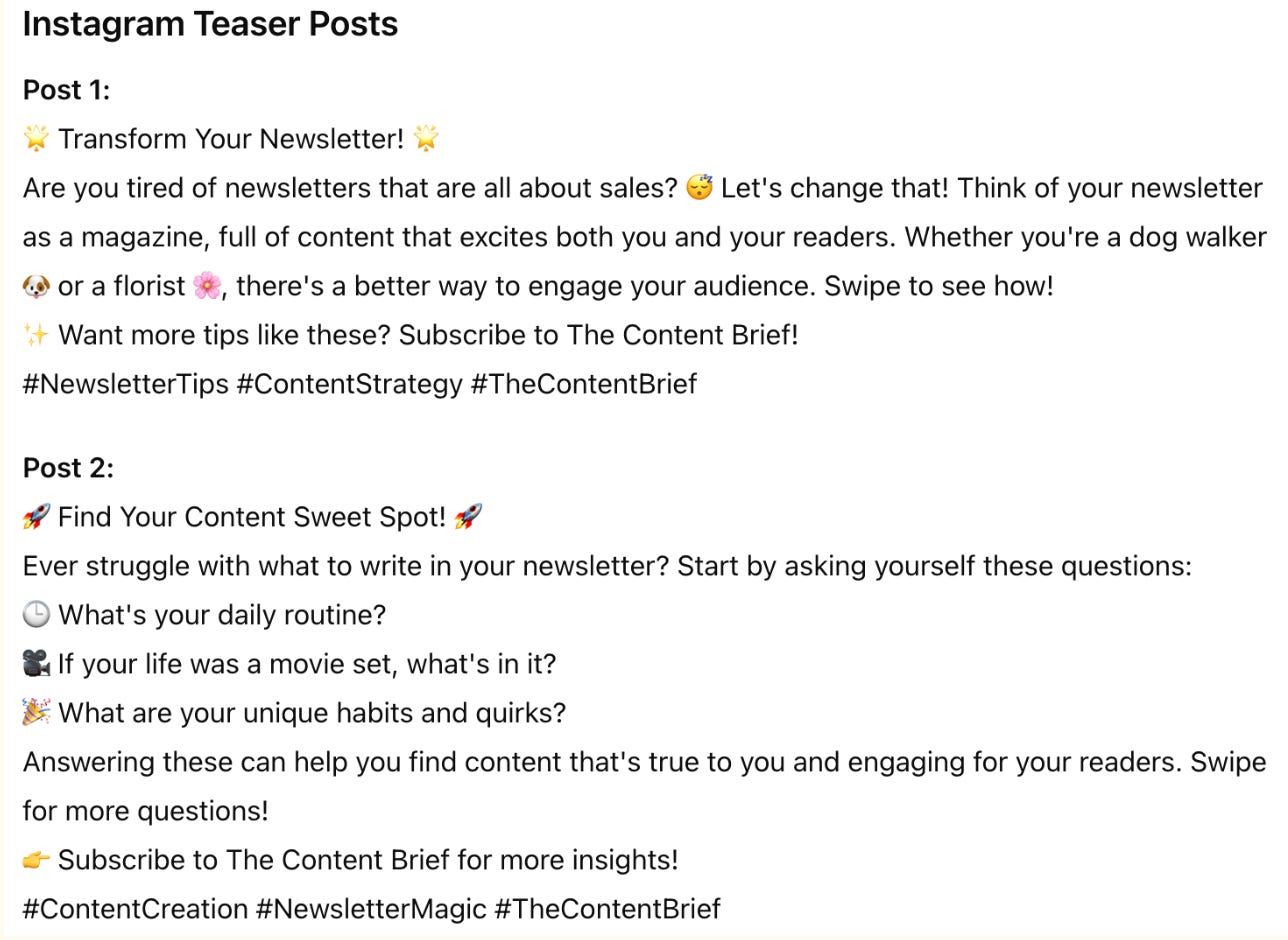
Not bad for a first pass. I always edit the intern’s work for quality and to sound more like me, but the beauty is you’re not starting from scratch.

Best coffee & coworking in your town?

I haven’t done any local coworking, but my favorite coffee shop to work in is The Boy & The Bear in Redondo Beach, California. It has an aesthetically pleasing dark, earthy, “let’s get to work” vibe and good coffee. Win-win.

Do you have a question for my next guest? 

What do you love about your work? 

Where can readers find you?

Please come visit over at 

The Content Brief!


Check out all the interviews in the Bold Types series.

Categories
Newsletter

🕵🏻‍♀️ Insights on Israel-Palestine, Shoplifting woes, self-care, and a bit of Mitski

Five solidarity actions you can take right now

It’s a week since Hamas launched an attack on southern Israel, and the footage coming out of Israel, Gaza is horrific and heartbreaking.

Can’t look at it, but can’t look away.

My thoughts are with the people of the Middle East – Israel, Gaza and beyond. Praying for peace and hope for the future.

I was in two minds about whether to post anything this week – it’s not BAU, is it? It feels insensitive and inappropriate to be posting humorous content right now.

And we need to be mindful about what we’re sharing on social – lots floating around from unverified accounts.

As Prof Samuel Woolley said about Russia-Ukraine, sometimes it’s better to say nothing and let the witnesses and experts take up the space.

People need to practise strategic silence. We should leave it up to the people who really understand the situation to post as much as possible.

We should give them our support, but we should allow people with expertise to do the talking.

Kaya Yurieff posted about this dilemma and how some creators are pausing brand partnerships and usual content now.

There’s no right answer. It’s a tricky balance – damned if you do, damned if you don’t. Silence is communication.

So, you do whatever feels right, which for me is to share stories from human rights monitors, shine a light on them, and let the oppressed educate us.

Graphic war images go viral

I’ve never seen such graphic imagery on social media – photos of dead babies promoted as ads on X from Israel’s government account.

It is shocking and deeply uncomfortable, but I can see why they’ve done it to ensure maximum visibility and tackle any conspiracy theories. There is a lot of misinformation. I have to verify my X account every time I post/update.

Seeing regular ads pop up on my feed is also jarring and annoying.

A simple and succinct historical background

I’m trying to understand this conflict better – often described in Western media as complicated and deadlocked. So, you have to choose your media wisely and seek out writing by indie journalists in Israel and Palestine.

• A simple guide to break down one of the world’s longest-running conflicts [Aljazeera English]

Five solidarity actions you can take for Palestine and Israel [Quakers in Britain]

This escalation must be understood in the context of 55 years of Israeli military occupation of Palestinian land and 75 years of dispossession and oppression of the Palestinian people.

It has been proven time and time again that there can be no military solution. Without an end to the occupation, equality, and full dignified human rights for all, this cycle of violence will never end.

• +972 Magazine is an independent, online, nonprofit magazine by Palestinian and Israeli journalists.

I don’t know the solution for Israel/Palestine, but war isn’t the answer.

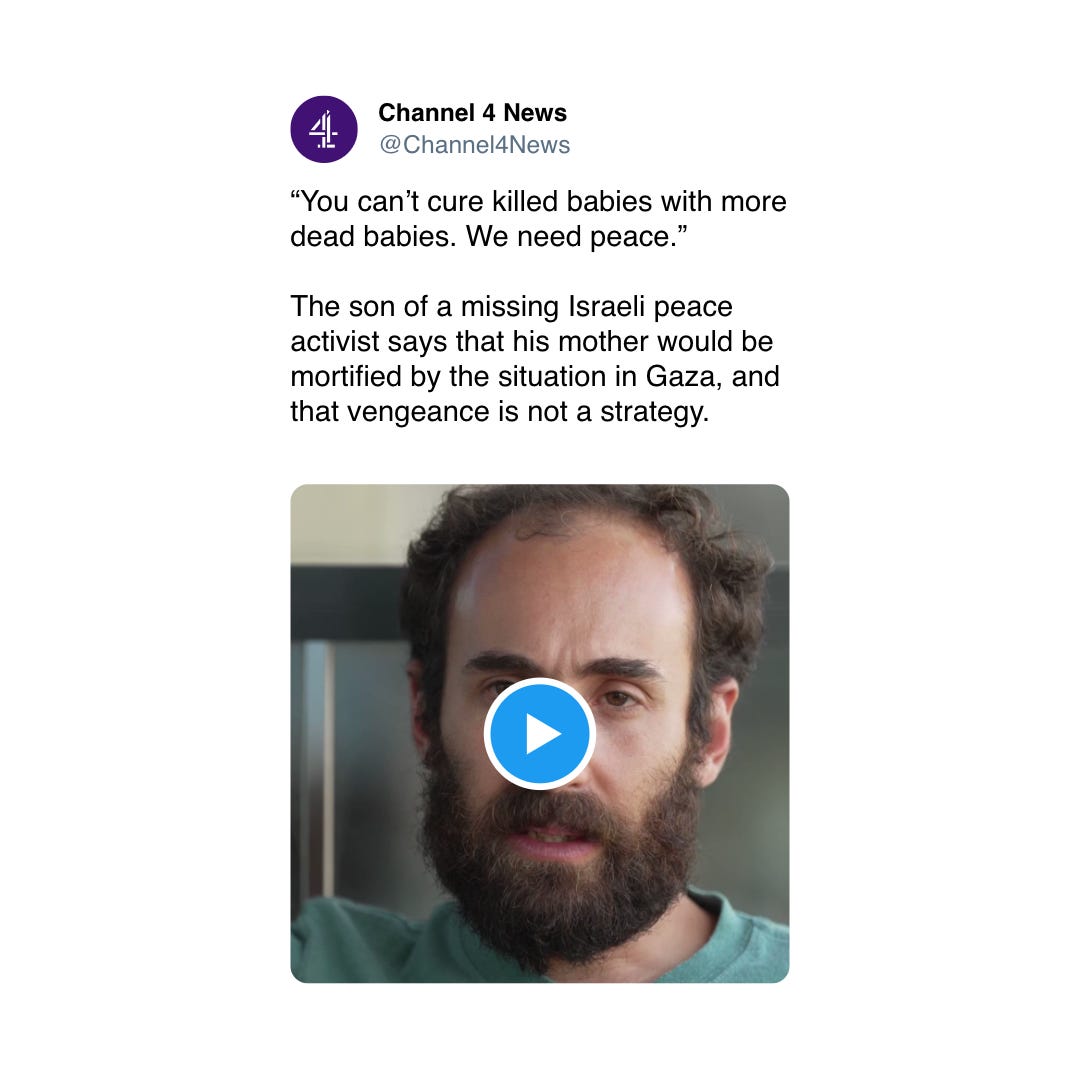
As the son of a missing Israeli peace activist said, “You can’t cure killed babies with more dead babies. We need peace.” Vengeance is not a strategy. 


Shoplifting woes  

I bought some eco pens from WHSmith yesterday – £9.99 and security-tagged with a plastic padlock 🙄

This is a new thing. I asked the sales assistant why, and he said, “It’s not just pens; it’s everything.”

Shoplifting is a big problem.

The cost-of-living crisis is still with us, and Xmas is coming. I saw on CBS News that Target is closing nine stores because of surging retail theft.

People are struggling everywhere – it may be less visible, but it’s no less important.

Have you noticed there are more security guards in the shops? Chatting on their walkie-talkies and sharing intel.

I’ve had them follow me round. I hate it. Puts me on edge and doesn’t make for a relaxed shopping experience.

Stealing isn’t right, but again, it’s context and empathy. People must be desperate to steal pens and food.

There’s bad shit happening, and the world can feel scary sometimes – planes are flying overhead as I write this.

A gentle reminder to step up the self-care, look after No 1 and check in with others this weekend 🙏

I’m enjoying Mitski’s new album. There’s something about the simplicity and purity of this that’s resonating with folks – My Love Mine All Mine is beautiful. 

Miski: The Land is Inhospitable and So Are We

– Nika

PS I applied to host a Substack Writer Meetup. I was planning to start one, so am happy they’re providing support.

Let me know if you’re local (Sussex/Kent) and fancy co-hosting one 👯‍♀️

Smart move – the network effect. Like Avon, Ann Summers, and Tupperware had strong communities – Substack will soon be a household name.

Thank you for being my subscriber – and on this journey with me.

Thoughts, ideas and suggestions welcome. Let me know if there’s a topic you want me to write about or someone you’d like me to interview: nika@nikatalbot.io.

Guest posts are welcome too. I love getting your emails, and I read and reply to every.single.one.

Categories
Newsletter

✍️How to create a writing culture

How does remote work change the way companies get things done?

David Perell (Write of Passage) said, “Remote work leads to writing-centric companies instead of speaking-centric ones.” Amazon and Stripe have a heavy writing culture. Amazon is famous for its six-page narratives, and Jeff Bezos is a brilliant writer. 

We don’t do PowerPoint (or any other slide-oriented) presentations at Amazon. Instead, we write narratively structured six-page memos. When you have to write your ideas out in complete sentences and complete paragraphs, it forces a deeper clarity of thinking.

Here’s how to write like an Amazonian 🚀

The GitLab team handbook is their central repository for how they run the company. Over 2000 pages of text, and as part of their value of being transparent, it’s open-source. Darren Murph, GitLab’s Head of Remote, has talked about the importance of having a Chief Documentarian and writing everything down with remote teams. 

Bill Gates was on it in ‘99. New Rules: collaborative culture & digital information flow.

I read all the e-mail that employees send me, and I pass items on to people for action. I find unsolicited mail an incredibly good way to stay aware of the attitudes and issues affecting the many people who work at Microsoft. 

Better writing  Better thinking  Better communication  Clear leadership  Boosts productivity

Writing democratises ideas and lets teams have their say. It breaks down workplace politics—you’re not relying on verbal accounts, 1:1s or presenteeism to get stuff done. Transparency and good documentation build trust. Josh Bernoff“Clear leadership, expressed in writing, creates alignment and boosts productivity.” 

How Stripe built a writing culture ✍️

David Perell asked Brie Wolfson, who worked at Stripe for five years and set up Stripe Press to talk to his students about how companies can create a writing culture. 

Out of their conversations, she made this stellar guide 🚀

I’ve come to believe that Stripe’s culture of writing is one of the organization’s greatest superpowers. As startup whisperer patio11 puts it, Stripe is a celebration of the written word which happens to be incorporated in the state of Delaware.

Stripe has always treated documentation as a first-class product. People from every corner of the company author blog posts. The company publishes a magazine about building and operating software (Increment) and books about technological and economic progress (Stripe Press). 

But what we don’t see is the massive library of content produced in-house for employees. She says that’s where the real magic happens…

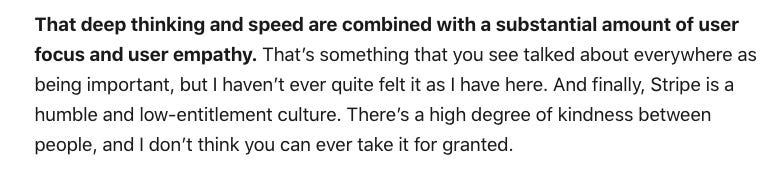
This interview digs into the company culture. Go deep and move fast.

One thing that distinguishes Stripe is that it’s an incredibly deep-thinking culture. It’s a written culture really focused on getting to the right answer. 

Another thing is a sense of urgency. The company is especially dedicated to moving very, very fast.  

Bring the Donuts

Ann Handley is also brilliant on this stuff. How to champion a content-oriented culture—the key to a customer-centric, intuitive, empathic point of view.

We don’t appreciate the work that goes into minute-taking—it’s bloody hard work!


🛠🖐5 Things 

★ Stop Asking QuestionsHow to lead high impact interviews and learn anything from anyone (Holloway). Lessons from a veteran podcast host with 2000+ episodes on the secrets of deeper conversation. It teaches you how to interview and how to learn. Excerpt here. I can’t get enough of Holloway’s brilliant books!

⟶ Stop Asking Questions

★ How to take smart notes (Forte Labs). Former Secretary of State Madeleine Albright says the secret of her career success is down to diligent and reliable notetaking. A simple technique to boost your writing, learning and thinking. Have a listen to Tiago’s interview and Q&A with the author, Sönke Ahren here.

⟶ How to take smart notes.

★ Field Notes: Miami (Devon Zuegel). What’s it like to live in Miami, the new tech hub? Writer and Product Director Devon Zuegel on what makes Miami special. The colours! The flowers! Immigrant spirit. These field notes are a bit different from previous cities she’s explored because Miami is her home. I’m listening to Order Without Design, her new podcast about cities.

⟶ Field Notes: Miami

★ Exotic and sustainable, night trains are coming back to Europe. The ‘Euro Night Sprinter’ map is utopian, but Europe’s rail future could look a lot like it. It’s a proposal by the German Greens, who want a Europe-wide network of sleeper trains. By 2030, it would connect more than 200 cities and places across Europe. Slow, comfortable travel. All aboard! 🙏

⟶ Euro Night Sprinter Network

★ A Twitter thread from Dickie Bush with advanced tips for every internet tool. Starting with Twitter – 10 advanced features, how to master Google search, Google docs, YouTube rabbit holes, Mac tips and more. One to bookmark and return to when well-caffeinated – there’s a lot to digest here.

⟶ Advanced tips for every internet tool.

🤔 Major Lifehack: A New Study Has Found That A Key To Getting Stuff Done Is Not Just Sort Of Wasting The Hours Between 3 And 7 PM Every Day.

Categories
Newsletter

How digital marketing has changed during lockdown – some stats for your strategy

Covid-19 has radically changed how we work, shop and live our lives – speeding up digital transformation already happening. And as consumer behaviour changes, businesses have had to adapt quickly.

We’ve had a look at some of the big data coming out of lockdown to help you plan your digital marketing strategy for 2021. Eight months on, some clues are coming out as to what trends will be long term.

What’s clear is digital is leading the way and helping companies to respond to the loss in revenue with the pandemic, which means reorienting business models to be digital-first is vital to keep pace with long-term changes in consumer behaviour.

Advertising spending pre and post-Covid

Data from the World Advertising Research Centre (WARC) shows brands are slashing advertising spend for 2020 to the tune of 50 million globally. Their latest Global Ad Trends report shows almost all product categories will see a decline in ad investment this year. However, best practice shows brands should continue to spend through difficult times to position themselves for recovery.

Consumer trends during lockdown

Deloitte’s Digital Consumer Trends survey explores the rise in online shopping, banking, video streaming and healthcare in response to the lockdown.

  • About 40% of respondents did more online shopping during lockdown
  • 14% had more remote (phone or video) appointments with health practitioners
  • 1/3 streamed more films and TV series on vod platforms

Here’s Google’s new data on six lockdown consumer trends here for the long-term.

Localism is accelerating

In the UK 43% of consumers believe local businesses are good for the economy and 57% said after lockdown they’re more likely to spend money at a business that offers locally produced products or services. Google searches for things ‘near me’ have rocketed. Highlight the local aspects of your product or service. Make sure your website is optimised for local search and update your Google My Business listing.

Be seen and heard in the community – there’s a focus on ethical and sustainable brands doing good and being helpful. 65% of people say a brand’s response to the pandemic will hugely impact their likelihood to buy its products, and that businesses have a big part to play in helping society recover. Strong brand values are important. Communicate what you’re doing locally to help during the crisis.

Social media communities

Ofcom’s latest report Online Nation shows a 61% growth in social media engagement during lockdown. We’re looking for new ways to keep connected, informed, entertained and fit during the pandemic.

TikTok reached 12.9m UK adults in April, up from 5.4m in January. Twitch, the popular live streaming platform for gamers, saw visitors increase from 2.3m to 4.2m. Video calls have doubled during lockdown, with more than 7 in 10 doing so at least weekly. Houseparty grew from 175,000 adult visitors in January to 4m in April. Zoom had the biggest growth, from 659,000 adults to reach 13m adults over the same period.

People are moving away from conventional forms of communication – landline and SMS to messaging platforms like WhatsApp and Facebook Messenger. Is your business there?

Video is essential

Video is now an essential, not nice to have. Ofcom’s report shows 9 in 10 adults, and almost all older children aged 8-15 are using sites like YouTube, Snapchat, Instagram and TikTok to create and share videos online. 1/3 of adults now spend more time viewing video-sharing services than broadcast TV. There’s been an explosion in user-generated content, and creators are making money from it.

It’s easier to watch videos when we’re working at home, and we have more time. Could you bring in more ‘how to’ tutorials next year? It need not be expensive and high production – a handheld iPhone clip is authentic and can be just as effective. Rob Kenney’s YouTube channel, Dad, how do I? has two million followers and has been described as wholesome and the purest thing. His content went viral and he’s now teamed up with retailers.

Community groups were the most popular thing on Facebook last year catering to our hobbies, interests and a desire to help out locally. You may not have the resources to run social media ad campaigns, but it’s free to set up a Facebook group – and more companies are hiring community managers to help them grow their business.

Social shopping posts

People are buying products in social media posts on Pinterest and Instagram – and also on LinkedIn via lead generation. We’ve been able to do this for a while, but the process is being refined to remove the friction in the user journey. Take advantage of this but always aim to drive people back to your website.

The rebirth of influencer marketing

Marketing with influencers has been around for a while – we’ve gone from brands working with big followings to micro-influencers with a more authentic, dedicated audience, who are seen as trusted specialists in their niche. YouTube is now giving influencers tools to help them measure their content and make money in new ways, and other platforms will do the same to support creators. It’s worth thinking about working with influencers on campaigns if this suits your business model.

Interactive content is becoming mainstream  

Tech-savvy consumers want to connect with brands in new and fun ways. The increase in online shopping searches for ‘live chat’, ‘virtual try on’, ‘next day delivery’ and ‘apps’ show we are looking for ways to enhance online shopping. Chatbots are one of the fastest-growing digital marketing trends in 2020 – the future of customer service. Interactive content is becoming mainstream – think about quizzes, polls, AI ads, podcasts, 360-degree videos, and voice search.

Responsive content marketing and education

We want simple, subtle and responsive content that improves our quality of life. It’s less about celebrity and selling – more focus on empathy and thought leadership. Provide thoughtful and useful content that improves your customers’ lives – tell them how you’re responding to the pandemic now. Be expressive and empathetic as far as it fits with your brand tone of voice – consistency is key. Think about cause-based communications – how you can help rather than what you can sell…

How can you help people to enjoy their time at home? Could you help them to work better and create new habits? Campaigns aimed at personal growth; mental health & wellbeing will do well. People are trying to become better versions of themselves, whether it’s learning a new skill, exercising more or meditating.

Revisit your website and social activity and think about where you can add value. Be positive, aspirational and supportive. Adapt your imagery to focus on social distancing and safety – your digital resources need to reflect reality. It’s vital to build trust at this time, and the best marketing campaigns engage with humans more helpfully.

People need seasonal content, things to look forward to, and reassurance. Be active on your social channels and adapt your messaging to suit the platform – if you’re B2B, focus on LinkedIn. For B2C – Facebook, Google Ads, Instagram, TikTok, YouTube. Facebook appeals to over 65s, while Instagram, Snapchat and TikTok attract younger audiences.

Investing in your customer’s online journey

WARC’s data shows the brands that have spent the last two years investing in their online customer journeys – be it via their website, app, or new technologies such as live streaming are now seeing the payoff. We’ll see a boom in click and collect at stores, pre-booking shopping slots online, and easy delivery. Sainsbury’s have done this well – investing in mobile app and e-commerce whereas Primark has no online presence and saw its sales drop from £650 million a month to zero after lockdown when stores had to close.

Your website is your window to the world – your shop front – so it needs to be up to date, fast and responsive to enquiries. If you’re a service-based business, can you add a tool that enables people to reschedule appointments? We’ve got used to the speed, ease and convenience of online shopping and contactless payments – why would we go back to supermarket queues and traffic jams?

Be agile, creative and experimental

Now is the time to be agile, creative, and innovative with your digital marketing. Don’t get bogged down in the process – act now as every day brings a new challenge. Find new ways to work and make quick decisions to speed up the creative process – automated digital tools can help you to meet this demand.

Digital is a shining light to help you through the next few months. Get your digital elves ready! Carry through the lessons you’ve learned in new ways of working.

If you need help with your digital marketing strategy get in touch – we’d love to chat! hello@perspectivemarketinganddesign.co.uk.

Categories
Newsletter

The Shift: Issue #27

Black Friday deals; How to reduce your digital footprint; Not more content, smarter content to grow your business.

This year’s Black Friday is expected to be the busiest on record because of Covid-19 and early discounts. 2020 has seen a 74% surge in online shopping as a result of global lockdowns. 45% of adults received more parcels during lockdown than ever before. Some sectors are booming – electronics, health & fitness, while others are struggling – fast-fashion retailers – Boohoo is offering up to 90% discounts. Work clothes have gone out of the window – I’ve been living in my gym gear since March.  

So far, I’ve bought two online courses from Udemy for £9.99 each and spent a gift card I’ve been saving since the summer. I have a fake Xmas tree this year for the first time – my ‘realistic’ Narnia tree that should last 10-15 years.  

I had a chat with our postie who said he can’t believe the amount of landfill.

Stuff is just piling up, it’s shocking. I can’t talk, I keep buying things on Amazon. But there’s just too much packaging on stuff. We need to make sure it’s biodegradable.

Reducing your digital footprint

Reducing physical crap is one thing, but what about our digital clutter? There’s a secret cause of global warming that we don’t talk about or think about much. It’s more insidious as it’s invisible. I’m lucky enough to work from home on a laptop but reading Gerry’s McGovern’s new book, World Wide Waste, has been a real eye-opener and made me think more about how I work and my digital footprint. Read more.