Categories
Interviews

Bold Types Q&A #10: Christin Thieme 🇺🇸

Since 1999, I’ve been writing online and interviewing creative folks I admire about courage and craft. I love learning from others’ journeys & experiences and want to help more ambitious solo entrepreneurs—especially women—impact the world with their personal stories. And make a shit ton of money!
Inspired by the book ‘Bold Types: how Australia’s first women journalists blazed a trail’ in the fight for gender equality, I’ve launched the Bold Types Q&A series.
Here’s the 10th interview, featuring Christin Thieme, creator of The Content Brief and host of The Content Spark Summit – Nika 

Christin is editor-in-chief of The Salvation Army in the western US, where she tells stories about people making an impact for good and prompts others to action. She holds a master’s degree in specialized journalism from the University of Southern California, has taught journalism, and helps creatives simplify their content strategies on Substack.
Welcome, Christin! ✨

What problem is ‘The Content Brief’ solving?

I help creatives simplify their content. Anything we create and share is an invitation to connect, and I want people to have a plan and a workflow that is exciting to show up for.

I hold a master’s in specialized journalism, have worked for nearly two decades leading a content marketing team for an international nonprofit, and taught journalism and communications as an adjunct professor. Content is what I eat, sleep and breathe if you will. 

After helping friends strategize how they could better connect with the right people online around their makeup artistry, barbershop and even psychology practice, I saw how overwhelming this world of content is to people who aren’t necessarily in it daily. I enjoy helping people break it down into something more tangible, sustainable, and real-life approved, so I’ve taken up doing so here on Substack.

If you’re feeling overwhelmed, frazzled, and frustrated with how you show up online… If you want to better connect (and convert) people to your ideas and your work… 

The Content Brief is for you. I’ll help you take control of your content so you can stay in your zone of genius.

What’s always on your desk?

At my full-time gig, coffee, water, a Blackwing and my Airpods. At home, I’m often typing straight into my Notes app between baseball practice or bath time.

With three boys under six, I love and live by the Julia Cameron quote:

The ‘if I had time’ lie is a convenient way to ignore the fact that novels require being written and that writing happens a sentence at a time. Sentences can happen in a moment. Enough stolen moments, enough stolen sentences, and a novel is born—without the luxury of time.

I also printed out a screenshot of my first-ever paid subscription and put it in a little frame to remind myself I might be onto something, to keep going, and to keep finding ways to be helpful as I build this community.

What are you struggling with right now?

Time! I have so many ideas, but we all only have so much time, so I’m constantly reminding myself to focus on what moves the needle. This week, I am largely wrestling with delivering a virtual summit I’m hosting: The Content Spark Summit.

This free full-day event on Substack June 27 is meant to help you spark meaningful connection with your content. From understanding the importance of engagement to creating a content strategy you can’t wait to show up for to fostering genuine connection and leveraging your unique expertise and experience, 14 expert speakers will share what they know.

And I’m working on getting the word out…so please come! Grab your free ticket here.

Best business advice received this year?

Just this other day, I saw this quote from Seneca: “You must match time’s swiftness with your speed in using it, and you must drink quickly as though from a rapid stream that will not always flow.”

He may have been a Roman philosopher, but the advice holds today:

Keep a bias toward action. It’s easy to hide behind planning, plotting, and perfecting (I know!), but the impact you want to make can never take hold until you actually take action.  

Tell me about your newsletter strategy, its value to your business, and how you measure success.

Right now, I’m in an awareness-building phase, focusing on free subscribers, which is part of the strategy behind the summit.

There are three ways to engage with me at The Content Brief:

  1. As a free subscriber, you get each of my posts to help you create a newsletter you love *without* the overwhelm. Things like: What to do with your story, questions to find your content sweet spot, and a template to write your personal bio. Plus, my monthly content report of things I’ve digitally dog-eared and Creator Briefing Q&As with other creatives, like this recent one with Lucy Werner.
  2. As a paid member, you get access to my quarterly content planning party, where I’ll help you plot out your next three months of content. The next one happens in August and will help you create a plan to show up consistently, with intention.
  3. And as a paid member of The Briefing Room (the founding member tier), which I’m just about to launch, you get exactly what you need to design or redesign your newsletter content strategy with ease, including my exact simple content system, an all-in-one dashboard workspace, and a monthly brief on one specific thing to reset to keep your strategy fresh. It’s all designed to save you a lot of time and frustration so you can have a bigger impact with your newsletter.  

If you Join The Briefing Room before September, you get a bonus 1:1 Content Strategy Session with me!

I’m also building in ways to collaborate and share with other creatives. I hope The Content Brief becomes a vibrant community that supports each other in what can sometimes be a lonely endeavor.  

What important truth do very few people agree with you on? Or your ‘spiky point of view,’ Wes Kao calls it. 

Providing value doesn’t mean having all the answers. 

Creative work that inspires an audience and builds a community (and business) doesn’t require anything stunt-like, viral or wildly innovative.

We don’t have to show up as “experts,” with all the answers ready to guide others to the big transformation. Trying to do so often leads to becoming another faceless creator of tips & tricks and *value* in some Wikipedia-esque, robot-generated “I have it all figured out” status quo.

And the problem is…that says nothing of the journey.

You could have the most well-researched writing in the world, but if it feels like nothing more than a robot production, it won’t get read.

Conversely, you could write about your life as a dog walker, and if you’re asking questions that take us on a journey and leading a conversation from your perspective, every word will get read.

To provide value, you need curiosity, questions, and a yearning to explore. It means being willing to lead the conversation and invite us on the journey of an idea in real time through your content. People don’t want to see processes, deliverables, skills. We want to see perspective, relationship, transformation—and that means your point of view, personality and perspective.

Last week, I wrote about why I hate the word ‘content’. It’s become a catchall term for everything we make—words, video, audio—invading everyday talk and devaluing the creative process. What’s your take on it?

This is SUCH an interesting question and a sentiment I’ve seen pop up recently. I’ve never thought of it negatively. I think of it like the word “box”—a catchall term that encompasses so many different specific things but one word that gives you the gist. 

I’m sure some of the negative vibes toward the word come from the push for “top ranking” and “click-worthy” content that doesn’t deliver, but for me, it’s just a succinct way to describe the many ways we invite people to connect with us. 

That’s what content is, in my view, whether it’s a newsletter, podcast, social post, and so on.

When you create and share something, you invite others to connect with you about your ideas and work. Of course, if you are specifically a podcaster or a novelist, say that. Lean into concrete specifics over summary words whenever you can.

How have you shifted from ‘creating content’ to ‘building community’ on Substack?

With a relatively new newsletter on Substack, I came in knowing I wanted to build a community. I love to plan parties. I love to build everything around a specific purpose. To carefully word the invite. To think through the menu. To find the right party favor. To design the table. To welcome everyone in. To surprise and delight. To make them feel loved.

I feel the same about crafting my own little club right here on Substack. Building a newsletter and community is the ultimate gathering. And I’m here to party. 🎉

Can you recommend some resources for entrepreneurs?

The Elements of Style by Strunk & White—I love this illustrated version of the classic go-to guide for writers on how to “make every word tell.” (It’s also one of my favorite gifts for the creative types!) 

Building a Storybrand by Donald Miller—The best how-to I’ve seen on using words to talk about your product or service. It’ll help you define a clear message on how you can help potential customers. Worth re-reading annually. (Here’s my full list of favorite books to improve your writing for more.)

And I’ve truly been loving 

Lucy Werner‘s community, 

Hype Yourself, for learning how to generate your own buzz.

Are you using AI tools? If so, how are they helping you work better/save time?

Yes! I call Chat GPT my intern. I love using it to prompt my thinking, research subjects, synthesize interviews, and spot holes in them. It also helps repurpose my hero content into supporting pieces.

My goal is to create one Substack post a week and then repurpose it into snippets and teasers for my supporting platforms. To help save time prepping those shorter pieces, here’s a basic starter prompt I use:

I am a [what do you do], and I need to create a social media post based off a newsletter I previously wrote. The audience is composed of [your audience.]

Use this text to write 3-5 short-form teaser pieces of content for [platform] that highlight the main points, benefits or offers of this newsletter. Ensure the tone is [your tone].

Include a CTA at the end to subscribe to my newsletter, [your newsletter name].

Here’s the newsletter: [paste copy]

Using that prompt on this recent post of mine, here’s the first two of the five posts it generated:
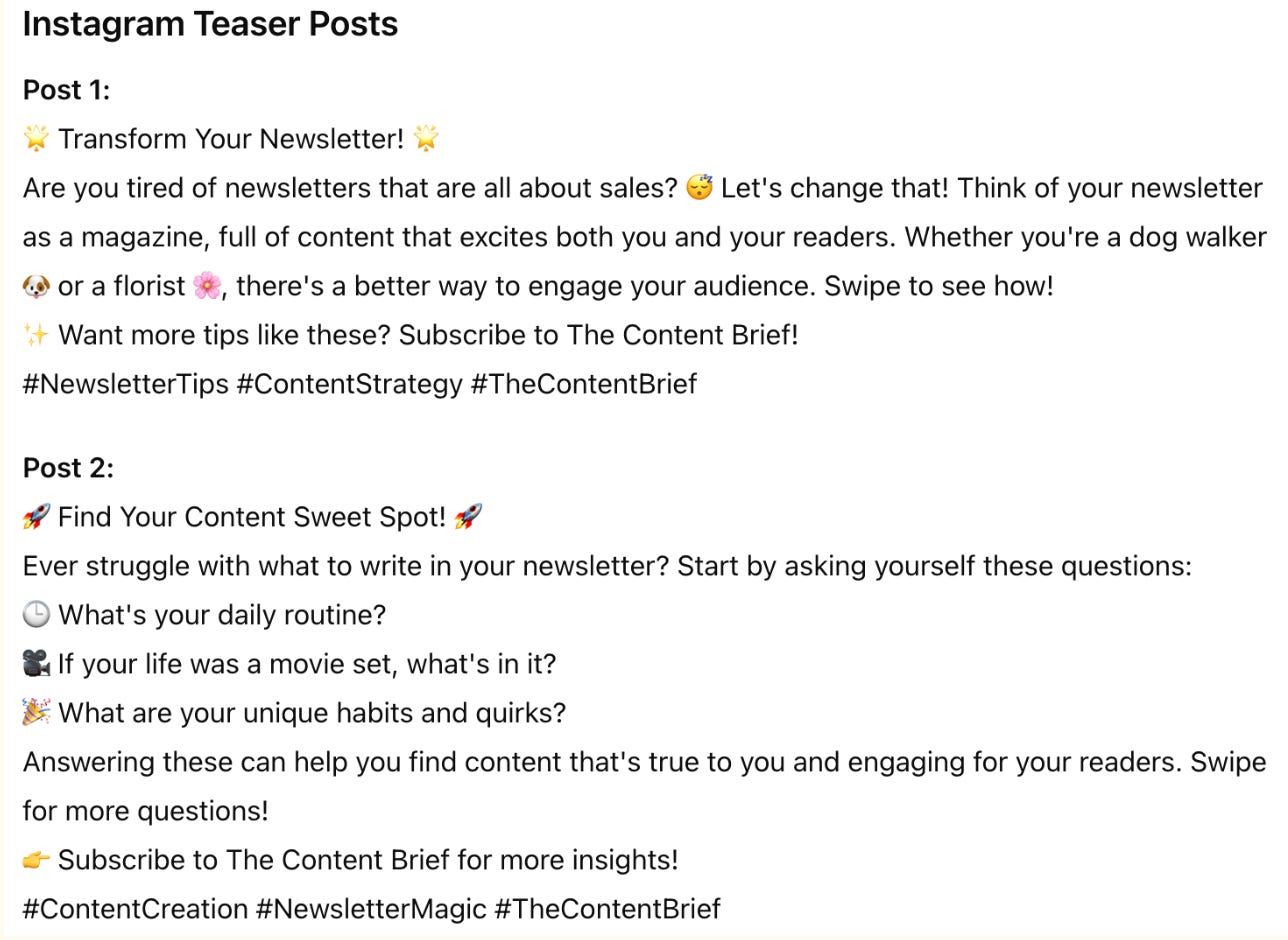
Not bad for a first pass. I always edit the intern’s work for quality and to sound more like me, but the beauty is you’re not starting from scratch.

Best coffee & coworking in your town?

I haven’t done any local coworking, but my favorite coffee shop to work in is The Boy & The Bear in Redondo Beach, California. It has an aesthetically pleasing dark, earthy, “let’s get to work” vibe and good coffee. Win-win.

Do you have a question for my next guest? 

What do you love about your work? 

Where can readers find you?

Please come visit over at 
The Content Brief!


Check out all the interviews in the Bold Types series.

Categories
Newsletter

Build your Google Business Card

I’ve been tinkering around with my Google Knowledge Panel this week. I have an old one from 2007 when I wrote my first book, which is outdated now and looks a bit sparse.

Google still dominates online search results, so I’m keen to grow and improve my KP – it’s your digital business card and the first thing people see when they look you up online.

If you don’t have a Knowledge Panel, you look like a nobody. So, it’s a really good way to push yourself up the career ladder as it were, to be recognised as a leader in your field.

Jason Barnard, the Brand SERP Guy. 

I clicked on the dots next to my name and suggested an edit. I added a a short bio, but they rejected it. That info comes from the Knowledge Graph, Google’s information collection about people, places, and things.

So, back to the drawing board. I have to educate Google!

Google is actually a child, thirsty for knowledge who wants to understand the world. It doesn’t care about notability; it just wants to understand everything.

I’m working through this free guide from Kalicube (Jason’s agency specialising in KP). I’ve updated my website bio (Home/About page) and social profiles (Crunchbase, Journolink, Response Source, Haro, Muck Rack, Substack, and LinkedIn).

He says your bio needs to be clear and consistent (who you are, what you do, who you help), and preferably written in the 3rd person. I’m not keen on that; it’s too formal for me, but I’ll try it for now. I can tweak it later.

Repurpose the same bio across all your social platforms and link back your website to “create an infinite loop of self-corroboration that Google understands”. 

I checked it this morning, and it’s now updated my name and added my social profiles, but there’s no pic of me or bio, so I still have some work to do.

It could take months so I need to be patient, but at least I’ve made a start.

Thanks to Jason and team for this resource!

I enjoyed his interview with Kristina God on how to create a KP as a writer (Kristina writes on Substack and Medium), plus they touch on other stuff – how Google is explicitly looking for writers, multimedia content, the importance of visual branding (often overlooked) and whether we should let AI crawl our content (we now have that option on Substack).

If the future of search is about how we educate these smart machines, then we need to understand the knowledge algos and how they function. This is a good place to start!

Also, check the information about you on ChatGPT, etc, to make sure it’s correct. Joe Pulizzi asked it what his favourite colour is, and it said ‘purple’ when we all know it’s orange! 🚩

If you make videos, check the auto-generated captions on YouTube, as they can be inaccurate.

Here’s Jason’s website (like an encyclopaedia!) and Knowledge Panel.

Let me know how you’re growing your Knowledge Panel.

Congrats to Kristina on becoming a Substack Bestseller and getting 100 paid subscribers! 🥳  


Good Reads

▶️It’s not just you. It’s harder now to make a living as a creator. An excellent essay on how the sea has shifted when building an online business. Those who are killing it are mainly marketers selling courses about marketing. I agree; it’s very meta (more Substacks about how to succeed on Substack). I’m in this space, too, and struggling with it. Some advice on how to look forward and innovate. [Alexis Grant

▶️Google’s Helpful Content update – reflecting on what happened. The September ’23 HCU caused thousands of sites to lose organic (SEO) traffic from Google in a few days (there seem to be NO recoveries from this), and the March core update rolls on. Here’s Lily Ray on patterns she’s seen in her work, research, and advice for smaller indie publishers. [Lily Ray

▶️Time to Act. What are publishers doing now? Some industry leaders in the blogging and publishing space have joined forces to create a collective non-profit association, the Web Publishers Association, to inspire change. Tony Hill shares his thoughts on it here [Amy Aitman]  

▶️Joe Pulizzi’s new book, The Content Entrepreneur, is out in the next few weeks. I love the cover of the proof copy – very Gatsby! Direct sales only via their websites, not Amazon etc, so a bold move. I’m interested to see how the experiment goes – not sure how it differs from Content Inc. [Joe Pulizzi

Categories
Newsletter

Building Backlinks

What are they – why you need them + how they’ll help your business.

Building Backlinks to Your Site

Google has over 200 factors that determine your site ranking and number one is backlinks.

What is a backlink?

If you dabble in the world of marketing or web design, it’s a phrase you’ll hear bandied around a lot when talking about SEO (Search Engine Optimisation). A backlink is a link from one website to another. Like a ‘vote’ for a page, it tells Google the content is valuable and useful. Backlinks are the basis of Google’s PageRank algorithm.

The more Backlinks you have, the higher you’ll rank on Google.

Link building is an art and science, creative and analytical. It involves detective work, psychology, tech tools, and relationship building. It’s good fun! And it helps you build relationships with other business owners, and establish yourself as a trusted expert in your niche, so that people come to you for content and quotes.

Quality over Quantity

Google considers the quality of the link to be more important than quantity. For example, Sky News linking to your site would be a higher quality link than your local free newspaper. However, algorithms also consider how relevant the links are. If your links are coming from unrelated sites or pages, they will be regarded as poor-quality links. So be strategic in your outreach and target sites in your niche.

Backlinks need to Grow Organically

This means you can’t go on a backlink mission paying people to link to your site! This goes against Google’s quality guidelines, and you could be penalised. Google likes to see the links occurring over time are relative and preferably come from trusted sites with high Domain Authority. (Domain Authority works on a scale of 0-100 with 40+ considered good, 60+ excellent.) The highest score is 100 – sites like Google, Facebook, and YouTube. The more authority a site has, the more it can pass on to your site via a backlink.

How do you check Domain Authority? Use Moz’ free Domain SEO Analysis Tool to see your DA, top pages, ranking, keywords and more. Ahrefs has a Domain Ranking score which looks at the quality of external backlinks to a site, a Website Authority Checker so you can see your backlink profile (free 7-day trial for $7 if you want to see all the backlinks).

Create a spreadsheet and get this information down!

The only way to increase your website authority is to get more high-quality links to your site. 👇

8 ways to get Backlinks in 2021

1. Roundup posts

Send an email to some thought leaders in your space. Tell them you’re writing a blog and would love to include their feedback on a specific question/issue and that you will reference them, their website, and social profiles. Once you’ve published the post, let them know and ask them to share it on their websites and social channels. This will generate more traffic for your site and increase reach, giving a higher probability that someone will link back to your siteMake sure you’re following them and interacting on social media first – so you’re not pitching cold!

2. Link roundups

A link roundup is a daily, weekly, or monthly blog post that curates and links to great content online. Go to Google and type in “[Your keyword]” + “roundup” and see what results come up. Once you’ve found a roundup that seems like a good fit for your brand/content, send them an email. Here’s an example of what to say:

Hi [Site owner name]

I just came across your [Roundup name] today. Great stuff. 

I’m reaching out because I recently published a [Content description] that might be a good fit for the site [Your URL or blog post link here]. 

Either way, thanks for your time, and it would be great if you’d consider me for future roundups!

Thank you 😊

[Your first name]

[Pro email signature that links to all your profiles] so they know it’s not spam.

Remember, you are writing to a human. Personalise every email you send and gently suggest they include your linkable asset in the roundup, and if it’s a good fit, they may also share it on social.

3. Broken link building

This is a good strategy as you’re adding value to someone’s site by correcting a broken link and offering a resource. Focus on resource pages in your niche and try and find some with recent 404 errors. So, if you work in the fitness industry, Google “Fitness” + “Resource page”, “Fitness” + “Resources” or “Fitness” + “links” and see what comes up.

Add the check my links Google Chrome extension to find broken links. Then contact the site owner and let them about the broken link and that you’ve written a post on this content – feel free to use it on your resource page.

4. Loot your competitors’ backlinks

Use Moz Pro or Ahrefs Site Explorer (free trial) to research your competitors and monitor your niche. Find out where their links are coming from and start pitching to the same outlets. (FYI, podcasts are a brilliant source of quality backlinks and free therapy). Also, look for sites that list your competitors but not you and ask them nicely for a link – send them a useful resource.

5. Write testimonials for products/services you use

This can help you to earn a link from an authoritative website. If you’re using a product or service you love, send them a testimonial. They may add a link to your website without you asking.

6. Link reclamation

Try Ahrefs Content Explorer tool, Buzzsumo, SEMrush or Mention.com (all offer free trials). Google Alerts or Advanced Search is free (search using “[Your keyword]” and other nifty search strings, but it will take longer, and it’s hard to export data.

You can do the same with unlinked images, e.g. infographics or products. Use Google’s reverse image search and upload an image you think may be used online. Contact the site owner and ask them to credit you and link back.

Get into the habit of doing this quarterly – it’s good to monitor online conversations about your company. No doubt you’ll find loads of results, so prioritise the most authoritative sites.

7. Create linkable assets

Content is king! The best way to create organic backlinks is to create great content people want to link to consistently. So, blogs, videos, whitepapers, infographics, how-to guides, software, quizzes, and surveys. To help generate ideas, check out sites like Answer the Public and Google’s ‘People also ask’ to find what people are searching for information on. Then create quality content that solves their problem.

You can also pitch guest posts to blogs in your niche. Search “[Keyword]” + “guest post” or “[Keyword]” + “Write for us”, and you will find a list of sites with opportunities to pitch.

You can also promote your infographics online by submitting them to sites to help you get more backlinks.

8. Become a trusted source for journalists, bloggers, and influencers

Sign up for HARO (Help a Reporter Out) – a site that connects journalists seeking expertise for their content with sources with that expertise. Sign up as a source and look out for requests alerts for your industry. Pitch helpful information and your credentials, and hopefully, they will use you again. HARO a US site but now has UK categories. Also, check out #JournoRequest on Twitter and ResponseSource for UK focused markets.

Business is about human connection. Develop authentic relationships with people in your industry and become a trusted go-to source of information and you will organically get more backlinks. It’s great to have a support network to bounce ideas around, help each other out, and collaborate on projects and campaigns.

Happy link building!

To recap, link building is the most crucial part of your marketing/SEO. Use these strategies to help you find link opportunities, grow your authority, and you will see a steady improvement in your Google PageRank over time.

Remember to keep notes to track your progress. 🤗

Which link building strategy will you try first? Please post a comment and let us know what’s working for you. No time for backlinks? Give us a call, and let’s chat! 

First published on Perspective Marketing & Design – more about our services here.

Categories
Newsletter

The Shift: Issue #21

#CopyCon2020—Top tips for being a successful copywriter; Death to perfectionism; Blogging for business; UX jobs—design systems are the new frontier.

“8 hours of copywriting gold” – 10 speakers, 8 training days, satellite sessions, poetry, illustration, networking, cats…🐱 ProCopywriters’ 7th annual conference and 100% online for the first time.

It’s my first one, so I had nothing to compare it to, but it was a fantastic event—inspiring talks (9 female speakers) and seamless tech. I’m still using the app (Attendify) to replay videos and download docs. If there’s one good thing to come out of all this madness, it’s being able to do global conferences that I wouldn’t have been able to afford. No travel costs and you can listen in while you work or on the go. I can’t sit at a desk all day, so I did a walking Zoom to break it up. See more.

Categories
Newsletter

5 Benefits of Blogging for Business

It doesn’t matter what kind of business you have – multinational, SME or creative solopreneur, you still need to be blogging regularly to help drive new (and returning) traffic to your website. These days, it’s crucial to have a strong web and social media presence to grow your brand – and having a blog is a smart, strategic way to do it. If you’re thinking about starting a blog and wondering what it will do for your company, read on.

Here’s how blogging can benefit your business.

1. Helps drive website traffic for free

Want more website visitors? Of course, you do! But if people don’t know the name of your business or product, how will they find you online? People don’t generally read blogs – they use keywords to research a product/service or solve a problem. If you’re providing unique and relevant content on your site, search engines will index it, so it’s easily found. Figure out what your customer is looking for, common problems, post useful articles and then share them on social media, so word gets around. Do this repeatedly, and your business will grow organically.

One of the advantages of blogging over paid advertising is that it’s free – you’re providing useful information for as long as your site is live. Tip: set yourself a publishing schedule and stick to it to show search engines that your website is active and needs frequently scanning for quality content.

2. Traffic becomes leads

Once you start publishing regular content on your blog, you’ll naturally attract new readers and return visitors. Always add a call to action to your posts to turn them into leads. Ask them to download a free e-book or white paper in return for their email address, so you can send follow up e-shots. Direct them to your products and services page or ask them to test a new product. You can set small targets and monitor analytics to see which of your posts are getting the most traction and engagement and then create more content around those themes. Tip: make sure people can subscribe to your blog, leave comments, and add share buttons so they can share content on their social channels.

3. Blogging brands you as an expert

Blogging positions you as an expert in your field, and someone others can come to for advice on a subject. If you share useful content that solves a problem or helps people improve their lives or business in some way, they will refer you to others as an authority and send more leads your way. It’s also an excellent platform for thought leadership – share your views on business (as well as your products) to engage your reader and grow your audience. Blogging can lead to new opportunities – more shares on social media, a speaking gig or even a column in a business publication. It also helps you to build authority and trust with customers. If your salespeople don’t know the answer to a question, they can refer a client to the blog as a helpful resource to help speed up the sales process. Tip: Share your opinions and take a position on things – don’t just sit on the fence – to help you stand out from the competition!

4. Scalable business blogging

One of the joys of blogging is that it’s scalable. It’s a good investment of your time as it keeps on working for you. If you write a blog and share it on social media, you’ll get a few click-throughs every time you share it. It will rank on search engines over the coming months and be a continual source of traffic and leads whenever someone searches for info on that topic. Unlike social media, a blog is on your website as long as you want it to be – a knowledge resource for visitors and your team. Tip: Create some evergreen posts about your products or services that aren’t time-sensitive and update them periodically to keep them fresh. HubSpot recommends that we focus on creating ‘compounding blog posts’ which solve problems, e.g. ‘how’ or ‘why’ in the title) as their traffic grows steadily over time.

5. Press & PR coverage

Having everything in one place on your blog (company news, personal stories, ideas & opinions) makes it easier for journalists to quickly find what they need to write about you and your business. Blogs should be open for comments to help you generate new business ideas and test out new products before you commit to spending money on them. Clients and journalists want to read about the people behind a brand, and a blog is an ideal platform for this as the tone is conversational and intimate. Take your reader on a journey and involve them in your business story and they will become loyal clients and share your content for you.

Are you interested in creating a blog for your business? We produce daily content for clients large and small to help them build brand awareness and drive sales. 

This article was originally published on Perspective Marketing & Design here.