
Skip to the content
firebird logo - Nika Talbot content studioNika Talbot
Writer and Creator
  • Home
  • About
  • the Shift
  • Services
    • Events
    • Blog
    • Books
    • Portfolio
  • Contact
    • LinkedIn
  • Home
  • About
  • the Shift
  • Services
    • Events
    • Blog
    • Books
    • Portfolio
  • Contact
    • LinkedIn

Category: Interviews

Categories
Interviews

Bold Types Q&A #10: Christin Thieme 🇺🇸

  • Post author By Nika Talbot
  • Post date June 27, 2024
  • No Comments on Bold Types Q&A #10: Christin Thieme 🇺🇸
Since 1999, I’ve been writing online and interviewing creative folks I admire about courage and craft. I love learning from others’ journeys & experiences and want to help more ambitious solo entrepreneurs—especially women—impact the world with their personal stories. And make a shit ton of money!
Inspired by the book ‘Bold Types: how Australia’s first women journalists blazed a trail’ in the fight for gender equality, I’ve launched the Bold Types Q&A series.
Here’s the 10th interview, featuring Christin Thieme, creator of The Content Brief and host of The Content Spark Summit – Nika ✨

Christin is editor-in-chief of The Salvation Army in the western US, where she tells stories about people making an impact for good and prompts others to action. She holds a master’s degree in specialized journalism from the University of Southern California, has taught journalism, and helps creatives simplify their content strategies on Substack.
Welcome, Christin! ✨

What problem is ‘The Content Brief’ solving?

I help creatives simplify their content. Anything we create and share is an invitation to connect, and I want people to have a plan and a workflow that is exciting to show up for.

I hold a master’s in specialized journalism, have worked for nearly two decades leading a content marketing team for an international nonprofit, and taught journalism and communications as an adjunct professor. Content is what I eat, sleep and breathe if you will. 

After helping friends strategize how they could better connect with the right people online around their makeup artistry, barbershop and even psychology practice, I saw how overwhelming this world of content is to people who aren’t necessarily in it daily. I enjoy helping people break it down into something more tangible, sustainable, and real-life approved, so I’ve taken up doing so here on Substack.

If you’re feeling overwhelmed, frazzled, and frustrated with how you show up online… If you want to better connect (and convert) people to your ideas and your work… 

The Content Brief is for you. I’ll help you take control of your content so you can stay in your zone of genius.

What’s always on your desk?

At my full-time gig, coffee, water, a Blackwing and my Airpods. At home, I’m often typing straight into my Notes app between baseball practice or bath time.

With three boys under six, I love and live by the Julia Cameron quote:

The ‘if I had time’ lie is a convenient way to ignore the fact that novels require being written and that writing happens a sentence at a time. Sentences can happen in a moment. Enough stolen moments, enough stolen sentences, and a novel is born—without the luxury of time.

I also printed out a screenshot of my first-ever paid subscription and put it in a little frame to remind myself I might be onto something, to keep going, and to keep finding ways to be helpful as I build this community.

What are you struggling with right now?

Time! I have so many ideas, but we all only have so much time, so I’m constantly reminding myself to focus on what moves the needle. This week, I am largely wrestling with delivering a virtual summit I’m hosting: The Content Spark Summit.

This free full-day event on Substack June 27 is meant to help you spark meaningful connection with your content. From understanding the importance of engagement to creating a content strategy you can’t wait to show up for to fostering genuine connection and leveraging your unique expertise and experience, 14 expert speakers will share what they know.

And I’m working on getting the word out…so please come! Grab your free ticket here.

Best business advice received this year?

Just this other day, I saw this quote from Seneca: “You must match time’s swiftness with your speed in using it, and you must drink quickly as though from a rapid stream that will not always flow.”

He may have been a Roman philosopher, but the advice holds today:

Keep a bias toward action. It’s easy to hide behind planning, plotting, and perfecting (I know!), but the impact you want to make can never take hold until you actually take action.  

Tell me about your newsletter strategy, its value to your business, and how you measure success.

Right now, I’m in an awareness-building phase, focusing on free subscribers, which is part of the strategy behind the summit.

There are three ways to engage with me at The Content Brief:

  1. As a free subscriber, you get each of my posts to help you create a newsletter you love *without* the overwhelm. Things like: What to do with your story, questions to find your content sweet spot, and a template to write your personal bio. Plus, my monthly content report of things I’ve digitally dog-eared and Creator Briefing Q&As with other creatives, like this recent one with Lucy Werner.
  2. As a paid member, you get access to my quarterly content planning party, where I’ll help you plot out your next three months of content. The next one happens in August and will help you create a plan to show up consistently, with intention.
  3. And as a paid member of The Briefing Room (the founding member tier), which I’m just about to launch, you get exactly what you need to design or redesign your newsletter content strategy with ease, including my exact simple content system, an all-in-one dashboard workspace, and a monthly brief on one specific thing to reset to keep your strategy fresh. It’s all designed to save you a lot of time and frustration so you can have a bigger impact with your newsletter.  

If you Join The Briefing Room before September, you get a bonus 1:1 Content Strategy Session with me!

I’m also building in ways to collaborate and share with other creatives. I hope The Content Brief becomes a vibrant community that supports each other in what can sometimes be a lonely endeavor.  

What important truth do very few people agree with you on? Or your ‘spiky point of view,’ Wes Kao calls it. 

Providing value doesn’t mean having all the answers. 

Creative work that inspires an audience and builds a community (and business) doesn’t require anything stunt-like, viral or wildly innovative.

We don’t have to show up as “experts,” with all the answers ready to guide others to the big transformation. Trying to do so often leads to becoming another faceless creator of tips & tricks and *value* in some Wikipedia-esque, robot-generated “I have it all figured out” status quo.

And the problem is…that says nothing of the journey.

You could have the most well-researched writing in the world, but if it feels like nothing more than a robot production, it won’t get read.

Conversely, you could write about your life as a dog walker, and if you’re asking questions that take us on a journey and leading a conversation from your perspective, every word will get read.

To provide value, you need curiosity, questions, and a yearning to explore. It means being willing to lead the conversation and invite us on the journey of an idea in real time through your content. People don’t want to see processes, deliverables, skills. We want to see perspective, relationship, transformation—and that means your point of view, personality and perspective.

Last week, I wrote about why I hate the word ‘content’. It’s become a catchall term for everything we make—words, video, audio—invading everyday talk and devaluing the creative process. What’s your take on it?

This is SUCH an interesting question and a sentiment I’ve seen pop up recently. I’ve never thought of it negatively. I think of it like the word “box”—a catchall term that encompasses so many different specific things but one word that gives you the gist. 

I’m sure some of the negative vibes toward the word come from the push for “top ranking” and “click-worthy” content that doesn’t deliver, but for me, it’s just a succinct way to describe the many ways we invite people to connect with us. 

That’s what content is, in my view, whether it’s a newsletter, podcast, social post, and so on.

When you create and share something, you invite others to connect with you about your ideas and work. Of course, if you are specifically a podcaster or a novelist, say that. Lean into concrete specifics over summary words whenever you can.

How have you shifted from ‘creating content’ to ‘building community’ on Substack?

With a relatively new newsletter on Substack, I came in knowing I wanted to build a community. I love to plan parties. I love to build everything around a specific purpose. To carefully word the invite. To think through the menu. To find the right party favor. To design the table. To welcome everyone in. To surprise and delight. To make them feel loved.

I feel the same about crafting my own little club right here on Substack. Building a newsletter and community is the ultimate gathering. And I’m here to party. 🎉

Can you recommend some resources for entrepreneurs?

The Elements of Style by Strunk & White—I love this illustrated version of the classic go-to guide for writers on how to “make every word tell.” (It’s also one of my favorite gifts for the creative types!) 

Building a Storybrand by Donald Miller—The best how-to I’ve seen on using words to talk about your product or service. It’ll help you define a clear message on how you can help potential customers. Worth re-reading annually. (Here’s my full list of favorite books to improve your writing for more.)

And I’ve truly been loving 

Lucy Werner‘s community, 

Hype Yourself, for learning how to generate your own buzz.

Are you using AI tools? If so, how are they helping you work better/save time?

Yes! I call Chat GPT my intern. I love using it to prompt my thinking, research subjects, synthesize interviews, and spot holes in them. It also helps repurpose my hero content into supporting pieces.

My goal is to create one Substack post a week and then repurpose it into snippets and teasers for my supporting platforms. To help save time prepping those shorter pieces, here’s a basic starter prompt I use:

I am a [what do you do], and I need to create a social media post based off a newsletter I previously wrote. The audience is composed of [your audience.]

Use this text to write 3-5 short-form teaser pieces of content for [platform] that highlight the main points, benefits or offers of this newsletter. Ensure the tone is [your tone].

Include a CTA at the end to subscribe to my newsletter, [your newsletter name].

Here’s the newsletter: [paste copy]

Using that prompt on this recent post of mine, here’s the first two of the five posts it generated:
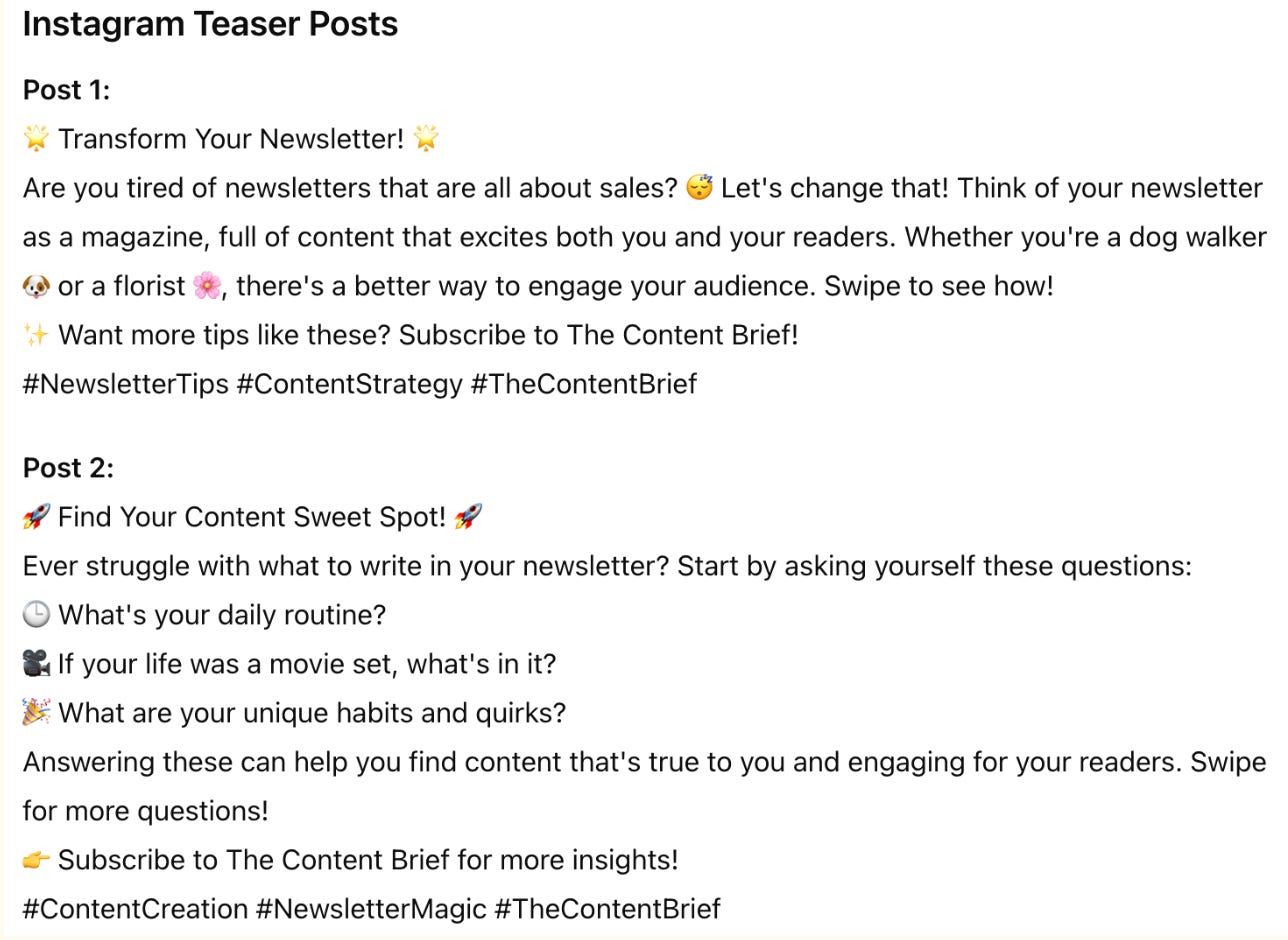
Not bad for a first pass. I always edit the intern’s work for quality and to sound more like me, but the beauty is you’re not starting from scratch.

Best coffee & coworking in your town?

I haven’t done any local coworking, but my favorite coffee shop to work in is The Boy & The Bear in Redondo Beach, California. It has an aesthetically pleasing dark, earthy, “let’s get to work” vibe and good coffee. Win-win.

Do you have a question for my next guest? 

What do you love about your work? 

Where can readers find you?

Please come visit over at 

The Content Brief!

Join the content spark summit

Check out all the interviews in the Bold Types series.

  • Tags AI, Blog, blogging, Christin Thieme, content marketing, content strategy, entrepreneurship, Interviews, journalism, Newsletter, newsletters, productivity, substack, The Content Brief, The Content Spark Summit, writing

Categories
Interviews Newsletter

The messy middle

  • Post author By Nika Talbot
  • Post date May 27, 2024
  • No Comments on The messy middle

Keir Whitaker is a business consultant and coach who supports agencies and app companies in the Shopify ecosystem. Before starting his consultancy in 2019, he spent seven years at Shopify. “It was an amazing run, but I knew it was time for a change and wanted to start my own business focused on helping founders and companies I’d met during that time.”

His initial offers focused on marketing, copywriting, and events. Over time, he also started working with solo agency founders who were looking for someone to support them in their own development as well as their business. “Thanks to my being around the block a few times myself, I apparently had a lot to offer!” 

He hosts an intimate event series called Craft+Work, which brings together self-employed folks to share their experiences and learn from each other.

It’s all about conversations, openness, and helping each other through the ups and downs of doing our own thing.

Coming to London on May 31 (bought my ticket!) and NYC and Toronto later this year.

I was going to suggest postponing our chat as I thought he’d be too busy, but he got back to me, “in the spirit of done is better than perfect.” There have been a few unexpected hiccups, but he seems very chilled about it. As our mutual business coach Ellen Donnelly would say, “Stay Calm and Authority On.” 

I like how he’s found a way to combine consulting, coaching, and events to keep things interesting. Read on for his best advice and tips for dealing with the messy middle (years!) when you feel like you’re constantly experimenting and questioning everything (more on that in the video chat).

Thanks Keir, and apologies for calling Shopify Spotify – all these tech companies sound the same 😉

Nika ✨

What are you struggling with right now?

Upping my own marketing game. Last year, I started questioning my business, what I was doing, who I was doing it for and even if I should change tack entirely. It’s hard to market with confidence if you’re not sure what you’re offering is right. As a result, I kind of hibernated, and things slowed down. 

Thankfully, something clicked earlier in the year, and I’m now in a rebuilding phase and feeling more confident about moving forward. The struggle now is to put the plan into action and build consistency, which has been the hardest part. 

What are you most excited about? 

Growing my event series Craft+Work and working on attracting a few more 1-1 coaching and advisory clients, as well as serving my existing ones. 

After questioning every aspect of my business last year, I have found a renewed interest in my work and feel more positive than in a long while – which is exciting. 

How did the coaching thing happen? Did you train as a coach?

It was a small agency owner based in NYC. We’d met previously, and when he knew I was leaving, he wondered if there was a way to work together. I came up with an amazing proposal (says I) and added a throwaway line: “And we can meet each week for an hour to chart progress.” He came back to me and said, “Can we just do that?” That’s how it began. I started attracting more clients over time.

I’ve had coaching myself over the years and found it very beneficial. I’ve always enjoyed working 1-1, so I’ve gained much experience supporting people’s development. Last year, I did a five-day course focused on Executive Coaching, which was great. 

I meant to follow up with an essay to get the formal credit, but my mother-in-law got diagnosed with cancer, so my motivation was at a low, and the writing bit didn’t seem worth it at the time. Maybe I’ll finish it one day, but I’m okay with not getting the certificate. 

I also read a lot about coaching and am part of a mastermind of other coaches where we share experiences, tools and techniques. 

How do you stay on top of industry trends? 

With difficulty. I’ve always been interested in all aspects of business. As a result, I often find myself going down rabbit holes of learning, which distracts me from focusing on developing core skills or staying up on trends directly related to the services I offer. That said, being a “generalist” has paid dividends over the years, so it’s not all bad. 

When not in a rabbit hole, I enjoy reading the wide variety of marketing, coaching, e-commerce, and culture-related newsletters I subscribe to.

I also have a group of colleagues and friends who act as my unofficial advisory board. They are great for intel, advice, and updates on what’s happening in our industry.

How are you getting yourself out there and selling your services?

I try to attend as many relevant events as I can. Over the years, I’ve been fortunate to meet many interesting people who have become friends and clients at conferences and workshops. 

I also host my own events, which means I have a good excuse to reach out to people I don’t yet know and ask them if they’d like to participate or attend. Even if both answers are no, it often leads to a good conversation and has led to work.

Outside of events, I try to engage on LinkedIn. It’s something I want to improve at, as it often feels like an afterthought and is not part of my daily schedule. 

How do you define success? Balance ambition and contentment?

I consider myself pretty driven but less by money and more about working to create a life where I can take time out to travel, spend time with family and friends, and stay relatively stress-free. It’s not always easy to achieve, but that’s my goal. Overall, I’m pretty content, but my family might disagree! 

What’s the best piece of advice you’ve been given?

It’s tough to narrow it down, but if you’ll permit me three they would be: 

  1. Early in my career, a mentor said, “Focus on getting really good at what you do, and the money will come.” 
  2. Business is all about relationships, so take time to invest in building and maintaining them.
  3. The ability to listen well is a competitive advantage.

How do you take care of your health and prevent burnout?

I’d love to tell you I have a well-thought-out regime, but I don’t. I used to travel so much that finding time to exercise proved difficult, but a few years ago, I started playing tennis with a friend. We’ve been very consistent (lockdowns and injuries aside) in getting on the court since. It helps my mental health and blows out the cobwebs from sitting in front of a screen all day.

I enjoy a good walk, eat well, and try to stick to one coffee daily. If getting older has taught me anything, some form of regular exercise and general moderation in most things pays dividends – possibly dull, but true. 

Where do you live, and what do you love about it? 

I live in Bath, in the West Country. After years of living in London, it was quite a change, but I can’t imagine being anywhere else now (at least while my children are still at school). 

Once you get over the fact that every building is the same colour, you appreciate the city and all it offers. There are great pubs and restaurants, beautiful parks, and it’s only a short drive to the coast. Plus, it’s only 1 hr 20 to London by train, and Bristol Airport is a gateway to Europe. 

Can you recommend any resources for entrepreneurs? 

The Acquired Podcast. I’m going to recommend a podcast where episodes frequently top three hours but hear me out. Oh, and don’t be fooled by the title – it’s not a startup bro fest focused on flipping tech companies. 

Instead, each episode covers the back story of great companies, discusses what makes them successful, and explains how we can apply those lessons in our businesses. Yes, there are tech companies in there, but as a child of the 80s, it’s fascinating to learn about Atari, Sega, and Apple. The episodes on Costco, Walmart, and Hermes are equally fascinating. 

What help or support have you had that’s helped you get where you are today? 

(from Nicola Washington @ Too Much Social).

I couldn’t do what I do without spending the last 12 years in the Shopify/e-commerce ecosystem. I couldn’t have done that without the support of my wife, who was often left literally holding the babies when I had to travel. Don’t worry – I did my share upon returning 🙂 

I’ve also been fortunate to work with several amazing people who believed in me and gave me opportunities that changed the direction of my career. Many became friends and mentors and still guide me today. 

Finally, I’d say the belief that there’s always more to learn and people to learn from keeps me going. 

Where can readers find you? 

Everything is on or available via keirwhitaker.com

Listen to this article now 👇

The Shift is a reader-supported venture. To receive new posts and give me a thrill! consider becoming a free or paid member. Subscribe now

  • Tags Business, coaching, entrepreneurship, Events, Marketing, self-employmen, self-employment, small business

Categories
Interviews Newsletter

Bold Types…Adriana Tica 🇷🇴

  • Post author By Nika Talbot
  • Post date March 11, 2024
  • No Comments on Bold Types…Adriana Tica 🇷🇴

I’m not big on International Women’s Day (it’s every day, as far as I’m concerned) and it’s hard to get enthusiastic when nothing much changes, but we do need to keep banging on about inequality and helping each other.

So a shoutout to all the strong, kind, and supportive women in my network who lift me up and keep me going. THANK YOU. It is much appreciated.

The other day, I was asked to promote a panel in parliament that was all blokes. “Where are the women?” I asked my colleague.

“Doing all the background work for less pay as usual, probably.”

But he did flag it and asked if we should suggest a more balanced panel. The usual female speaker was ill, so it was last minute, but there are other women who could’ve stepped in. 

I posted on LinkedIn here about #IWD2024 campaigns worth supporting:

  • United Nations: Invest in Women: Accelerate Progress – show us the money! #InvestinWomen #FundFemaleFounders
  • The NUJ’s #ShowUstheMoney pay transparency campaign

And it’s Mother’s Day. First priority today: calling my lovely mum.

I did appreciate the flowers and dark chocolate waiting for me when I got back from the conference 💐 🍫

We’re off to Bella Vista for a mother-and-daughter day dinner.

Nika


Bold Types…Adriana Tica

Wine is my drink of choice. I even thought about becoming a sommelier at some point. I write about some of the gems I discover on Instagram

I really enjoyed chatting with Adriana Tica, a strategist, writer, trend forecaster, and entrepreneur known for her no-BS, zero-hacks marketing strategy. We met on LinkedIn.

She’s built not one but two businesses on her own, with absolutely minimal investment, zero paid ads, and zero PR effort. “My rise to (moderate) internet fame was “more organic” than Whole Foods.”

“Getting hooked on independence doesn’t take much.” I agree!

And now introducing biz no #3: Ideas to Power Your Future, her brilliant weekly newsletter, which she says is the best lead generation tactic she’s ever built.

Semrush named her one of the world’s top 100 Content Marketing Influencers, and Buffer said she knows a thing or two about social media.

She’s a digital nomad who loves working remotely, especially from a Mediterranean island. She also speaks six foreign languages.

I like that she’s not your typical ultra-niched strategy consultant. There’s so much pressure to narrow down and be known for one thing, but broad expertise across industries is a superpower. It gives you an edge.

One of the things the Executive loved about the conference was the “non-industry attendees.” And in the feedback survey, the members always ask for more “speakers outside of the industry.”

Worth bearing in mind when you’re pitching yourself as a speaker. Be bold, and as Cindy says, never give it away for free 😉

Super inspiring. Enjoy! (scroll down for the video 🎦)

Hi Adriana, firstly, I’d love to know where you grew up and your first job. 

I grew up in Craiova, Romania, and then moved to Bucharest for college, where I stayed. These days, I’m a digital nomad who enjoys working remotely, especially from a Mediterranean island.

My first job was waitressing when I was 16. It lasted for exactly six days; it turns out I’m not cut out for smiling at jerks 😊. In college, my first job was in ad sales—also not a good fit for the same reason: the utter lack of a poker face.

What do you do and why?

I started my business out of sheer need. It was supposed to be short-lived, with a few freelancing gigs between jobs. But those freelancing gigs took off, and before I knew it, I was making more freelancing for a couple of hours a day than my full-time job paid.

So, I stopped going to interviews and turned my freelancing gigs into a digital marketing agency in 2015. My goal has always been to create great content for our clients, not the SEO fodder you see everywhere, and I’m proud to say I have succeeded.

At the end of 2022, I launched Ideas to Power Your Future, a weekly newsletter about no-BS marketing strategy. As this newsletter and its community keep growing, I’m happy to see how many people are over hacks and quick wins and focus on building a solid foundation for their business instead. 

This is what I set out to teach my subscribers, and despite all the bro marketing out there, it resonates with my community.

What are you most excited about at work right now? 

Growing my newsletter and my consulting business. I love seeing the spark in my clients’ and subscribers’ eyes when something clicks. When they realise they don’t have to hack social media algorithms to grow their audience or sell their soul to sleazy marketing tactics.

I know everyone hates marketers – and they have good reasons to. I’m here to show there’s a better way to market your business, one that lets you sleep easily and doesn’t annoy your audience.

How do you stay on top of industry trends?

I read a lot, perhaps too much. I focus on mainstream media (The Economist, HubSpot, Forbes, and so on) and obscure blogs, newsletters, or social media accounts that border on fringe. It’s very easy to dismiss them, but they are usually trendsetters.

Piecing the information together is my favourite thing to do, along with finding correlations between seemingly unrelated industries or trends, i.e. how does the state of the economy affect the creator economy? Or is there a connection between the housing market and the travel industry? Fun questions to answer!

Tell us about your marketing process. How are you finding clients, and building your network?  

Most of my clients and subscribers come from LinkedIn and Twitter, the platforms I’m most active on. My newsletter is the trust bridge that establishes me as a credible strategist and the best lead-generation tactic I’ve ever built.

Social media is also where I find partners, friends, and networks like Lettergrowth (for newsletter cross-promos) and the Convert Kit Creator Network.

Samaria Gorge in Crete, Greece – her favourite place

How do you define success? And balance ambition and contentment?

Success is the most subjective word. For me, success means not dreading my work and being excited about the future. Every job and every business has ups and downs. But as long as there are more ups than downs, I count it as a success.

I never set out to rule the world, so I’m content with carving a small corner of the internet for myself and a business that feeds me and allows me to travel without claiming my soul in return.

How do you manage your health and prevent burnout? 

I’m afraid I don’t do enough here. I love what I do and tend to become hyper-focused on my work. Since I’ve already dealt with severe burnout once and definitely don’t want to go back there, I force myself to take breaks, exercise, and disconnect at least one day a week—even when I’d rather be working.

Can you recommend one book and one podcast for digital entrepreneurs?

Before you get to the trendy books, I recommend reading Philip Kotler’s Principles of Marketing. The book may be slightly dated, but it has everything you need to understand the foundations of marketing. Mastering a new trendy channel or tactic will be a breeze if you read this.

My favourite podcast is Everyone Hates Marketers by Louis Grenier. His conversations with his guests are refreshingly candid, with zero boasting and posturing.

What’s the best piece of advice you’ve been given? 

Paul Graham’s “Do the things that don’t scale first” is my guiding light. This is what you need to do in the beginning – talk to your customers and your partners, gather feedback and ideas, and mine the web for information.

And you have to do all this yourself, not by automating DMs through AI. It’s a crucial step most digital entrepreneurs miss in their chase for quick hacks.

Are you happy, and what would you change? 

Oh, that’s a loaded question! Yes, I’m happy and content overall, but there’s always room for improvement. If I were to change one thing, it would be my working hours; I need a better balance here. I’m working on it!

Who should I interview next and why? 

Hannah Szabo and Michael Scott Overholt are the smartest, most fascinating people I’ve met on LinkedIn, and I’m proud to call them friends. I think you’ll like how their businesses are built on solid principles and ethics. (I surely will! Send me your questions for Hannah and Michael).

How can readers get in touch with you?

The best way to get in touch with me is to subscribe to my newsletter, Ideas to Power Your Future. This is where I publish my best work and answer every email from my subscribers. You can also find me on LinkedIn and Twitter.

Resources

  • Special issue: One-year anniversary – How I grew and monetised this newsletter in the past year (what fuels the growth of her newsletter – ranked from best to worst). Read it here. 
  • Spending too much time creating content? Read this! (why repurposing and reusing are your best friends). Read it here.
  • Is the subscription economy in trouble? (tips on how to price a paid newsletter or paid community and future-proof yourself as a newsletter writer). Read it here. 

How am I doing?

I love hearing from you, and I’m always looking for feedback. Is there anything you’d like to see more of or less of? Which bits of the newsletter do you enjoy the most?

Hit reply and say hello – or email me: nika@nikatalbot.io.

Join the Newsletter Talent Network! Directory for collabs – online and local: Go here.

Upgrade to paid
  • Tags Adriana Tica, Business, content marketing, creator economy, digital marketing, entrepreneurship, Interviews, Marketing, newsletters, writing

Categories
Interviews Newsletter

Twitter and Threads 🧵

  • Post author By niccitalbot
  • Post date July 11, 2023
  • No Comments on Twitter and Threads 🧵

ALSO: An interview on marketing without social media | #121

Have you left Twitter for Threads yet? 😉 I played for a couple of hours on launch day.

Instagram has over 2bn monthly active users, which explains why Threads has exceeded 70m sign-ups in less than 48 hours.

Very smart move letting you port your existing audience over (stop, think. Do you actually want to!?). The worst thing about joining a new social network is starting from scratch with zero followers. 

Initial thoughts – it’s fast, clean, light, good UI. I like the simplicity – no fancy features yet, fun for now. Good vibes – it feels like Twitter c2008. It is the first-week flurry and novelty factor, but people seem to be enjoying it.  

I’m not loving the data grab. 

Threads collect the same data as Instagram, Facebook and WhatsApp. From Znet: “Threads collects users’ physical addresses, health and fitness data, and sensitive info like biometric and ethnic data. Twitter does not collect these types of data.” 

It’s unavailable in the EU for now – privacy nightmare, but people are finding ways around it – a tip here from Jens Joseph Mannanal, co-founder of Passionfroot.

Future versions will integrate with ActivityPub, a decentralised social networking protocol, so you could potentially take your content elsewhere. The friendly fediverse as it’s called – interoperability is where the industry is heading. 

Early days, but I think it’s worth your time, especially if you used to enjoy Instagram.

All this talk about strategies to win on Threads already. Ugh. Chill, keep it light, and reconnect with long-lost friends! Mine will be tiny threads as I hate typing on my phone. There’s no desktop version yet. 

LinkedIn is still my main social platform, and I’m trying something new over there – themed weeks focusing on specific topics. So, this week it’s ‘newsletters’, and how to market yourself off-socials. Timely!

Meta has chosen a name that the Germans can’t pronounce very easily, which seems bizarre in their quest for world domination.

Expect to see even more puns on the platform. Stitch is a serious contender.

At least it’s not Threadz… 🙀

Listen to a special episode of the Hard Fork podcast with the head of Instagram, Adam Mosseri, on why the company now wants to take on Twitter.


Interview: Johanna Renoth, founder of Bye, Social Media!

“Say Bye to Elon and Mark!”

Johanna Renoth is the founder of Bye, Social Media!, an agency for marketing without social media. She helps small businesses, creators, and solopreneurs thrive away from the algorithms.

In this interview, she shares her insights into moving her marketing off all social media, how her PhD on social media inspired her to make the move, and what she’s learnt in the past year of pursuing this avenue. 

Food for thought here – enjoying your marketing is important.

I have mixed feelings about this. I agree with a lot of what Johanna says, but social media is a gift and we’re lucky to have it.

I don’t take it for granted – it is a great time to be a creator. We can share ideas and connect with others for free.

If I stop enjoying it, I’ll stop doing it.

READ JOHANNA’S STORY

Things to Read, Listen, Watch  

The Write to Roam | Ethan Brooks. An inside look at how 6 & 7-figure writers make money, and on their own terms (via the Copyblogger podcast). 

Chenell Basilio | Build In Public podcast on what newsletter creators are doing differently to grow to 50K subscribers. “Find the thing that feels like torture to others and a gift to you. And do that thing!”

Josh Spector studied the home pages of 10 smart creative entrepreneurs. They have a LOT in common. Here are six approaches you can borrow from them for your own site (via For The Interested).

– Just keep going 🙂

Nika


Classifieds 

Trible offers a no-code platform that lets experts, coaches, and content creators easily build their own branded websites and mobile apps to deliver & monetise courses, content, community memberships, and coaching services. Get started here. 

Get smarter with expat money. Our friends are publishing Money Abroad, an excellent resource for expats to learn about building wealth while living abroad.

Money Abroad shares fresh tips about money & wealth that you can learn in under 10 minutes. Plus, it’s free. Sign up here!

📣 Want to see your ad here? Go here

✍️ Want to write a guest post? Submit here

☕️ Tip Jar | LinkedIn

  • Tags content marketing, digital marketing, entrepreneurship, newsletters, Social media, Threads, Twitter, writing

Categories
Interviews Newsletter

Bold Types: Johanna Renoth, founder of Bye, Social Media! 

  • Post author By niccitalbot
  • Post date July 8, 2023
  • 1 Comment on Bold Types: Johanna Renoth, founder of Bye, Social Media! 
“Say Bye to Elon and Mark!”


Johanna Renoth is the founder of Bye, Social Media!, an agency for marketing without social media. She helps small businesses and solopreneurs thrive away from the algorithms.

In this interview, she shares her insights into moving her marketing off all social media, how her PhD on social media inspired her to make the move, and what she’s learnt in the past year of pursuing this avenue. 

Much food for thought here – enjoying what you do with your marketing and being self-sufficient is so important. 

I have mixed feelings about this. I agree with a lot of what Johanna says, but social media is a gift and we’re very lucky to have it. It is the best time in history to be a writer and creator.

So it’s about being intentional with it, using your time well and using platforms that you enjoy and get value from.

Tell us about yourself and why you started Bye, Social Media! 

I’ve always been an ideas person. I live in the realm of “Wouldn’t it be cool if…” Curiosity and enthusiasm led me to many career paths, including journalism, startups, VC, art, and photography.

Ultimately, I’m a creative at heart. The best occupation for me is at the intersection of business and creativity. 

The story of Bye, Social Media! starts with my frustration about social media. I hated promoting myself on socials and found no success in it. My curiosity led me down a path of trial and error in figuring out off-socials marketing for myself. 

When I realised others were also struggling with their disdain for socials, starting Bye, Social Media! was an organic next step. It’s been very fun so far. 

Who are you serving? Target audience and niche?

I currently serve solopreneurs, creatives, creators, and small businesses. I offer consulting on marketing and create off-socials marketing strategies. I also offer to write my clients’ newsletters and grow their audience. 

This niche is interesting because it’s not defined by an age bracket or industry. The common denominator is business owners’ frustration with social media marketing. They come to me because they want to get off the hamster wheel of creating content for socials and feel more free as entrepreneurs. 

For many, socials feel disingenuous, as if they had to fake a persona to make it on there. I recently received a message from an exasperated designer who said they only wanted to do their work, not pose as a content creator. I empathise with that very much. It’s challenging for social business owners or CEOs of small companies when much marketing hinges on them. 

Marketing always takes time and effort. It shouldn’t consume vast amounts of energy or emotion because you are on a platform that doesn’t work for you. 

You’ve done a PhD in Social Media – did this inspire you to move off socials? What have you learnt?

Yes, it 100% inspired me to move off socials. I never enjoyed using social media for work. I signed up because people at various stages of my career recommended I use socials. I got Twitter as a journalist, Instagram for photography, and LinkedIn as a founder. 

The PhD highlighted that not only did I not enjoy social media for work, but it was also at odds with my values. I didn’t want to build my business using the services of companies whose business models I found unacceptable. I don’t think you can find success that way. And if you did, it would always raise the question of the price tag of your values. 

Did you sell them for 1K followers? 10K? 500K in revenue? It’s a question I didn’t want to have to ask myself. 

Fundamentally, technology should serve humanity and not the other way around. This is especially relevant now, as we’re entering the age of AI.

With social media, that is not the case. Its purported benefits (connection, economic opportunity, self-expression) come at the expense of mental health, the robustness of democratic systems, widespread data collection & analysis, and manipulation through algorithmic feeds and nudges that undermine the autonomy of our minds. 

We’ve been using social media for almost two decades now. Its long-term effects are tangibly becoming visible. We’re atomised, disconnected, and distracted. How we’ve been using social media has incentivised people to turn themselves into or present as these singular, branded nodes. Yet, the fabric of humanity is interwoven and complex. 

How we perceive ourselves and our role in the world has changed since the advent of social media. This is especially noticeable in the conversation around personal branding. There’s a social expectation to build a personal brand on social media. The discourse surrounding it positions it as the best track to clout, fame, and success.

Yet, what happens when you distil the many faces of personhood into branding? 

Being human is complex and messy. Meeting other people requires nuance, understanding, and grace. Social media and branding culture flatten that. We’re incentivised to show bland versions of ourselves in a professional setting – and overshare even the most minute details of our lives in a personal context.

The algorithm magnifies both effects when it rewards certain sharing and posting behaviours with views and engagement – all in a battle for attention on the internet. 

I explore what happens when people as brands come together for communication in the public sphere, among other things. Doing so chips away at the open, messy, and sometimes challenging nature of public discourse that is so important for democracies. Personal brands don’t find compromise. They don’t need to. People do. Consider that representation is a central tenet of democratic systems. 

What happens when social media shifts the cultural paradigm to presentation, for example, an idealised version of the self on social media? 

Meta has almost 4bn monthly users. It’s important that we reflect on whether we feel comfortable with a company controlling communication and information streams for half of humanity with their algorithms and in their data centres. The companies who own these algorithms have tremendous amounts of power. The scale of their influence is mind-blowing. This is neither desirable nor healthy for democracies. 

Much marketing in the creator/online business world focuses on social media. There’s a gap in information and inspiration for alternative systems. 

What channels and strategies do you suggest for people who are fed up with socials? How can we do things differently?

I’m very frustrated by the groupthink in marketing and entrepreneurship. 

I understand there are people who enjoy making content for social media. The mono-focus on socials helps nobody, though. This is also a function of the algorithms. We see more of the same type of advice about social media marketing on social media. It pays off to produce more of the same kind of content. 

LinkedIn, for example, recently changed its algorithm. It now prioritises posts that share knowledge and advice – whatever that means. You can expect a deluge of repetitive content in your feed now. Yay. How boring is that? As unengaging as it is to consume that kind of content – it’s also not fun to make it.

What are you even doing if you’re not having fun with your business, at least occasionally? 

I’m even more frustrated by the standard advice around social media marketing: Get over it and just do it. It implies that if you don’t like to perform this type of marketing, you’re the problem and need to work on your attitude.

I wish business owners would spend less time figuring out how to game the algorithm and more time on how they can serve and delight their target audience with their marketing. 

From a strategic point of view, marketing without social media requires a mindset shift from ‘me’ to ‘we’. Business is a collaborative endeavour. We buy and sell from people; we’re connected to others through our products and services.

Marketing without social media reverts to the communal and social aspects of business. At its core, off-social marketing is an investment in people rather than algorithms and platforms. 

Here are four things to consider if you want to leave or cut back on your social media.

Find your strengths and build your marketing around them. That’s the prerequisite. Social media marketing has stuffed everyone into the same box. If the algorithm wants videos, videos you must make. 

Any sustainable marketing strategy for solopreneurs and small business owners leverages a person’s strengths and likes. If you like to write, write. If you enjoy speaking, explore podcasts. If you cringe at the thought of networking events, give yourself permission to stay at home. 

Please do yourself a favour and stop forcing something that’s not yours because that’s the trend or sounds smart. That’s a recipe for burnout and failure. Nobody connects to marketing that’s borne from misery. We’ve all seen a deluge of mediocre content that somebody made because they felt they had to. 

Joy, fun, authenticity, and candour are much more engaging and refreshing. Good marketing comes from the heart, not the head. 

Secondly, be creative with your marketing channels. If you hate writing, why not send a video newsletter? If you have no time to do an original podcast, why not record your newsletter to make the experience more personal and intimate?

Thirdly, explore collaborations. Offer cross-promos on your blog or newsletter, be a guest on other podcasts, and connect with people who are synergistic with you. Weave a net of people around you and support each other. 

And lastly, social media is fleeting with constant algorithm changes. If your business is going through an earthquake because the algorithm sneezes, you must make changes. Whether you want to be off socials entirely or partially, guide people towards a channel you own. This could be your website or a newsletter.

I like to imagine a marketing strategy like an octopus. Where does all activity point to? Whether you collaborate, have a podcast, network, or speak at a conference – it should direct people to what you define as your octopus’ head. 

What have you learned over the past year of your business? You ran a solo podcast for two seasons.

I went through a steep learning curve over the past year or so of my business. I learned two things in that period: that business is an inner game and to have a bias towards action. 

I was a freelancer for a long time before I started brands and businesses. As soon as I began to sell my own ideas, services & products, a lot of conflicting beliefs, protective inner parts, and resistance revealed themselves.

I felt like I was taking one step forward and two steps back for a long time. I needed to work through and release much of that before I began seeing traction in my work. 

The inner aspects of doing business deserve attention.

Bias towards action doesn’t mean hustling or forcing things. It means cultivating a willingness to start imperfectly. I still question my instincts and have perfectionist tendencies. Yet, I know now that I’ll be the most content with myself when I act on my ideas.

The solo podcast is a great example of that. I didn’t have perfect equipment and decided to record it, anyways. It feels imperfect, and I want to cringe at my insights from a year ago; I’ve learned so much. I’m still glad I recorded it with my phone. 

What’s the best piece of advice you’ve gotten on creativity and entrepreneurship?

Two things helped me find my own path in business: Human Design, a holistic tool, and the book The Slight Edge. The former helped me meet myself at my essence and free myself from thinking I had to do things in a certain way, THE WAY™. The latter is a very grounded approach to getting things done calmly and collectedly. 

If I may share two words of advice: Speed and growth have their own rhythms. The entrepreneurship and creator space places a great emphasis on speed and growth. Instead of chasing six figures in six months, ensure that what you’re doing is enjoyable in the first place. Your goals will unfold more easily from that sentiment than from forcing growth because that’s the cool thing to do. 

The other thing is to be clear on whether you’re more creative or an entrepreneur. It helps to know which side of the continuum you’re on. Some people are more entrepreneurial with a glaze of creativity; others are the other way around. When I understood that I’m more of a creative than the entrepreneur I thought I had to pose as things shifted immediately. It was such a relief! 

It’s very cool to be an entrepreneur right now. You’re still cool and successful if you don’t chase that title. You do you! 

Any recommended tools and resources?

The person worth knowing is you. I’m aware this sounds very cheesy. Outside advice and input can, of course, be a catalyst for growth and success. If you don’t know yourself, your work as a creative entrepreneur will stall. 

Business gurus on the internet can make it sound like they have the perfect formula to solve your problems. Those external inputs are only band-aids until you embark on the quest to know yourself and your values. 

You may read this interview and think it’s the best idea to leave social media for your marketing. Until you ask yourself why you want to go and how you would like things to be, there’s only so much my work and I can do for you. 

Other people’s newsletters, podcasts, and books can be excellent sources of inspiration and intrigue. If you hope they will deliver that one thing that will fix your life or business, examine that desire for input first. 

Also: input can feel like you’re doing something. But knowledge is only as great as it gets you to do what you want. The magic is in doing, even if it’s messy and imperfect.

There is no one magic book you need to read and no guru to follow. There are so many paths that can lead you towards your goals. In the bigger picture, it doesn’t matter which you choose. 

What does ‘success’ mean to you? And what will change when you get there?

The momentum I’ve built around Bye, Social Media! feels very exciting. It’s like I’ve hoisted a pirate flag in the land of marketing and business. Doing so feels deliciously mischievous. 

Lately, I’ve also been thinking about how fun it would be to grow this business into an agency – the only one of its kind in the world.

I’d love to see a big company or start-up lean into off-social marketing as a bold, visionary, and counter-cultural move. I’d be thrilled to help them through it – especially with a team that shares the light-hearted, disruptive spirit behind Bye, Social Media! 

Success to me is feeling spaciousness personally, emotionally and financially. I used to think I wanted to work only a few hours a week, Tim Ferris style. Then I realised that wanting your work hours to be gone fast is like wishing away time in your life.

Recently, I’ve become aware that I crave a sense of spaciousness in my days and a work schedule that accommodates my fluctuating energy levels. 

I like to feel that I’m playing, exploring, learning, and connecting daily and have ample time for rest and flow. I want to feel vibrant and inspired as much as possible in my days. I’m happy when what I do has an impact. 

Also, I’m determined to have a fantastic time with whatever I do.

All that to me is success, and I can have that at any moment, not only when I get there. 

What question do you wish I’d asked you?

What my favourite dish is, and why it will always be Schnitzel. Just kidding! Not.  

Visit byesocialmedia.com to learn more about Johanna’s work. You can sign up for her newsletter here. 

Get 20% off 1:1 marketing consultations with the code NIKA20.

Enjoy reading this? Sign up for the full experience here.

  • Tags content marketing, newsletters, Social media, social media marketing

Posts pagination

← Newer Posts1 2 Older Posts →
  • LinkedIn
  • YouTube
  • X
  • Reddit
  • Bluesky

    The Shift

    Join the Shift – letters on culture, tech and creative work, from a GenXy writer who walks.

    Made with ❤️ in St Leonards.

    © 2025 Nika Talbot

    Create a website or blog at WordPress.com

    To the top ↑ Up ↑
    • Subscribe Subscribed
      • Nika Talbot
      • Join 109 other subscribers
      • Already have a WordPress.com account? Log in now.
      • Nika Talbot
      • Subscribe Subscribed
      • Sign up
      • Log in
      • Report this content
      • View site in Reader
      • Manage subscriptions
      • Collapse this bar
     

    Loading Comments...