
Categories
Newsletter

Thoughtful exit interviews: how to offboard yourself

My summer work project ended with a bang last week. I was given a day’s notice via email and asked to quickly hand over to the new in-house copywriter. 

I get it – budgets and a new project manager, but it still took me by surprise as we were in the final stages of the work. I also felt a handover was a bit out of my scope as a freelancer – surely this was the PM’s job? So I asked my hiring manager for advice. She backed me up and said she’d speak to the PM. I told the copywriter I was happy to chat but checking the process first (also not clear if I’d be paid for this). 

I was onboarded quickly to fill a gap during the holidays and the project ended as abruptly. Here I am three months later, waiting to be paid for work that started in July. I enjoyed the work but the transactional nature of it has left me feeling frustrated and a bit fed up – where’s the humanity? All a bit soulless. Adland can be like this and it’s something I struggle with. I like to build relationships with the team and see the final end product.

It’s made me realise how important offboarding and exit interviews are with clients, so I have a process and checklist for my personal sanity and mental health…

  • Review the final project – what went well, what could have been improved?
  • Get a testimonial from the PM.
  • Say thank you to the team (people move around all the time, you never know when you’ll be working with them again). Ask to see the end product if possible – for my portfolio.
  • Send the final invoice.
  • Give feedback to HR and ask them to fill in a quick survey if they have time.
  • Leave a review on GlassDoor to help others. 

I may not get a response from the PM, but at least I’ve wrapped things up my side. 

Onboarding and offboarding is something companies need to think about more as the freelance revolution grows, and they need to manage freelancers at scale. Even better, hire a Head of Remote as my hiring manager was in a different country and not involved day-to-day.

Good communication is crucial for remote teams and having a handbook means new starters feel connected and can jump right in. Otherwise, it’s easy to feel disconnected and undervalued – which won’t foster good work. 

I’m also wondering if I need to tighten up my T&Cs and ask for a part payment upfront with overseas suppliers (I’ve been burned in the past). I’m grateful for the NUJ – if I end up chasing payment I know they have my back. Union membership is worth every penny.


Pandemic social fatigue

Is it just me, or is going out exhausting? I went out for a meal last week at a new restaurant, and we ended up sharing a table with a group of guys who’ve just moved here. Sensory overload. Too bright, too loud, too many people. I found it a bit overwhelming, so I guess I’m just out of practice.

I’m not alone – a piece by Lisa Milbrand on why socialising is more exhausting now for both introverts and extroverts and how to get your mojo back. 

Wishing you a relaxing and restful World Mental Health Day🎗 🧠

I’m not going to overload myself this quarter. I’m focusing on what I have, taking care of myself, reflection and R&D – the key to the productivity puzzle, Bojo…

Take care,

— Nicci

P.S. The most beautiful thing I’ve heard lately.


🔗🖐 5 Things 

★ Global Study on Freelancing: 75+ research partners and 1900 freelancers. It’s a big tent – 31% were over 50, and 64% were full-time freelance by choice. Most have a solid workload, but ⅓ are struggling (consider timing and context with Covid). Tech workers are the happiest. Freelancing is large and growing, but the platforms must continue to add value — great to see the expansion into coaching and education.

— Global Study on Freelancing

★ Facebook outage: offline for over six hours on Monday and on Friday. I enjoyed the break, but it highlights the issue of small businesses putting all their eggs in one basket and selling their services via social media rather than websites and customer service software. Excellent piece on how Facebook is acting like a hostile foreign power, and it’s time we treated it that way. Wow to the new cover of Time👀

— Facebookland: The Largest Autocracy on Earth.

★ The future of work should mean working less. Now we have space to reimagine how a job fits into a good life.A call for creating policies to keep work in its place: Universal Basic Income, rights to housing and healthcare, a living wage, and shorter hours at full pay. Human wellbeing is more important than productivity.

— The Future of Work Should Mean Working Less.

★ Headlines Network: free workshops starting in November to support media workers’ mental health in partnership with Google News Initiative. Great to hear they’re working with MIND to tackle mental health stigma in the media. Free, weekly 90-minute sessions: tips and tools for wellbeing and space for a chat – looking forward to it.

— Headlines Network

★ “There is no such thing as info overload. The overload is from ‘noise,’ and your ability to segment and ignore that noise will be a crucial survival skill for the future of your career and personal sanity” – Rohit Bhargava. A deep dive into how we develop this skill from Nir Eyal’s perspective as a tech insider who wrote Hooked: how to build habit-forming products. Clever tips on how to improve your attention and limit distraction. 

— How to Survive in a World of Information Overload


💛 Enjoy this newsletter?

Forward to a friend and invite them to subscribe here.

Buy me a coffee to support what I do via my Ko-fi page.

Leave me a voice note: nicci@niccitalbot.io.

Help me build an Ecologi forest! To offset the carbon emissions of my online work, I plant 12 trees every month via Ecologi 🌱 🌍
Categories
Newsletter

The future of education is community

Hi,👋

Welcome back! I hope you’ve had a reset and some family time.

I’ve been juggling a UX project with a 30-day writing sprint, posting daily atomic essays on Twitter via #Ship30for30. I’ve done a few Cohort-based Courses and this one stands out because of the community, fast results, and learning in public. I’m on Day 21/30 – here are my thoughts so far.

Positives – shipping daily is powerful. It stops you from overthinking, over-editing and being a perfectionist. The aim is to get stuff out there and analyse your data, so you can see what’s resonating and go all-in on that. Progress over perfection.

Personal stories resonate the most, and work/travel content. I’ve had the most interaction on essays about digital nomadism, Smart Villages, and dealing with negative feedback.

300 words is tight, so it focuses your mind on short, powerful ideas. Constraints help creativity. Typeshare adds a visual element and reader experience. The curriculum is packed and fresh – internet-based courses can be updated quickly. And it’s more affordable than longer training – incredible value for what you get.

Visibility, accountability and community – you’re doing it under your own name and growing your Twitter followers, so there’s a personal benefit.

It’s a transformational experience and a rite of passage. At the kick-off, Nicolas Cole said, “See you on the other side.”

Challenges – there’s a lot of course material to digest, weekly live calls, and an accountability buddy I’ve not managed to speak to yet. It’s a large cohort: 200+ people, so a fair bit of reading and feedback. I can’t do it all, so have focused on the essays and engagement. I’ve read Nicolas’ (excellent) book, and I’ll catch up on the coursework and replays.

What’s happened organically is smaller breakout groups with people in the future of work and nomad space. We cheer each other on and will Zoom after the course.

Some people have done several cohorts, which is a testament to the power of CBC’s.

The future of education is community.

Maybe we’ll see a wedding onboard soon🚢 👰🏼

Have a great week.

Nicci

🖐5 things

🗺 How digital nations like Plumia are giving digital nomads wings. I had a chat with Leanna Lee about Plumia, an online movement advocating for and protecting remote workers. A good overview of the latest research on the growth of location-independent work and the remote work problems we need to fix to be free to roam. Check out the Plumia Speaker Series and join the community for a borderless world.

🇪🇸Digital nomads are here to save Spain’s ghost towns. 30 dying villages across Spain have joined the National Network of Welcoming Villages for Remote Work scheme. It aims to attract remote workers with a new 12-month work visa. It’s not sun, sea and sand, but tranquillity, nature – and a chance to experience the ‘real Spain.’ Brilliant. They also need to focus on the cultural heritage, history and food, glorious food!

👩‍💻Future of Work documentary (PBS) – a six-part docuseries chronicling six mid-career adults as they navigate the shifting work landscape. It covers the rise of the precariat, gig economy, remote work, working to live, digital nomads, UBI, new opportunities, and more. All the videos are on their YouTube channel. And there’s a virtual weekly event series exploring the FOW.

🎧Fadeke Adegbuyi on the On Deck podcast chatting about her recent article on Study Web and her experience joining Every, a writer collective (I’ve applied to join). The article is also mentioned in this Think With Google report on what YouTube culture can tell us about the changing future of video – the accelerated trend for ‘slow living’ and how we’re creating community through company.

📚Global Natives: The New Frontiers of Work, Travel, and Innovation by Lauren Razavi. I’ve pre-ordered a copy via Holloway (many excellent books, including a free one on using Twitter). It explores the origins of digital nomads and location-independent work, and how the internet has changed our relationship with place. Knowing Lauren, it will dig deeper than the hype and tired nomad beach photos.

🌎The future of work is now

Let’s build it. The Shift is your guide to running a small but mighty business. Start living and working on your own terms.

Your weekly(ish) dose of inspiration, ideas and solutions every Sunday.

• Question or comment? Email nicci@niccitalbot.io
• Tip me – this is a one-woman labour of love; all donations gratefully received
• Book a Classified Ad

To offset the carbon emissions of my online work, I plant 12 trees every month via Ecologi. We’ve got 10 years to sort this out – no time to waste🌍 ✈️

Categories
Newsletter

The Shift: Professional Reinvention🕵🏻‍♀️

• Four big trends at work
• Practical strategies for reinvention – meet your possible selves 

How do you reinvent yourself professionally during precarious times? 

A friend has stopped hosting corporate events because of the pandemic and isn’t sure she wants to go back to it, given all the restrictions – where’s the fun? She’s figuring out her next step and doing another job and a ceramics class – enjoying working with her hands. I’m also in transition, not so much reinventing as repositioning myself, so I’ve been digging around to see what resources can help. 

Catch up on this talk on professional reinvention with Herminia Ibarra, a professor at London Business School, if you’re contemplating a career change or thinking about how to redefine your current role. She takes an evidence-based approach and shares some tools and practical strategies (via The RSA Good Work Guild/Polymath Festival).

Four big trends

  • Longevity – we’re living longer, and we want to do different things, so we’ll need to reinvent ourselves a few times – including reinventing retirement. Lynda Gratton and Andrew Scott are leading thinkers on this: The 100-Year-Life: Living and Working in an Age of Longevity.
  • Technology is disrupting things – gig work, freelancing, portfolio careers, and remote work – which wasn’t really a thing 20+ years ago when I started working. It’s creating opportunities and changing how companies operate.
  • Work change – the pandemic has disrupted our routines and created space to ask the big questions: what matters? What do you want to do? What is worth doing? It’s also a reminder of our mortality. My neighbour (in her 60s) has quit her corporate job to co-run a brasserie and jazz bar with her best mate here in Hastings. She doesn’t want to spend her life commuting and has more time for herself now her kids are at uni.
  • Social expectations – in a survey of 5000 people (aged 20-60s) asking about a career change, by far, the most significant trend was a shift towards more meaningful work. We want meaning, passion, and balance – and to create our own opportunities.

Professional reinvention is a transition which can be unsettling – but it’s also exciting. 

A psychological and social process:

Moving away from something without not yet having yet left it, while moving towards something without not yet knowing what it is. That’s the magic of it and that’s the challenge of it. 

Transition takes longer than you anticipate, and it’s a messy, non-linear process of experimenting and learning. It’s about knowing what you don’t want anymore, but you can’t pinpoint what you’d like to do instead – or the goal posts are shifting. It’s also under-institutionalised – there’s no set pattern and the steps are unclear.

As she calls it, I’m in the ‘messy middle’ phase – an exciting and challenging period between old and new – oscillating between ‘holding on’ a bit longer and ‘letting go’ and taking the leap. Psychologists call this ‘fertile emptiness’ – you may be busy exploring things or having quiet time to reflect and do inner business. I’ve been doing both over the last year. You can’t shortcut it. Play, explore, and delay commitment.

3 things you can do

Get out there and start activating some of these possible selves. 

  1. Get some side projects – experiment with your ideas. Take on projects at work or advisory roles externally, work with friends, do voluntary work, give or take a class, start a side hustle, write a book, speak to a headhunter… Bring those possible selves to life.
  2. Shift your network – our identity is the company we keep. Find mentors and kindred spirits – this helps generate ideas and shapes the messy middle process.
  3. Make sense out loud – create new experiences and self-reflect out loud to help yourself figure things out. Talk about it with others, it’s hard to self-reflect in isolation. 

As adults, we’re more likely to act our way into a new way of thinking than to think our way into a new way of acting.I love that. Get out of your head and do stuff. It’s a really productive phase of taking action rather than getting stressed about not having clarity or knowing the outcome.

There are all kinds of constraints – financial mostly, and of course we can’t get into every career in our 40s, but from what she’s seen during her research: “where there’s a will, there’s a way.” Lots of positive comments about her book Working Identity changing people’s lives along with Charles Handy’s The Age of Unreason.

For more on multiple selves check out psychologist Hazel Marcus.

Follow her research @HerminiaIbarra.

I’m taking a break from publishing the newsletter in August – going on a pilgrimage locally with a friend and seeing my folks – can’t believe it’s been a year! I’ll be on board #Ship30for30 in mid-August and sharing essays on Twitter🚢

Have a great summer!


5 things🖐

📆What really happened in Iceland’s 4-day week trial? It’s complex: this project was about understanding the impact of fewer hours, not specifically the 4-day week. Key lessons: Regardless of the type of work, productivity does not slip if we cut hours. We unquestionably waste time at work (and in the UK, we work some of the longest hours in Europe). We need more trials like this – sign this petition to encourage companies to join the 4-day week pilot in 2022.

Nicole Michaelis’ on teaching content marketing, running a business, and UX writing at Spotify (includes tips and advice). Super practical and encouraging career advice, and she tells it like it is! Fantastic example of a one-page resume that has inspired my own on Canva. 

🤾🏻‍♀️When we allow ourselves to work and live at full throttle, scarcity is bred very quickly. I personally think [it] destroys our psychological freedom and the ability to enjoy the successes that we do have in life.” Dr Pippa Grange on how we can let go of fear and lead more fulfilling lives. I love what she says about the power of small acts of intimacy to unlock teams’ performance (she’s worked with some of the biggest names in sport and business). 

Well done, Simone Biles and Ben Stokes, for taking a break from sport to prioritise your mental wellbeing and have a rest. Physical health is mental health. 

👩‍🎤How the desire to maintain a personal brand may be harming your business. A deep-dive into the darker sides of having a personal brand as a business owner: distraction, burnout, cancel culture and the tricks that followers and algorithms play on you. There’s a lot at stake in the world of the digital entrepreneur. Ellen Donnelly on how creator culture is distracting us from our craft – “at least make your job your job, not talking about it.” 

🛣Remote, hybrid or in office? How to travel the (messy) road to the future of work. As we move to a ‘new’ normal where remote work is possible if not required, it’s important to recognise that the likely leaning toward hybrid work conditions will be a messy road to travel down. Minter Dial on what needs to happen to make hybrid work work. “Trust is the glue that makes remote work work – how trusting and trustworthy are you as a leader?”


The future of work is now

Let’s build it. The Shift is your guide to running a successful minimalist business🚀 Start living and working on your own terms.

Your weekly dose of inspiration, ideas and solutions✨

• Question or comment? Fancy doing a guest issue or contributing a section?
Email nicci@niccitalbot.io.
• Tip me – this is a one-woman labour of love, all donations gratefully received.
• Book a Classified Ad.

To offset the carbon emissions of this newsletter and my online work, I plant 12 trees every month via Ecologi. I encourage you to do the same in your country – here’s a list of climate action groups. We’ve got 10 years to sort this out – no time to waste🌍


Categories
Newsletter

The Shift: Reinvent yourself 🤠

My flat is like a greenhouse, so I’ve been working in cafés most days this week. I’m spending more but I need it. Self-care 🙂 To walk to work, be around people and have a chat with the baristas to find out what’s going on in Hastings (a slice of £610m government funding, lightning fibre broadband)⚡️

The Portfolio Collective: ‘The Domino effect is massive and contagious on the site.’

I’ve joined the Portfolio Collective, a startup by Ben Legg, a former COO of Google Europe, global technology CEO, McKinsey consultant and soldier. His mission: Helping entrepreneurs to reinvent themselves and society. There are 300,000 people in the UK with portfolio careers, and 16 million of us have a side hustle, so it’s a rapidly growing way of working. Eight months since launch and they already have 2,000 members. 

I did a couple of free events, decked out my profile, and set up a virtual coffee with the co-founder. The 1-hour Focus workshop is a deep dive into ikigai – the Japanese word for happiness, i.e. your reasons for getting out of bed. Finding the intersection between what you love, what the world needs, and what you can be paid for. Finding your why and discovering your strengths.

There’s a design-thinking tool called the Odyssey Plan, where you map out three alternative lives you might live over the next five years. There are multiple versions of you and it’s good to remember how fearless and open you used to be as a kid before becoming a serious grown up with a one-person career… 

The Portfolio Collective

If I could give my younger self some advice, I’d say keep searching, there are so many opportunities to design a life you love. Be patient and don’t settle (for men or work!!) out of fear. Create your own roles and don’t be scared to wait for the right opportunity. Know that good things will come and have confidence in your worth 😍 

I think the resources and service they’re providing are brilliant whatever stage you’re at with your career. We all get stuck in a rut and need a shift in perspective which comes from hearing other people’s stories. Never underestimate the power of networking: ‘The domino effect is massive and contagious on the site.’ 

Get signing up and introduce yourself!! They’re looking for community voices to write articles and people to interview for the podcast. Coming soon – the first book club (Simon Sinek, The Infinite Game), and new talent matching opportunities with startups looking for hires 👍
https://portfolio-collective.com/

Here’s my playlist, Iggy-inspired as I could listen to him all day. Dial it up before your next Zoom performance to get you in the mood. No one remembers much of what you say during meetings, but they will remember your funky mug, focus and energy. Let me know if it changes your Zooms.

Happy sunbathing! 😎 🏝
Nicci


Tools for thought 

👨🏽‍💻Interesting report from Contra on the future of freelancing, with six key trends to note – we don’t want to work ourselves to death, portfolio working, charging by the project, top skills required for writers, and the mindset shift from freelancer to creator. I don’t use the term ‘freelance’ anymore as it doesn’t resonate. National Freelancers’ Day needs a rebrand: National Boss Day!

🤓Lockdown Leadership Series: Making Hybrid Work with Clare Josa (imposter syndrome specialist). How to take your virtual teams (and yourself) from surviving to thriving as we move from lockdown into hybrid working. 11 interviews and panel discussions during June. Get your free ticket and you can watch the earlier sessions on replay here.  

📕Brilliant talk with Harriet Minter on her new book: Working From Home. How to plan for the year ahead and balancing soul work with survival work. Ace on money: Have two budgets, ‘ask for the highest figure you can think of without laughing’; procrastination as perfectionism (she had a 10-week deadline and spent three weeks not writing it), & using the Owned, Earned and Paid media model for your networking.

🎙Simon Sinek on Finding Your Why. Why some organisations inspire and others don’t. People don’t buy what you do; they buy why you do it. Explain your purpose, cause and belief – your ikigai. Why do you get out of bed in the morning, and why should anyone care? It’s worth reflecting on your ‘why’ and making sure it shines through in your comms.

🙆🏻‍♀️Imposter Syndrome – how it affects all of us, and 7 actions to help you overcome it. CEOs most deep-seated fear: ‘Being found to be incompetent.’ How it can create a workaholic and perfectionist mindset, shying away from asking for help and needing to know everything yet never knowing enough. Yep, tell me about it!


The future of work is now

Let’s build it. The Shift is a newsletter about humans, technology and wellness. Rethinking how we live, work and play. Weekly curated tools for thought and ideas to share ✍️

Question or comment? nicci@niccitalbot.io
Enjoy the read? Share it on TwitterI run on caffeine and Amaretti biscuits.
Want to be featured? Book a Classified ad. I’d rather promote your products and services first.

To offset the carbon emissions of this newsletter and my online work, I plant 12 trees every month via Ecologi. I encourage you to do the same in your country – here’s a list of climate action groups 🌍

Categories
Newsletter

Geriatric Millennials + your digital body language 🤔

Ever heard of geriatric millennials? This Medium article explaining the term went viral last week and hit the headlines. It says kids born between 1980-85 are ‘best positioned to lead teams that will thrive in the hybrid workplace’. They spent their formative years on both sides of the analogue and digital divide, and have a crucial role in helping bridge the gap between ‘digital adaptors’ and ‘digital natives’. 

There was internet outrage – we like to fight about labels. Some people had fun with it, adding #geratricmillennial to their handle and asking about discounts. Others were offended by the term and suggested a name change. Can we have a sexier name? How about Elder Millennials or Xennials? I find that a bit sad. If we don’t like the term geriatric, we need to rethink how we view older people.  

Of course, labels are silly – a marketing ploy to put us in boxes and sell us stuff, but the argument she’s making is right. ‘The speed of technological adoption makes it wrong to see an entire generation (spanning almost a 20-year difference) as being the same.’ Geriatric Millennials straddle the digital-adapter-native divide and are often able to live in two worlds – they are comfortable with both communication styles. 

Age plays a partial role. We’re individuals – there are ‘Millennials’ who hate Zoom and love their phones and ‘Gen Xers’ like me who don’t answer calls and prefer texting and Slack. It shows the benefits of having a diverse team – we can all learn from each other. 

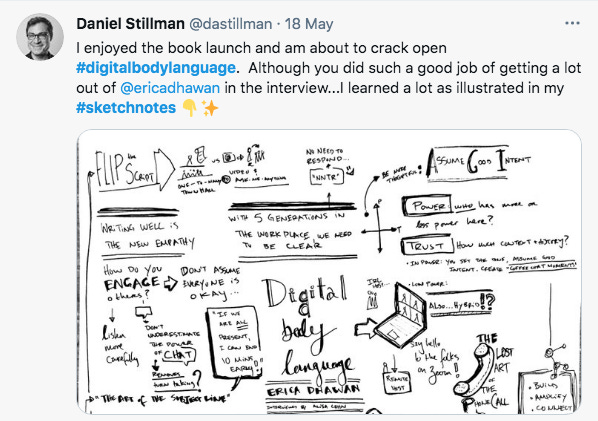
Anyway, great PR by Erica Dhawan, who wrote the article to promote her new book, Digital Body Language. She used a provocative term to spark conversation, identifies as a geriatric millennial and explains why they’re great. 

Erica spent over 10 years investigating, researching and finding new ways to encourage collaboration and communication at work. She grew up as an immigrant in America – caught between two cultures, and says we’re all digital immigrants now. She wanted to write ‘a nuts and bolts rulebook for clear communication in the digital age. Our shiny new tools are causing issues, and most of us speak badly in this world.’ 

I’ve been listening to the audiobook – lots of funny stories, anecdotes and practical advice, and it’s made me think about my digital behaviour. I think I’m doing my colleagues a favour with my short and snappy emails, but maybe they’re perceived as cold and distant. I still have an urge to multitask while on Zoom. Does it look like I’ve checked out when I look down at my phone during meetings or when I turn the camera off? ‘You’re a black square in the corner…’ 

I had a boss who told me off via email for not responding to my colleagues’ emails. I thought about it for a bit and wrote back in my defence i.e. of course, I’ll reply, there are lots of emails flying back and forth, I can’t work out of my inbox, I wouldn’t get any work done etc. I signed off with NNR – no need to reply (one of Erica’s recommendations) which went down like a lead balloon. I got an email back saying ‘I’m not going to respond to that.’ Cultural differences 😉

Great tips on how to model digital body language for your teams, inclusive language, digital empathy, how to enhance customer experience through words, gender differences in language, and emoji as the universal language. Her top tips? We need to slow down, assume the best intentions from people, think about how we make them feel, and put ourselves in their shoes. 

And a great lesson in resilience. Publishers told her the book was too niche, but its time has come – it was #3 on the WSJ Bestseller list 👏

As Seth Godin says, it’s a salve for exhausted Zoomers. 


We write the talk, not talk the talk in 2021 

Julie Sweet, CEO of Accenture says the way you write your emails can make or break your career. The best investment you can make is to develop one overlooked skill: written communication.

What’s the greatest advice I give? Develop excellent communication skills. Both in-person and in writing, such as when using email.

An employee, even a very junior person, if they can articulately summarize a meeting, if they can put together a presentation and even emails that are really salient and to the point, they are so valued.

Even more relevant given face to face communication is on the decline, remote work on the rise, and we’re spending more time alone, staring at our screens.

Mildly terrifying to think about how traditional body language is being shaped by our digital body language. What digital behaviours will we carry over in this new hybrid world? Will we be speaking in bullet points? Avoiding eye contact and sitting two metres apart in meetings? It’s a new frontier! 

A bit sad to read that unscheduled calls are perceived as intrusive and ‘as far as booking sales meetings were concerned, it seemed that the strategy with the least human interaction [setting up meetings via Calendly] delivered the most success.’ Where does this leave us? Loneliness is an epidemic and we have an empathy crisis. A YouGov poll found 30% of millennials said they always or often feel lonely, compared to 20% of Generation X and just 15% of baby boomers. It doesn’t ask why – but previous studies show social media and internet addiction play a part. 

A phone call is worth a thousand emails – and it’s becoming an obsolete art! We need a new ad campaign. As Bob Hoskins said, it’s good to talk. 


Photo by Alain Pham on Unsplash

👋 The Zoom wave

I can’t resist the urge to wave at the end of Zoom calls – glad to see I’m not alone. ‘I have never felt the need to wave in person,’ Kennedy, 36, the chief communications and marketing officer for the city of Olathe, Kansas, said. ‘What am I doing?’ Apparently, it’s a good thing. I’m not socially inept. 


Tools + resources →

📹 Erica’s Podcast interview with Rohit Bhargava: How to communicate with digital body language

🙇🏻‍♀️ Digital Body Language course

Hilarious thread from Danielle Rene on your favourite phrases to use in a professional clap back – those passive-aggressive emails. 

  • Just a gentle reminder
  • As we discussed previously (See attached email)…
  • lmao nothing is more passive-aggressive than “PLEASE ADVISE…”
  • If I’m feeling Big Petty I’ll hit them with… I’m not sure where your confusion comes from, but allow me to clarify..
  • Thank You in advance for your prompt response. I look forward to hearing from you.
  • Subject line: ‘Friendly reminder’

Vyv Evans on why emoji is the universal language. And it’s making us better communicators 😍

James Clear on writing as leadership at scale

A new WHO study finds working over 55 hours per week is considered a ‘serious health hazard’ 


Photo by Jason Rosewell on Unsplash

Playlist of the week →

9 essential podcasts for remote workers, managers + teams


The future of work is now

Let’s build it. The Shift is a weekly newsletter celebrating writing, good design, creativity, flexible working, growth, travel, and online communities. If you enjoy the content, please share it with friends.

Work Better. Live Smarter. Be Happier.

Question or comment? Email nicci@niccitalbot.io.
Was this helpful? I’m powered by caffeine and Amaretti biscuits.
You can listen to this post here.