Categories
Newsletter

Corona Diaries: How to Keep Your Business on Track

I’ve just finished six months of voluntary self-isolation writing a book, so it’s bizarre to find myself facing another one with COVID-19. Major new measures have been announced to protect people at highest risk of coronavirus, so I’ll be getting a letter this week asking me to stay at home for at least 12 weeks, as I take immuno-suppressants for rheumatoid arthritis. I work from home so it’s not a huge change to my daily routine, but I am feeling anxious about the lack of financial support for freelancers, and how I’m going to work and home-school a teenager in a small flat. I washed her school uniform last night – “Bin it!” she said gleefully, “I won’t be needing it.” 

One freelance colleague has lost £1,000 of photography bookings. Another, an events manager, has had all of her work cancelled. I’m lucky that I can work remotely for clients but some of my work has fallen off. I was due to start a three-month part-time contract to finish off the book – not heard a peep, and other work – also events-based, has stalled. I’ve put money aside for tax and other contingencies, but it’s not enough to see me through months of upheaval. Last week the Chancellor Rishi Sunak announced various measures to help companies and employees. Still, there’s not much support for creative freelancers and the five million self-employed in the UK. 

Employees have a guaranteed 80% of their income, up to £2,500 a month. In contrast, the self-employed have so far been advised to claim Statutory Sick Pay at £94.25 a week or Universal Credit, which is a minefield when you have unpredictable earnings. The eligibility criteria for UC include savings, which means those who set aside money for tax may be ineligible. Oliver Heald MP has said that Sunak will make a statement on the self-employed on Monday. Fingers crossed as so many of my freelancer friends are worried sick. 

The National Union of Journalists is lobbying for support for freelance workers. It has some policy recommendations here, e.g. that the 80% rule be extended to the self-employed, based on recent tax returns along with a temporary cancellation of the savings rule for UC. This would help freelance members at the bottom of the earnings scale. It seems to strengthen the case for a Universal Basic Income going forward! 

I can’t control the big stuff – my heart goes out to Italy – almost 800 deaths yesterday, and it’s heartbreaking to see a country brought to its knees. So, I’m focusing on the things I can control – my environment, self-care, online chats and campaigning, and using this unexpected pause to read, study online, and do some business planning.  

Here’s what I’ve been doing to keep my business on track during COVID-19. 

MONEY – I’ve given myself a pay cut. I have a limited company and pay myself a monthly salary, so I’ve reduced this for now. I can cut back to the essentials as I won’t be travelling to London, doing coffees with clients, using hot desk space etc. I’m reviewing all my subscriptions and memberships and cancelling those I can do without. I’ve been using Xero for my accounting, which is expensive – £36 a month as I had EUR payments coming in, so I’m switching to Free Agent, which offers a 30-day free trial and seems more contractor-friendly. I’ve found a cheaper online accountant who specialises in creative businesses. I’ll do my tax return at the end of this month to get it out of the way, so I know what tax I have to pay next year. 

Some guidance from HMRC for small businesses and the self-employed and from The Guardian.

TIME TO HUSTLE – I rent my home, so will speak to my agency to see what help is available and haggling with utility providers and suppliers to see what they can do. I’ve applied for a grant from the Society of Authors contingency fund for authors and journalists and joined the Creative Industries Federation (they are offering free six-month membership for all freelancers and microbusinesses). There are small grants available from various charities, so see what’s available in your field. Facebook is offering cash grants and ad credits for small businesses.

TRAINING – I’ve signed up for some online courses and webinars to learn new skills. AllBright, a club and community that celebrates and connects women at work, is running 20 digital courses at 2 pm every day, so an excellent opportunity to dip my toe in and see what they offer. FEU Training has a digital learning centre for creative freelancers (free to NUJ/union members). Also, check out Skillshare.

ONLINE WORK – it’s a good time to update the CV. I use Indeed, We Work Remotely, Hoxby Collective, Yuno Juno, The Dots, Freelance Alliance, and LinkedIn to find remote work. Search hashtags: #remotejobs #remotework #workingfromhome #JournoJobs. I also subscribe to newsletters that list writing jobs, e.g. The Professional Freelancer, Journo Resources, Freelance Writing Jobs

OPPORTUNITY/MINDSET – things are going to be very different over the next few months, so I will use this opportunity to think, review my business and what I want to do next. As Debbie Wosskow, co-founder of AllBright, said, “It’s an unexpected pause. I’ve never spent any time in my own home, and now I’m here!” Make the most of it and enjoy family time. Small businesses might need more online content and social media to stay connected while they’re shut, so I’ll pitch my services around locally.

DIGITALISE YOUR BUSINESS – What income streams can you digitalise? I’ve seen yoga teachers, fitness instructors and nutritionists doing online classes via Zoom. I wrote a book a few years ago which got pulled, so a good time to publish it as an e-Book. What digital products can you create now for future passive income? I use Free Conference Call for team calls, Skype, WeChat groups, Trello for planning, Twitter and LinkedIn to share work.

SELF-CARE – It’s tempting to scroll the newsfeed all day, but it makes me feel anxious and unable to concentrate, so time to stop. It’s also easy to spend all day on your laptop when you work from home and not take proper breaks. It’s spring and the weather’s changing so I’ll go for walks and jogs to clear my head. Check out online fitness classes, and the Headspace app for meditation. 

COMMUNITY – This is a war on a virus, and there’s been nothing like it in my lifetime, so we are having to rethink how we live, work and interact. We’re in this together and need to help each other. I’ve joined Nextdoor to find out what’s going on in my neighbourhood, and AllBright Connect – they asked for volunteers to do skills swaps so a good opportunity to make new contacts. Follow hashtags on Twitter like #SupportFreelancers and local Coronavirus groups on Facebook to find out what’s going on in your area.

CAMPAIGNING – I’ve signed and shared several petitions to support freelancers and the self-employed: 

Don’t Leave Freelancers Behind in the Coronavirus Crisis

Self-employed in Statutory Sick Pay

Self-employed 80% of Their Median Salary During the Coronavirus Pandemic

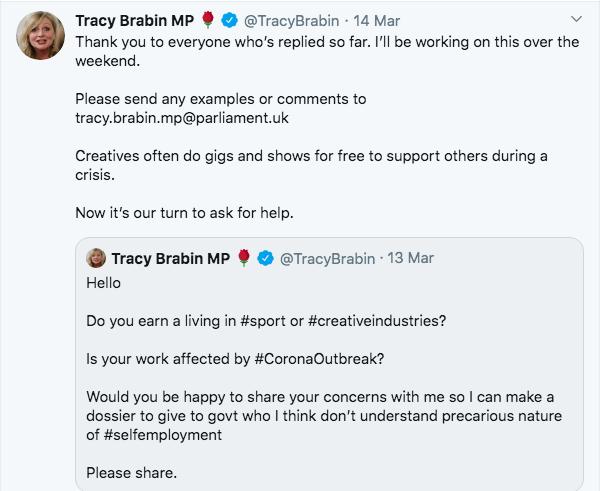
I’ve written to my MP calling for the benefit to be extended immediately to the self-employed. Here’s a template letter from the NUJ which you can adapt. I’m also following various MPs on Twitter like Tracy Brabin, John McDonnell, and Keir Starmer who are campaigning to help the self-employed. 

Keep calm, carry on. We can survive, we will thrive! Let’s see what happens next week. I hope more measures are introduced to help the self-employed. Celebrate your achievements and have a virtual glass of vino with your colleagues to help each other through this crisis. If you’re home-schooling – there are some great ideas here. This is an opportunity to do things differently, and it will lead to a more creative and connected way of living.

Stay safe, keep well, and look after those around you! 

What are you doing to keep your business on track? Send me your tips and follow me on Twitter @niccitalbot, I’d love to hear from you. 

Clear messaging (& tone of voice) is crucial at all times – not just during coronavirus!

Enjoy reading this?

If you need a little help with your marketing activity in the coming weeks – get in touch today. Nicci@niccitalbot.com.

Categories
Newsletter

Corona Diaries: Getting Tested in the UK

Europe is now the centre of the COVID-19 pandemic, and we’re facing the most significant public health crisis for a generation. So far, there have been 35 deaths in the UK with an estimated 10,000 or more people infected. Since coming to stay a few weeks ago, my mum has been ill. A few days ago, she was up all night with a temperature, hot skin, shoulder pain, a dry cough. “It’s not your average cold,” she said. “It feels slightly alien to anything I am used to. I’ve had a persistent headache for weeks, and my tinnitus is going through the roof”. Concerned that she might have coronavirus, she called the NHS 111 helpline.

Because of her age, pre-existing health conditions (she has CLL and a heart murmur), she was told to go to A&E immediately, so my brother cancelled a couple of jobs to drive her over. When they got there at 7 am, “it was eerie, totally deserted. Just rows of empty chairs.” Not what you’d expect to see in an ordinarily busy A&E. A nurse checked her over and told her she has an ‘upper respiratory tract infection’. 

“I said “look, could this be coronavirus? She said, ‘well, it could be – I can’t say it’s not, but it’s probably just a severe cold.’

“I said, ‘well, don’t you do any tests?’ she said ‘no’. She said ‘we just tell you to self-isolate now.’ Worryingly, the nurse hadn’t heard of her health condition either. My mother had to spell it out and explain what it is (a type of cancer that affects the white blood cells). She didn’t have a temperature as she’d been taking paracetamol, so didn’t meet the ‘criteria for testing’, which is ridiculous given she was sent to A&E in the first place. She told to self-isolate for seven days and to call 111 again if her symptoms didn’t improve and tell them she might have the virus.

So, my mum’s left in limbo. “I’m waiting: is it going to get better, is it going to get worse?”. My mum is in the vulnerable group and has a right to be tested for coronavirus – as do we all. The government promised an additional 10,000 tests a couple of days ago, so, it’s frustrating to see the U-turn from testing everyone to ‘high-risk groups’ only, i.e. in hospital with breathing problems. After we’d spoken, I called the A&E department to find out what’s going on but was told they couldn’t answer questions about coronavirus testing and that I had to call 111 for further information. I did and was kept on hold for half an hour and eventually gave up. If this is my experience of calling 111, it will be many other people’s too.

I called the local press to tell them about my mum’s experience. The Nottingham Post interviewed us. I spoke to BBC Radio Nottingham this morning about the importance of mass testing. People are being advised NOT to go to their local GP or pharmacy if they have any symptoms of the virus, and to call 111 instead. But what are you supposed to do if you can’t get through? Or in my mum’s case if you’re sent to hospital, not tested and told to self-isolate for a week? If the government is going to announce virus isolation for the over-70s for up to four months, there needs to be a proper plan of action and more funding for social care. Who will visit them and bring supplies if they live alone? My mother doesn’t do online shopping and banking. “No way would I be imprisoned in my own home for four bloody months staring at the walls waiting for Deliveroo to drop off a food parcel outside. People who live alone will commit suicide without the physical or mental benefit of going for daily walks or to shops and the library.”

The UK’s strategy is to delay the peak of the virus or “squash this sombrero” as Boris so eloquently puts it so that we don’t overwhelm the NHS (years of Tory cuts and austerity have run it down to the ground, so you reap what you sow). The idea of letting 60% of the population contract the virus to develop “herd immunity” to protect the most vulnerable is reckless. This means potentially 36 million people will need to be infected with the virus, with around 2 million seriously ill and 330 people requiring a critical care bed. It would cripple the NHS and could lead to thousands of deaths. Also worrying to hear from a contact working in the NHS that they have been buying lots of body bags… are we anticipating a large number of deaths?!

200 scientists have written an open letter to the government asking for stricter measures. They say the current proposals are “insufficient” and “additional and more restrictive measures,” i.e. social distancing should be taken immediately as has happened in other countries. We seem to be the only country in Europe following a “laissez-faire” attitude towards coronavirus, with our “keep calm and carry on” approach. South Korea’s approach is “being open, transparent, and keeping people informed,” says their foreign minister, Kang Kyung-wha. They are testing 20,000 people a day and monitoring them afterwards via an app. Their goal is to detect it early to prevent spreading, and so far, it seems to be working. Their view is that mass testing is vital so they know how many people have been infected to tailor medical care and monitor them in the future.

Good to see that Democrat Katie Porter has succeeded in getting the Centres for Disease Control and Prevention chief to agree to free coronavirus testing for all Americans. UK government take note!

Labour MP Lisa Nandy is calling for a Public Health England (PHE) information campaign, “not just a gif telling us to ‘wash our hands'”. The government is due to publish its scientific modelling this Thursday, and as of today, there will be daily press briefings.

It has now become a political issue says Robert Colville in The Sunday Times: Delayers v Containers: the new political divide. It’s worrying to hear medical experts arguing about the best approach to tackle the pandemic. I agree with former PM Gordon Brown who says we need to work together to tackle this rather than being nationalistic. Get heads together to come up with a vaccine, pronto!

My mother would be happy to pay for a private test. “I have a right to know whether I’ve had it for my medical history and peace of mind. It affects how I live my life going forward. If I’ve had it, then I have some immunity, so I’ll feel less anxious about going out. If I haven’t, then I know I need to be careful and take precautions.” I agree. My daughter and I have been ill recently, and I have rheumatoid arthritis, a chronic health condition which means my immune system is compromised so I also need to know. I saw my consultant last week who advised me to stay home. So, what are the options if you can’t get tested on the NHS?

This Harley Street clinic is offering private coronavirus testing for £375 after being inundated by people wanting to be tested. Channel 4 News reported that a rapid self-testing kit is set for UK release this week (they’ve already sent 50,000 to South Korea). But if you’re not supposed to go the pharmacy if you have any symptoms, how do you get it? Can you order it online and how much does it cost?

I went for a walk to Bexhill yesterday, which was surreal. You can feel the fear and anxiety. People are apprehensive about what’s going to happen over the coming weeks as the virus peaks here. People are giving each other a wide berth and there’s not much eye contact. My daughter saw a whole family wearing masks at the station. Most of the conversations are about coronavirus.

“The only way we can stop it is to not visit her.”

“Did you see the shops in Eastbourne? Totally empty. It’s like a ghost town.”

The M&S Café in Bexhill was deserted (it’s normally packed with older folk having tea). All the makeup and perfume tester kits have been removed from the shelves which makes sense, but it looks so strange and impersonal. There was no loo roll or pasta in my local ASDA as people panic-buy. Don’t do it! There’s enough for everyone – think about the people who can’t afford to panic buy.  

This is a war on a virus, and it brings out the best and worst in people. It’s upsetting to hear about racism against the Chinese and Italians. Fewer visits to Chinese takeaways. Last week a boy in my daughter’s class said: “Are we making pizza because it’s Italian and they have coronavirus?” The teacher put him straight.

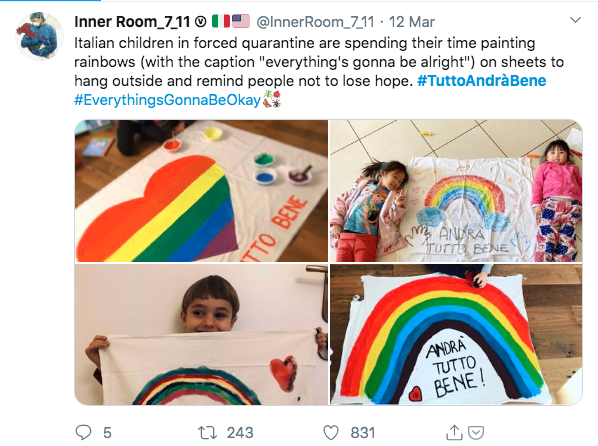
But also great to see people pulling together. I love little drawings by Italian kids under quarantine, hashtag #TuttoAndraBene, #EverythingsGonnaBeOkay? And these videos of Italians singing to their neighbours – this Turin opera singer gave hers a treat. In the UK, we have postcard campaigns to encourage people to check in on their elderly neighbours, #ViralKindness #HowCanIHelp. It shouldn’t take a national crisis for this to happen but here we are.

#AndraTuttoBene #EverythingWillBeOkay

We may be spending a lot of time at home over the coming months, so it’s an opportunity to slow down, think about how we live, and make some changes. Do we need to travel so much and buy more stuff? We can shop local, work from home if possible, and do more in our communities. I’m keeping a corona diary. I really hope this is the beginning of a new way of living with more tolerance and time for each other and more cohesive leadership. We need better international cooperation with governments around the world working together to solve problems and create change.

I’ll let you know if we manage to get hold of a self-testing kit and what the outcome is. I’d be interested to hear your experiences too – email me on nicci@niccitalbot.com.

  • Staying Home Club – the running list of what in tech has been affected by COVID-19 and what social distancing policies have been enacted by 238 companies
  • Last month, China rolled out an app for people to test if they’ve been in ‘close contact’ with people exposed to the coronavirus. It shares data with the police. (this is in the pipeline for the UK although if its success depends on widespread testing I can’t see how can it work here) 

Send her your feedback so she can put together a dossier for the government on self-employment and coronavirus: Tracy.brabin.mp@parliament.uk

  • Labour MP Lisa Nandy on how to campaign during a pandemic. She says we should be using video conferencing to carry on the Brexit negotiations. Her team have launched an app for her leadership campaign, which has been adapted for the coronavirus with virtual Q&As. “The Nandwagon will continue to roll on. We have three weeks,” she told Andrew Marr 
  • Coronavirus: Why You Must Act Now. A fascinating article by Tomas Pueyo, which has been widely shared online. I’m not sure about his scientific credentials – he’s a Silicon Valley tech executive, but it’s interesting data, and he’s a passionate speaker. Watch the debate on the Channel 4 News coronavirus special
  • Who Gives a Crap? Eco-friendly toilet roll delivered to your door… they’ve been completely wiped out – back in stock soon

Enjoy reading this?

Clear messaging (& tone of voice) is crucial at all times – not just during coronavirus!

If you need a little help with your marketing activity in the coming weeks – get in touch today. Nicci@niccitalbot.com.
Categories
Newsletter

Coronavirus and freelancers: “If I become ill, I’ll have to work.”

Working as a freelancer or contractor in the UK? You may find this interesting. 

Petition: Include Self-employed in Statutory Sick Pay (SSP) during Coronavirus. It’s had over 65,000 signatures so far. If it hits 100,000, it will be considered for debate in parliament. I’ve signed it and shared.

Self-isolating employees can access sick pay from the first day of being off if they earn enough, but it’s not clear if this will be extended to those on low incomes, zero-hours contracts and the self-employed if a pandemic hit the UK. 

Freelancers make up 15% of the UK workforce, and the majority of us aren’t entitled to any sick pay. So, we rely on our savings. We need to pay bills and put food on the table like everyone else so most of us will carry on going to work, sick or not, which raises the risk of spreading the virus further. 

As the petition points out, “4.8 million people are registered self-employed in the UK (2017 figures from the Office of National Statistics so this figure is probably higher). “It would be easy enough to work out what each person is entitled to based on their tax returns.” 

Good to see trade union action spurring this on. On March 4, Francis O’Grady, General Secretary of the Trades Union Congress (TUC), called on the government to make SSP available to all workers. “Unless we sort out our sick pay rules and make them fair, many workers are going to face that invidious choice of do they pay their bills, put food on the table, or do they follow government health advice to self-isolate if they’ve got symptoms? No one should be out of pocket for doing the right thing.” The National Union of Journalists (NUJ London Freelance Branch) has also written about it here

And Lisa Nandy (my favourite Labour candidate) in The Guardian today calling for an extension to the Brexit transition period because of the coronavirus. “Businesses trading with the EU do not know what terms they will be trading on in 10 months. Add to this the falling demand and disruption created by the coronavirus, and it is reasonable to expect many businesses will not survive.” Which means more stress for the freelancers who work for them.

She has also suggested extending SSP to avoid a ‘public health disaster’ waiting to happen if self-employed people and those working in the gig economy can’t afford to self-isolate. 

Please sign it and share! 

Photo by Hello I’m Nik 🍌 on Unsplash

Enjoy reading this?

Clear messaging (& tone of voice) is crucial at all times – not just during coronavirus!

If you need a little help with your marketing activity in the coming weeks – get in touch today. Nicci@niccitalbot.com.
Categories
Newsletter

The Rise of Email Newsletters (here are some you’ll love…)

The email newsletter is having a moment. Just reading about how they are part of the ‘Passion Economy’ in this month’s Courier. I see a new one launch every day, and women are on it. They’re a more intimate form of communication with people who actually want to read your stuff. Mine will focus on writing, creativity and work culture.

What else do I want this year? More fun. Deeper connections. To prioritise my own projects and happiness (getting up an hour earlier to work on my own stuff). To sort out my health. I have rheumatoid arthritis and want to find out what’s causing it and get it into remission. It’s no fun when your fingers keep getting stuck when you write for a living. Over the past year, I’ve been working with Gayle Merchant on my nutrition and have just done a comprehensive gut test to try and get to the bottom of it! (literally – stool samples in mum’s fridge over Christmas). I also want to feel stronger, so as well as running, which keeps me sane, I want to try some weightlifting this year. 

I also love a good tattoo so have decided to go for it and get a full sleeve 🙂

More travel. To read a book a month. Better paid work. I’ve signed up to the Hoxby CollectiveThe Dots, and I’m checking out The Allbright, a members’ club for women. Interesting event programme and some inspiring women on board – member spotlights. It would also be great to have a regular coworking space in London. 

So, if you want to take your working life up a notch and set some goals this year, check out The Professional Freelancer by Anna Codrea-Rado. How to set freelance goals you’ll actually stick to, and the importance of distinguishing between outcome goals – things you don’t have any control over like “getting a book deal” and process goals – actionable steps you can control like “emailing five agents this week”. Why it’s important to do both. Here’s some more freelance friendly content to check out, via @JessicaAnneLord.

What I’m reading

How to escape your phone and other life hacks

Family life suffers from always-on work culture

‘I quit life as a BBC journalist to live as a jade carver in China’

Resounding NUJ victory in landmark equal pay case. A wake-up call to all employers!

Little Black Book – A Toolkit for Working Women

DCW chief Swati Maliwal hospitalized after fainting on 12th day of hunger strike

Bittersweet legacy of a blazing talent – Motherwell: A Girlhood

Elizabeth Wurzel and the illusion of Gen-X success

CES 2020 – all the latest news and highlights – the joy of tech!

What I’m listening to

#237 Emma Forrest: Writing & Transcendental Meditation. Dreams and creativity. Keep a pen handy. You are most creative when you don’t realise you’re doing it.

Lana Del Ray – Norman Fucking Rockwell

Where I’m going

StartUp 2020 – the UK’s biggest start-up show of the new year.

The Allbright

Nicci Talbot is a freelance journalist and copywriter. She can be reached at nicci@niccitalbot.com or follow her on Twitter @niccitalbot.

Photo by Lee Soo hyun on Unsplash

Categories
Newsletter

Christmas Gift or Charity Donation?

What would you prefer? A conventional gift or a charitable donation given in your name this Christmas?

According to new research by one of my clients, the Gift Card & Voucher Association (GCVA), more than one in five Brits (21.5%) would prefer a charitable donation. In the run-up to Christmas, the GVCA surveyed 1,000 consumers who celebrate Christmas in order to determine how gifting habits are changing over time. When asked what else they would be happy to receive instead of a traditional Christmas gift, gift cards emerged as a popular alternative, being chosen by 44% of Brits.

40% said they would prefer to receive “experiences”, such as nights out or skydiving trips, rather than traditional gifts, and 36% said they would like to choose their own gift, as opposed to a present that was picked out for them.

The research also found that a fifth of people would want a donation to be made to charity on their behalf, instead of receiving a physical gift, showing that attitudes towards gifting are changing in line with our sustainability values.

Is the rise of alternative gifting a response to the huge amount of waste produced from unwanted Christmas gifts? According to the survey, Brits receive an average of TWO unwanted gifts each Christmas, equating to a total of 119,584,080 across the UK. And nearly 23 million of these gifts will be sent straight to landfill! Not good enough!

We also use nearly three rolls of wrapping paper on average and most of that isn’t recyclable.

If, like me, you’re out shopping this weekend for last-minute Christmas gifts, think about getting a gift card.  They can get something they really want or enjoy a new experience.  Gift cards are either digital or increasingly being made of sustainable materials these days.

Happy gifting – and have a wonderful, festive Christmas break!

More on what the GCVA does to support the gift card industry and its sustainability pledge at www.ukgcva.co.uk.

Photo: Virgin Experience Days