Categories
Newsletter

A Day in the Life of Brittnee Bond, Founder, Remote Collective.

I believe all people should have access to remote work, and I intend to make this a reality.

Brittnee Bond, Founder, Remote Collective.

Thinking big 💡

I wake up, I meditate, I go swimming in the sea. I run, I do yoga, and then I sit down and start work.

I’m doing crypto investing right now and investigating blockchain, specifically to help women gain more financial freedom, so I’ll spend a couple of hours on calls with people and then I do a lot of community building. We build gardens, we help the local Thai people. So, there’s just constantly things happening.

But the first part of my day is like for me. For soul-building, for my creativity and then I do my work. And then I have time to give back to the community.

A day in the life of Brittnee Bond, Founder, Remote Collective – the latest video in Hoxby’s Workstyle Stories Live: a series of real-life stories that showcase the transformative power of workstyle. Brittnee is a remote work consultant and a coach for women entrepreneurs, currently based on Ko Pha Ngan, a tiny island in Thailand.

Pre-remote, she worked as a Paralegal in Intellectual Property law for six years.

An hour on the train each way every day, work for 8-9 hours, and that was my life.

Was it like Suits, the TV show? A stressful work culture with long hours and corporate tension?

Yeah, I would say it’s creepily accurate. My friends loved watching that Suits show, and I’m like, I can’t watch that, that’s my everyday life. Sometimes they would even have places at the office where you could sleep, just so you would keep working. It was really bad.

What was the dealbreaker?

I always wanted to work remotely. Even when I graduated high school and into university. That was my thing. I wanted to help people and make an impact, but I wanted to have my own freedom.

She worked as an internal consultant for three law firms helping them to go paperless and getting the systems in place to work remotely. She made herself indispensable and kept going, creating opportunities to build the workstyle she wanted.

The third firm let her work remotely and live in Costa Rica – the start of her remote working adventure.

It worked perfectly, her KPIs were off the charts and she proved she could do it. But after six months they wanted her back in the office.

The culture within the legal field, it’s too traditional for me, I can’t handle it. They were willing to let me work remotely because I’d helped them so much, and then the attitude was like, okay, we gave you your six months, and now you need to come back to the office and work for the rest of your life for us. And I was like, I can’t do this.

It was 2014, and this is like, old white men in suits, you know. They didn’t even like the idea of me being seen near the beach when they had to be in the office.

Professional jealousy, maybe?

She quit her job to do other things, first setting up a travel company to help pay her way, and then consulting for large corporates in Asia, based in Kuala Lumpur, flying out to a different country each month, and helping them to run their companies. There weren’t that many people with her business background in Asia at the time, so everyone wanted to work with her, and her workstyle was negotiable. She could start building her own projects and had a big mindset shift…

I am good. I don’t need to prove to myself anymore that I’m successful. And I also really, really wanted to help women.

So she started consulting companies to go remote.

So many companies are just trying to meet their KPIs and make a profit, and they don’t have the time or emotional energy to transition to remote, so I was like, I can step in and help. So that’s what I’ve been doing for the last couple of years.

Lots of takeaways here – she quit!! Thinking about where we’re at now – after a year of working at home – employers need to create a situation remotely for their top talent, an environment where they can thrive, so they don’t lose people. The law firms she worked with had an opportunity to think differently and mark themselves out as trailblazers: ‘The first paperless law firm with remote workers’ – that would have been great PR, but they didn’t see it that way – trust was an issue.

People want flexibility, freedom, and autonomy at work – give them that, and they will give you their best.

I also love what she has to say about mindset and money after raising capital for her ventures.

There’s so much money out there in the world. I want you to be able to access that money. So if you have questions about how to raise money… how to find the shared audience, please reach out to me because this is the stuff I live for, especially for women entrepreneurs, because I think so many women don’t realise how much money there is out there. We feel like we almost need to be given permission to even go after that money.

I’m giving you all the permission in the world right now that this is your time to shine, and I want to help you do that, if anything, just to root you on.

An inspiring story on evolving your work to enable your travel, escaping the bureaucracy of corporate culture, and creating a life you love.


🙌 The Hoxby Way 

I’ve renewed my passport with Hoxby to stay in the community for another year. They’ve introduced The Hoxby Way, a new way of doing business that will help them collaborate more closely as a community. They are merging their ‘core’ and Business Units into a single organisational structure made up of 10 functions with an MD for each, in response to feedback that things can feel a bit siloed. Good stuff. The goal is to continue to grow the community and create 30% more work for their consultants.

There are lots of questions, comments, and enthusiastic emojis flying around on the Slack channel, so it will be interesting to see how this develops and what new projects come in.

You can join the Workstyle Revolution community on Mighty Networks. It’s open to everyone who believes in what they are trying to achieve including those outside Hoxby.

Our goal is to replace the traditional 9-5 system with workstyle, fitting work around life and not the other way around.


Go deeper 🛠

🚀 Brittnee Bond on the future of remote working, getting into blockchain and launching the Women’s Circle Mastermind (Remote Collective).

👨🏽‍💻 The Rise of Working From Home (The Economist). The shift to remote working has gone better than expected. People are working longer hours, but they report higher levels of happiness and productivity. On the pros and pitfalls of remote work, the rise in work-from-home technologies, and new laws regulating remote work.

💻 The Nowhere Office (Demos) – The first report from the Chair of the Demos Workshift Commission, Julia Hobsbawm, says that lessons learned from the pandemic should inform an entirely new way to approach work, workplace, working life and productivity. ‘Everyone wants jobs, but they want something else too: meaning. Work-life balance. In other words, a work shift.’

👩‍💻 After working at Google, I’ll never let myself love a job again(New York Times). A former software engineer at Google on learning the hard way that no publicly traded company is a family. On the upsides of remote work: ‘I took a role at a firm to which I felt no emotional attachment. I like my colleagues, but I’ve never met them in person.’ 

📅 Save the date: Hoxby will be chatting to Ali Green on 29 April about remote work, non-traditional career arrangements and building rural economies through location-independent work. You can sign up and join Ali Greene’s live Workstyle Story.


Welcome to my bookshop! 📚

I’ll be sharing books in my bag and recommended reads on Bookshop.org. They pay a 10% commission on every sale and give a matching 10% to local bookstores, an integral part of our culture and communities. I would be very happy if you make the odd purchase here.


🕵🏻‍♀️ Work with me 

Leopard print, always. Worry less and rock a red lip. Remote worker, problem solver, internet person.

💡 Something you want me to write about? Leave a comment or email nicci@niccitalbot.io

☕️ Has this helped you? Buy me a virtual coffee

📩 Subscribe to The Shift here

👋 Copy Club, 6 pm GMT, Saturdays on Clubhouse – drop in!
Categories
Newsletter

How to Thrive as a Soloist

Thinking big 💡

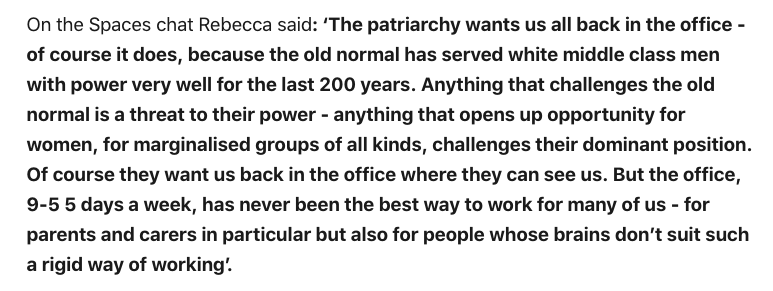
This month, Bruce Daisley ran a Twitter Spaces chat: Has the Work Culture Myth Been Busted? Rebecca Seal (author of Solo) made a point about offices that set his pulse racing (I can totally relate to this): 

Rebecca Seal, via Bruce Daisley

We mustn’t let the conversation about the future of work be dominated by loud, white male CEOs or by poorly worded staff surveys. If we sleepwalk back into the old ways, we will miss the moment of a generation, the chance to make work equitable and to design it in a way that puts human lives at the centre.

Bruce has written about it here: Offices are a Battlefront for Equality – a call to action to embrace new ways of working that are productive, fair for all and will transform the lives of millions, i.e. women, 50% of the population, many of whom have quit the workforce over the past year as they can’t juggle the demands of work and childcare. I talked about this in an earlier post on the Double X economy by Linda Scott. 

Bring it on! The juggling act between work and childcare is nothing new, but I hope we can learn from the past year and take the opportunity to reset work cultures and fix the barriers holding women back at work. We all need to step up. You can start by connecting with Rebecca here

I didn’t quit the workforce when I had Julieta but was self-employed so had no proper maternity leave. I stepped up the freelancing to keep my career going while my partner commuted to London at 5 am every day. And later, as a single parent living miles away from my family, it’s been the only way I can operate. I’ve been working this way for 15 years and remote working suits me, but there was no other option while she was young. I’m not alone. As the rise of Mumsnet, Netmums, Digital Mums, and ‘mumpreneur’ culture shows.

I’m half-way through Solo, and it’s an inspiring read, the next step along from the freelancer bibles. Less of the practicalities and more about the way you work. How to work well in isolation and how to thrive as a soloist. She’s taken the best ideas in psychology, economics, social sciences to help you stay resilient, productive, and focused in your company of one. She also explores the idea of meaningful work. Her inspiration came from not being able to find a book which answered her question: if I’m doing what I’m supposed to love, why am I sometimes so unhappy?

We are not farming a hot and dusty hillside 7,000 years ago. We are not Victorian labourers. We can do what they were denied. More than any other group of workers, soloists have the opportunity to change things for the better.

Rebecca Seal

AND: this new report from Demos think tank is along the same lines: a call to action about using the lessons learned from Covid to campaign for a new way to approach work, working life, the workplace, and productivity. The rise of The Nowhere Office, where work is based on outcomes not hours worked. 


End of lockdown review 

I’ve been thinking about the people and things that have helped me through the past year. I did a quarterly review this week – helps to get the fire in my belly – and wrote a plan. As Darren Murph, Head of Remote, Gitlab, says, ‘Documenting everything solidifies a remote company.’ ‘It’s the most valuable skill in tech’, says Slack CEO Stewart Butterfield. 

I started by making a list of all the things I’ve achieved this year. What has energised me? What has drained me? Financial wins? What impact has my work had? What new services, products, and packages have I launched? What skills have I learned?

Then a deeper dive into how I make my money. Other ways I can make money. New offers, promotions, raising prices. What’s not working? What systems do I need to have in place? What am I putting off, and why? Thinking about mindset, physical health, hours worked, and social networks. What habits have I created? (apparently, it takes 66 days to build a new habit). What are my flow activities? What can I automate or stop doing? 

I spent a couple of hours on this, so it’s a long list. The next step is to create a vision – 5-6 things I want to achieve. Then choose the top three for the next three months and make them specific. Break them down into 12 weeks steps – one action per week – and get them in the calendar. 

I’ve used the FAST framework for goals – frequently discussed, ambitious, specific, and transparent. They may change, but it’s good to have things written down. I’ll try to do this every quarter.

Changes I’m making: Working less (‘one piece of research surveying 1,000 freelancers suggests because self-employed people take fewer holidays and tend to consider themselves on duty for longer each day than employees do, we work up to 65 hours per week’). My core hours are 8 am – 1 pm then a two-hour break to go for a walk (been inspired by Sabatigo’s Wonder Walks to explore entrepreneurship.) People are refitting shops, selling fresh fish, takeaway breakfasts, street markets, making street art. Someone has built a Rent A Pod in their garden for hire by the hour for work or dinner.

I’m still plugged in, however, so I need to challenge myself to go for walks without my phone. 

Back by 3 pm for admin/emails/calls till 5 pm finish. Having this routine has helped with boundaries, and I’m more productive with time constraints. The old adage: work expands to fill the allotted hours (and more). I do a lot via my phone which means I’m always on, and it’s easy for work to spill over into the evening.

I’ve booked a week off over Easter and will redesign my studio. I’ve bought a Freedesk desk riser so I can stand for a couple of hours a day – ‘sitting is the new smoking.’ ‘It’s been out of stock since November, so I think it speaks for itself.’ I’ve become a plant parent – getting into biophilic design in the workplace and bought some nature art – I’m happiest out walking so let’s bring nature inside. I bought a Stanford map of the world – sticking pins in it to mark where I’ve been and want to go. A remote retreat this summer, and a city break later in the year.

I had my first residents’ meeting at the House of Beautiful Business. A mime artist, DJ, update on House Work, and 1-1 Zoom chats with other members. I met a human rights consultant and a humane branding consultant, both based in Berlin. Waleria also teaches Conscious Connected Breathing so got me on to that. I’ve been doing this exercise every morning and it’s transformed my day. Less shoulder pain from desk work since I started doing it. 

What’s your lockdown takeaway? 🍕 🍛 🍣 How’s it been for you, and what changes are you making this year? 

Mine’s an Indian – anything with panini. Julieta’s is a chocolate pizza.

Never eat more chocolate than you can lift.

Back in two weeks. 


Go deeper 🛠

📚 How to work alone – more about the book and some useful resources for soloists. Rebecca is also a food writer, so she knows what tastes good and what our bodies and brains need. I have her LEON Happy One-pot Cooking

🎧 The Solo Collective – a podcast for anyone who works alone, whether for yourself or by yourself, featuring experts and solo workers discussing topics like burnout, self-sabotage, mental health, and happiness at work. 

🌵 Green friends! How to incorporate biophilic interior design into your home.

💬 Bruce Daisley on why offices are a battlefront for equality

📌 Demos’ call to action: The Nowhere Office by Julia Hobsbawm. 


Welcome to my bookshop! 📚

I’ll be sharing books in my bag and recommended reads on Bookshop.org. They pay a 10% commission on every sale and give a matching 10% to local bookstores, an integral part of our culture and communities. I would be very happy if you make the odd purchase here.


Work with me 🙋🏻‍♀️

Leopard print, always. Worry less and rock a red lip. Remote work evangelist, problem solver, internet person.

💡 Something you want me to write about? Leave a comment or email nicci@niccitalbot.io

☕️  Has this helped you? Buy me a virtual coffee.

📩 Subscribe to The Shift here.

👋 Copy Club, 6 pm GMT, Saturdays on Clubhouse – drop in!
Categories
Newsletter

🕵🏻‍♀️Heartificial Empathy Sneak Peek: The Empathic Bot Experiment 

Humanizing Tech: The Future of Work, Automation and AI

Thinking big 💡

Minter Dial was one of 500 people who signed up for a unique experiment: Empathic Futures. Run by the FELD Studio for Digital Crafts in Berlin and sponsored by the Volkswagen Group Future Center Europe. They invited him to spend five days chatting with an emotionally intelligent (EI) app, training and teaching it, and building a relationship through text conversation.  

The goal of the experiment was to see how humans responded to an empathetic bot. The assumption is that machines will be helping us more in the future, and for this to work, it’s essential to build trust and empathy. So how do we achieve that?

He soon got into the swing of it, naming his bot (JJ) and giving it sex (she/her). The schedule included daily themes and IRL tasks, and he began to look forward to their discreet exchanges (though not so private for the experiment).

I was absolutely impressed by the level of the conversation. It had me hooked.

Minter Dial

His conclusion? 

It was nothing short of stupendous. To the point where I will say: either JJ is unfathomably great, or she is a human being.

JJ was part machine, part human – mixed learning. A team of 5-7 programmers moderated the chats and intervened to keep things real.

JJ communicated empathy in several ways, including mirroring speech patterns, transparency – showing she understood, not repeating words, giving him agency, and using modern communication – emojis, images.

Interesting that men gave the bot a female voice while women did the reverse.

It is a fascinating experiment – an opportunity to explore how things might be in a world when humans communicate naturally with machines. Here are some of his thoughts post-experiment. He believes work on empathy is crucial for the development of AI, and there are deep ethical questions and issues of effectiveness to resolve. 

One of my outstanding takeaways was that, in a world where we, as human beings, parents, teachers or colleagues don’t give the time to listen and understand one another, the on-call empathic bot could become a two-edged sword for society and businesses alike.

He wanted agency. It would have been easy to take advantage of the bot.

Explore the Empathic Futures archive

Minter’s book, Heartifical Empathy, is a journey into what experiments like this can teach us about human empathy and how to improve it. He explores the pioneering work on making bots more empathetic and the ethical challenges around AI.

We may be some way off being able to code empathy into machines, but what’s exciting is that experiments like this can help us learn more about human compassion and how to be more empathetic. Immersive VR, for example, could allow us to view the world through someone else’s eyes. 

The empathy crisis 

Psychologists have measured our levels of empathy for the past 40 years, and they are in decline. The modern world is driving it – greater levels of isolation, a breakdown of community, and algorithmically optimised social platforms exposing us to divisive content and a lack of diversity that’s critical for empathy – being able to see the world from different perspectives. 

Minter wants to put more heart into business as well as AI as a force for change. Right now, work is running people into the ground, not elevating them. And employees don’t trust businesses.

There is now a study that shows that businesses with empathy within their culture and toward the customer will have a net positive benefit on their bottom line. And that shows up in the shareholder stock price.

So if we want to build empathic AI, start with self-empathy, and imbue empathy into your company culture with diverse teams and perspectives. 

Empathy is a muscle we can develop 💪 Reading classic fiction, narrative art, contact theory, different friendship groups, mindfulness, heart-centred meditation, being present – less multitasking… there are many ways.


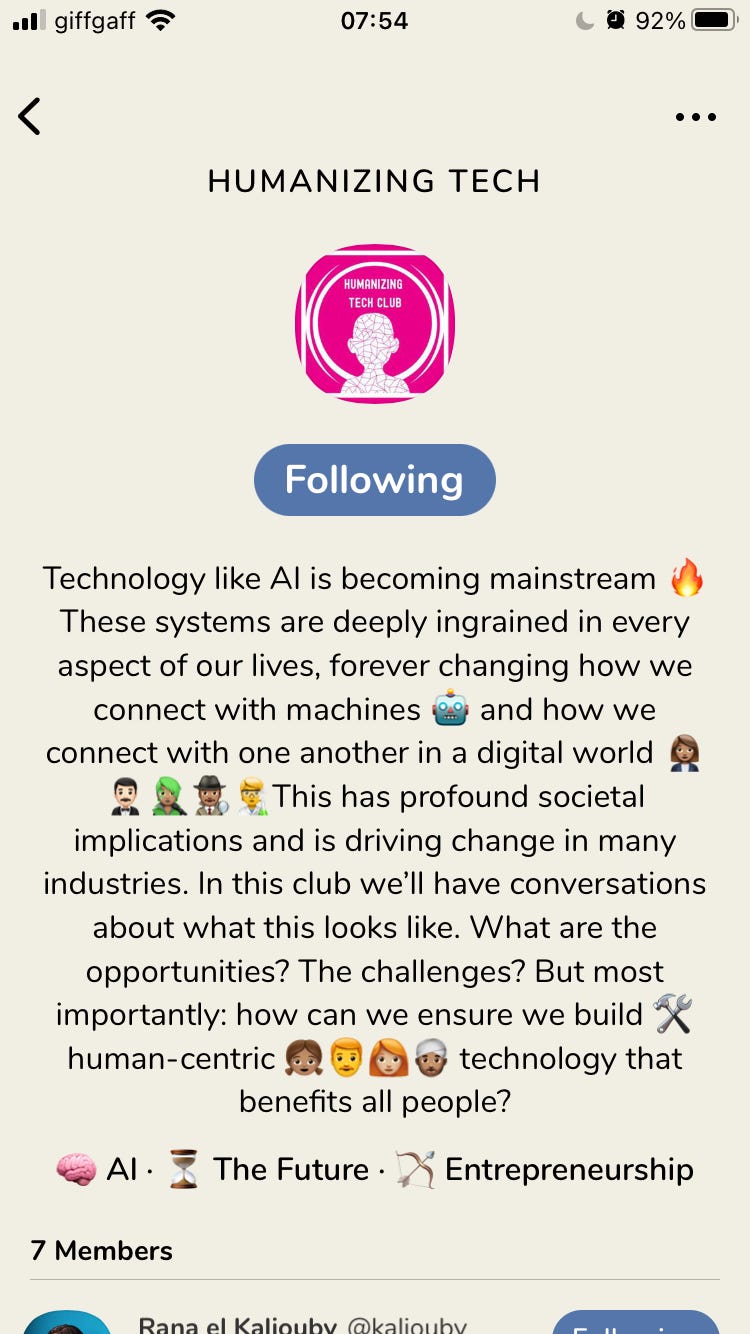
Humanizing Tech: The Future of Work and Human-Machine Collaboration 

Humanizing Tech

I joined a discussion on the future of work, automation, and AI, co-hosted by Natalie Monbiot, Head of Business, HourOne and Rana el Kaliouby, CEO and co-founder, Affectiva, and guests. 

How do we ensure we don’t lose our emotional intelligence as the virtual world dominates? Exploring some real-life examples of AI innovation (see below), how we can upskill, and what new jobs it will create for us. 

Top takeaways:

• We need to rebrand and reframe AI as collective/collaborative intelligence that explains it better as a joint effort in humans’ service.

We need a new narrative for AI that’s not in competition with humans.

Rana el Kaliouby

• We, as humans, need to develop our empathy skills for AI, learn how to collaborate with it, and take pride in the relationship rather than seeing it as competitive. It’s an opportunity to increase our emotional intelligence and become more empathic. 

• The wild world of AI is fast-emerging. It’s creating new jobs for us – trainers, coaches, and helpers. We’re using virtual shop assistants, CGI influencers, and health coaches to communicate pre-scripted healthcare advice. Gaming is leading the way with avatars. 

Remain open to being surprised. Explore and be open to new experiences.

• The challenge: AI eliminates the mystery and unpredictability of life, leading to a culture that’s boring and devoid of innovation and imagination. Our lives are richer when they’re not over-curated, algorithmic experiences. 

• Embrace the philosophical idea that we need to respect other life forms and objects – Japanese Shinto religion treats inanimate objects with respect. Why shouldn’t that apply to AI systems? Interesting to hear workers at the Audi factory had compassion for their robots – taking care of them and noticing when they were under-performing. 

• Super high-speed travel will transform the commute. We heard from Sarah Luchian, the first passenger on the Virgin Hyperloop, a floating pod which reached speeds of 107 mph and travelled 500 metres in just 15 seconds at Virgin’s test track in the Nevada desert. 

• The future of remote work – how AR glasses are our gateway into the virtual world – the metaverse – the next platform after smartphones. 

Overall, an optimistic and passionate conversation about intelligent AI, how its benefits can outweigh the problems, and how it can help humanity. Look forward to hearing more – Humanizing Tech: Mondays, 8 pm GMT on Clubhouse.

We need beautiful AI, it’s magical, and it will serve us. The leaps and bounds will come from humans.


Affectiva – a pioneer in Emotion AI, the next frontier of artificial intelligence. Bringing emotional intelligence to the digital world with technology that senses and analyses facial expressions and emotions.

I’ve been on a mission for the past 20 years to humanise tech.

Rana el Kaliouby, CEO & Co-founder, Affectiva

HourOne – a video transformation company that uses advanced neural networks, machine learning and audio-visual to create synthetic characters that look and sound like real people.

Our belief is we should have human beings behind the virtual people. 

Natalie Monbiot, Head of Business, HourOne

Kate Darling – Leading robotics expert known for her research in the field of robotics ethics. Author of The New Breed: How to Think About Robots.

• Catalia Health – bringing together AI, psychology, and medicine. Replacing phone calls with an in-home digital companion delivered via Mabu, an interactive and empathetic social robot and wellness coach. 

Transhuman – a tech research and development lab focusing on cognitive and emotional communication for human language evolution. Known for its ‘Be a Looper™’ mental health app.

Robovision – The human-machine revolution is out of reach for most companies, so they’ve built an interface to change that – the first AI vision platform that makes Deep Learning collaborative.


Go Deeper 🛠

🎧  Futureproof: Building Empathy into the Brands of Tomorrow with Minter Dial. Everything starts with the individual. Build self-empathy first, then think about how you want to express your brand—advice on developing a culture of empathy at work.  

📚 Girl Decoded, Rana el Kaliouby. There are loads of books on AI, but this is the first memoir I’ve seen – her quest to make technology emotionally intelligent and change the way we interact forever.  

✍️  Artificial intelligence isn’t coming for your job, but it will be your new co-worker. Here’s how to get along. (Harvard Business Review)

📱 10 Breakthrough Technologies 2021 What if your smartphone could sense when you’re down, sad, angry, and offer words of comfort? Karen Hao on how AIs with multiple senses will gain a greater understanding of the world around them. (MIT Tech Review)

🏠  The House of Beautiful Business – a global platform and community to make humans more human and business more beautiful. Special reports on The State of AI and The Future of Experiences. I’m excited to join as a resident! 


Welcome to my bookshop! 📚

I’ll be sharing books in my bag and recommended reads on Bookshop.org. They pay a 10% commission on every sale and give a matching 10% to local bookstores, an integral part of our culture and communities. I would be very happy if you make the odd purchase here.


Work with me 🙋🏻‍♀️

Leopard print, always. Worry less and rock a red lip. Remote work evangelist, problem solver, internet person.

💡 Something you want me to write about? Leave a comment or email nicci@niccitalbot.io

☕️  My Ko-fi page – tips and large bank transfers welcome

📩 Subscribe to The Shift here

👋 Join Copy Club, 6 pm GMT, Saturdays on Clubhouse

Categories
Newsletter

Burnout culture is alive and well. How about you?

Thinking big 💡

I am not just busy; I am being overwhelmed by an onslaught of requests like yours… 

The pioneer of workplace burnout research is swamped with work. Christina Maslach, a psychology professor at the University of California, Berkeley, first studied burnout in the 1970s and has been searching for solutions since. She was busy before the pandemic, but now… her inbox has exploded.

I found myself apologising last week when a client called to chase me for invoices. ‘I’m a bit concerned you might need groceries… You can send me this month’s and last month’s if you like…’ Usually, I’m on it – I love invoicing clients, but right now, I’m overwhelmed and behind on admin. I have over 6,000 emails, as I said last week. 

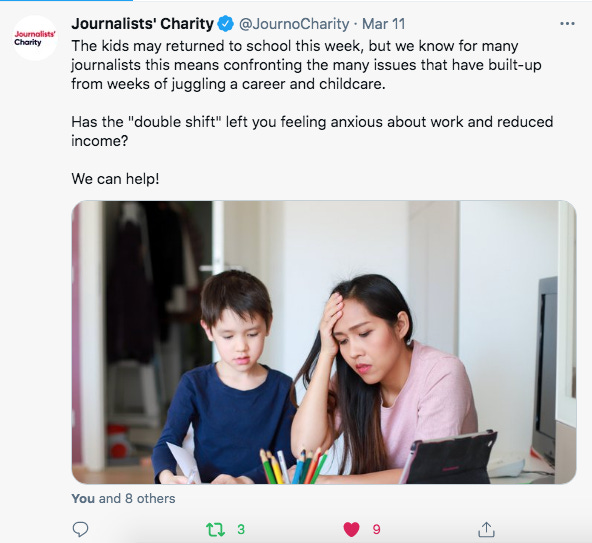
It’s been a double shift since Xmas, and it took this tweet from the Journalists’ Charity to remind me of that. 

@JournoCharity

I’ve been reading lots of articles about pandemic burnout – it’s our anniversary, but burnout has been a silent issue for some time. Interesting to read this piece in The Atlantic on how burnout is technically a work problem.

Research suggests we tend to feel more stressed when we face conflicts about our various roles—mother, worker, friend to a frazzled co-worker, daughter to an anti-vaccine parent. And right here is the role conflict plague.

Three million American women have dropped out of the workforce since the pandemic began because they are shouldering the burden of all these different roles.  

It points out there are plenty of wellness hacks to help us push through the pandemic, but according to burnout experts, it’s a problem created by the workplace, and changes to the workplace are the best way to fix it. The World Health Organisation defines burnout as a syndrome resulting from chronic workplace stress that’s not been successfully managed.

We’re in the thick of the ‘shecession‘, and globally, women’s job losses due to Covid-19 are 1.8 times greater than men’s. According to McKinsey’s survey, one in four women said they were thinking about reducing or leaving paid work due to the pandemic, citing company inflexibility, caring responsibilities and stress. 

High status doesn’t insulate women from stress and burnout. Senior-level women are significantly more likely than their male peers to consider dropping their hours or dropping out of the workforce because of the burnout associated with being “always-on” and juggling multiple responsibilities during the pandemic. BBC Worklife.

As the McKinsey report shows, companies are stepping up, but many don’t address the underlying causes of stress and burnout—the childcare crisis and a need for flexible working at all levels of work. We still have outdated views of women in the workplace and see child giving as a female function, and care work is still low paid and undervalued.

Companies can do more—childcare subsidies should be the norm, not a job perk – and employers that offer this will attract and retain top talent. People give more and are loyal to employers when they feel valued and cared for.


The advice 🤔

Path For Life

I heard Jeanette Bronée talking about burnout and self-care in the workplace. She is a workplace wellbeing strategist and on a mission to make self-care part of business culture. She is hugely passionate about her work and what she said resonated with me.

Self-care is an essential skill in the future of work. Burnout is probably the most disruptive issue that we have to deal with in work culture, yet we don’t really know what to do. We’re focusing too much on the symptom of burnout rather than looking at the root cause.

I had burned out twice by the time I was 40 years old. And to no surprise. I was young, ambitious, and I expected my body to be there for me.

And she’s not alone. 7 out of 10 millennials burn out before they’re 40.

We need to foster the mindset that burnout is a work company problem to fix, not an individual issue.

The future of work requires us to change the way we think about performance and productivity. Even though time is our greatest challenge, health is the foundation for peak performance that can transform the workplace from a burnout culture running on stress and survival mode to a culture driven by care, purpose, focus and engagement.

‘Self-care is not for after-work’ – find ways to give yourself microdoses during the day. And it’s not about ploughing on: ‘We need to redefine resilience with Covid – it doesn’t mean to keep pushing through, it means to be supported.’

It’s time to rethink work culture – burnout culture is not working. And a warning that we may be heading to another version of it virtually – the next burnout – if we don’t get the balance right now.

Self-care can’t wait. As the last year of the pandemic has shown, the world is speeding up, but we’re not robots – our bodies are still running on the same system.

We think of self-care for when we make it, but we’ll make it faster if we practice self-care. It’s a choice. We can hustle because we practice self-care.

We can be successful and healthy; it shouldn’t be a choice between the two.

And there’s a direct link between individual self-care and the health of an organisation.

Someone said: ‘If I want to suffer, I’ll go back to being an employee in the corporate world.’ 

That makes me sad. Is this the world we want to bring our kids into?

More resources on Jeanette’s website, Path for Life, and she’ll be speaking about how we can fix work at the Self-employed Summit on April 12 & 13. 

Here are some practical things you can do to help prevent burnout and be your best. Thanks to Jeanette Bronée, Nilufar Ahmed, The Worldwide Association of Women Journalists & Writers, and the Society of Freelance Journalists – excellent events this week on mental health.

There’s a lot of help out there. 🙏

On work routine: 

• Start with the basics – create a work schedule that integrates basic care, water, food, sleep and have structured work hours during the day.

• Fake commute: We need physical movement to prepare our brain and body for the next task. We need structure and separation. Build activity into your day. Try a standing desk. 

• Power Pause – check-in: where am I right now, and what do I need to be more focused and have more energy? Get into the habit of giving yourself microdoses of self-care during the day.

• Have a personal board of advisors – mates, colleagues – who will look out for you.

• Take a nap – it’s better to take a 10-minute nap than have a coffee as it calms you down. The Nap Ministry is on a mission to bring back the culture of napping. ‘We believe rest is a form of resistance and reparations.’ 

• Create a compliments folder – log every compliment you receive, including the date and who said it. Kudos – You’ll instantly feel better.

• Put your work stuff in a box and pack it away end of the day.

Tech is one of our biggest stressors: 

• Be mindful of your email use and keep ’em short and succinct. Respond to emails at set times and set an autoresponder.

• ‘The pandemic is sending our brains conflicting messages. With video calls, faces are within 50cm of us, and this tells our brain that these are close or intimate friends when instead they are colleagues or strangers. It’s tiring. Avoid back-to-back meetings – we need time to pee, hydrate, and reset our brains.’

• Work on one thing at a time. Close additional tabs on the browser, clear your desktop, turn off notifications.

• When did you last have a proper belly laugh? We forget to have fun at work – play music while replying to emails.

• Make time in the day for casual chat that isn’t work-related – have a virtual lunch and use tech in different ways. 

What can you do differently from tomorrow? 


Go deeper 🛠

💡 The Maslach Burnout Inventory™️ – take the test.

🕵🏻‍♀️ The Self-investigation – A free online stress management and digital wellness program from Pulitzer prize-winning journalist Mar Cabra, Kim Brice, and Aldara Martitegui. 

🎧 Managing Burnout – Women at Work podcast, Harvard Business Review with Mandy O’Neill, an expert on workplace wellbeing. When was the last time you had a proper belly laugh? Great discussion. 

💻 Path for Life, Jeanette Bronée – Resources for people and companies to achieve better work-life quality. Jeanette is speaking at the Self-employed Summit on April 12 & 13. 

📚 Can’t Even: How Millennials Became The Burnout Generation by Anne Helen Petersen. Loving her newsletter, Culture Study – Imagine Your Flexible Office Work Future, and looking forward to her new book on the future of work.


Welcome to my bookshop! 📚

I’ll be sharing books in my bag and recommended reads on Bookshop.org. They pay a 10% commission on every sale and give a matching 10% to local bookstores, an integral part of our culture and communities. I would be over the moon if you buy something every now and then here.


Work with me 🙋🏻‍♀️

Leopard print, always. Worry less and rock a red lip. Remote work evangelist, problem solver, internet person.

💡 Something you want me to write about? Leave a comment or email nicci@niccitalbot.io

☕️  Tips & large bank transfers welcome

📩 Subscribe to The Shift here

👋 Join the Copy Club, 6 pm GMT, every Saturday on Clubhouse

Categories
Newsletter

🕵🏻‍♀️A World Without Email

A World Without Email Reimagining Work in the Age of Overload (or the hyperactive hive mind

Email is making us miserable. By trying to be more efficient, we’ve accidentally deployed an inhumane way to work.

Cal Newport

Thinking big 💡

I have a love-hate relation with email. Love the convenience of it as a messaging tool but hate stuff piling up and having to go through it all. 

6083 in my personal Gmail account 😱 

Over half the world population uses email in 2021. The total number of business and personal emails sent and received per day will exceed 319 billion in 2021 and is forecast to grow to over 376 billion by 2025. Despite the growth of chat apps, we still use email, and you need an email address for most online activity. I spend most of my day in work inboxes – it’s where the magic happens – sign off, editing, documents because it’s faster and in real-time—the ping-pong game…like a slot machine. 

The overall feeling is low-level anxiety like my work is never done.

  • We check our emails every six minutes 
  • Knowledge workers receive and send an average of 126 emails every day 
  • We spend an average of three hours a day on email

A growing body of research on the effect of email suggests banning or putting restrictions on email can dramatically increase individual productivity and reduce stress. Companies have also taken action to reverse the trend. Thierry Breton, CEO of the French information tech company, Atos Origin, noticed his employees were distracted by constant emails, so he took steps to eliminate what he saw as adverse effects on productivity. In 2011, he announced he was banning email and wanted Atos to be a ‘zero email company within three years. 

We are producing data on a massive scale that is fast polluting our working environments and also encroaching into our personal lives. We are taking action now to reverse this trend, just as organisations took measures to reduce environmental pollution after the industrial revolution.

Thierry Breton, CEO, Atos Origin

The solution was not to ban electronic communication outright for over 70,000 employees; instead, they built a social network organised around 7,500 open communities working on collaborative projects. Atos hasn’t got rid of email entirely but reduced it by 60%, increasing their margins and reducing administrative costs. 

The movement to protect leisure time is gaining ground. The EU parliament voted massively in favour last month of a resolution calling on the European Commission to propose a law allowing digital workers the ‘right to disconnect’ outside of work to reduce burnout. Research shows people who work from home are more than twice as likely to surpass the maximum of 48 working hours per week. And we’re putting in more hours since Covid – two a day on average.

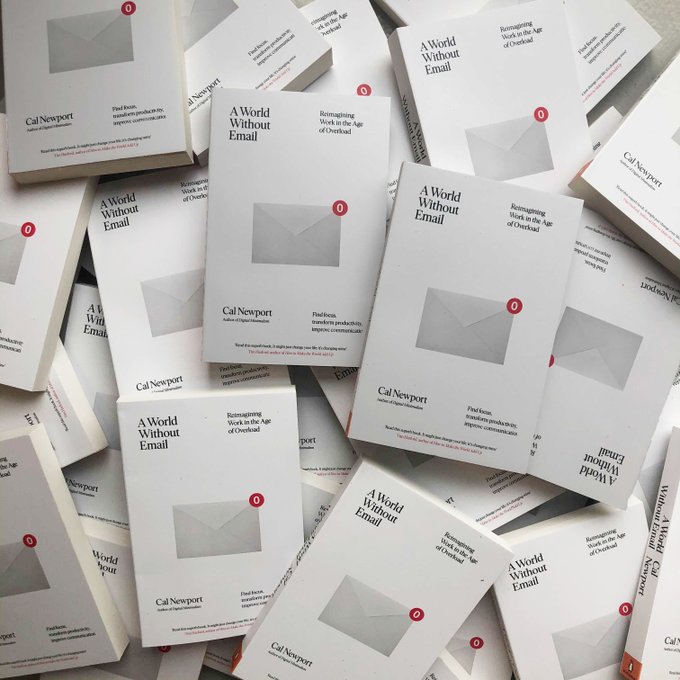
A World Without Email: Reimagining Work in the Age of Overload

Penguin Books

Last Friday, The New Yorker published an excerpt from Cal Newport’s new book, A World Without Email. Cal, aka Mr Deep Work, is a Professor of Computer Science at Georgetown University and the New York Times Bestselling author of seven books. 

The chapter focuses on an aspect of overload culture that isn’t talked about much – that email is making us miserable. The more time we spend emailing, the less happy and more stressed we become. What makes this a game-changer is that Cal is putting the onus on companies to make top-down changes rather than focusing on the individual as per earlier books. As Peter Drucker said back in the 70s, knowledge workers are autonomous, but only to a point.

As a freelancer, you can create your own systems and habits to manage information, but it’s not going to make much difference if your clients don’t work in the same way. 

The hyperactive hivemind 

Our workplaces are set up for convenience, not for getting the best out of us. We must be switched on to multitask with knowledge work, which doesn’t fit in with creative, deep thinking. Neuroscientists tell us our attention is single-tasked, and it’s not productive to switch from one task to another. This is making us miserable. 

It mismatches with the social circuits in our brain. It makes us feel bad that someone is waiting for us to reply to them. It makes us anxious.

Cal Newport

Cal describes this workstyle as the ‘hyperactive hivemind’ based around unstructured communications via email and IM and meetings that dominate our day. Email is fine for short communications as intended, but it’s a terrible knowledge management system. 

How do we tackle the hivemind and do our best work?

Cal says we need a more linear approach to workflow. Doing one task at a time to allow the brain to switch contexts – with fewer interruptions from email & IM. One study found (via BBC Worklifeon average, it takes us 23 minutes and 15 seconds to regain a deep focus after an interruption

We can learn a lot from how software engineers operate – extreme programming, Scrum & Agile methodologies. Working on one product for a period of time and giving it your whole focus. A more intense, shorter day of deep work with no ad hoc tasks works better with how our brain operates. Try applying Sprint methodology to your creative work – pitches, ideas. 

Work on the productivity of the knowledge worker has barely begun. Globally, the world has more than 1 billion knowledge workers, so we’re well overdue for a rethink & revolution.

It’s coming!!

The next five years will see an insane amount of change and we’ll be embarrassed that we opted for ease over efficiency with email. There’s a lot of interest in getting rid of the hyperactive hivemind to produce higher quality products and services because money and productivity are on the line.

Companies that require their workers to be ever wired and working on multiple tasks will fall behind companies that prioritise more in-depth, slow creative work.

It’s a radical and bold vision – a world without email – that could make you happier and more productive. As Caroline Sauvajol-Rialland, the author of Infobesity, says, information overload is a cultural crisis.

There’s this great challenge of lundimanche that we must tackle, – the French portmanteau word for the blurring of Sunday into Monday. 

Caroline Sauvajol-Rialland

It’s time to change how we communicate at work. 

The advice 🤔

  • Use Calendly instead of emails to arrange meetings to reduce the back-and-forth comms.
  • Use shared project management tools like Trello, Dropbox or Flow to organise tasks and share links so your team know what you’re working on, can see status updates and add comments – it reduces the pressure on your inbox. 
  • Basecamp has ‘Office Hours’ – if someone has a technical question for a given expert, he or she can’t shoot an email and has to wait until the expert’s next office hours to ask a question.
  • Get rid of personal email addresses and have a team/project email so everyone can respond. 
  • Try Scrum/Agile methodology – combines working in intense sprints (1-4-week projects) with daily 15-minute standing meetings to get things done. Everyone gets a chance to speak and ask for help. Pin coloured notes to a board to show commitments, so there’s no ambiguity.

If it works for 12+ million software developers…

Go deeper 🕵🏻‍♀️

🎧 The James Altucher Show – A World Without Email with Cal Newport.

💻 The New Yorker: Email is Making Us Miserable and The Rise and Fall of Getting Things Done.

📹 LinkedIn Live: Journey Further Book Club with Cal Newport – A World Without Email, March 16. 

📚 Under New Management by David Burkus – the companies outlawing or at least restricting email and getting more done.

🎤 National Union of Journalists event, March 8 – a chat with John Crowley, co-author of the Journalism in Time of Covid survey, on freelancing and mental health.

Guests welcome – email me!! if you’d like to come.