Categories
Newsletter

🕵🏻‍♀️ Exploring the future of journalism

How we can use Design Thinking to solve journalistic problems.

I’ve been to a few journalism events this week on the industry’s future and what needs to change.

NUJ Racism and the Media special meeting, Freelance Industrial Council, and the #buildbackwellDEN Spring ’21 meeting. 

Common themes: Digital transformation, reinvention, diversity, resilience, burnout and mental health.

There was a backlash to the Society of Editors’ bizarre statement denying press racism in the UK. Press Gazette did a survey which shows there’s still much work to do. NUJ Black Members’ Council made a statement about what we can learn from the Meghan Markle race debate saying how the industry should have used the comments made by Meghan and Harry to start a long-overdue debate about the best way to prevent racist coverage.  

We heard some shocking stories about racism in the media and how the media has a problem pigeonholing journalists of colour. Editors want pitches related to race and lived experiences, giving little space for journalists to explore other topics. 

Lack of diversity in newsrooms was the biggest issue flagged. It’s not so much a problem with recruitment, but retention – if the work culture isn’t diverse and welcoming, people won’t hang around. Depressing to hear stories of endemic racism in our media corporations and comments like: ‘Sometimes the only way to break out [of the box you’re put in] is to leave and come back in through another door.’

Look out for the full report on londonfreelance.org.


Do freelance rates discriminate?

We have some new data on gender, ethnicity and rates. Thanks to the #FreelancerPayGap initiative LFB has added over 1,000 Rates for the Job with info on ethnicity as well as gender. We have a gender pay gap and an ethnic pay gap. In this data set, women are getting less than men and people who don’t identify as ‘white’ are getting less than those who do.

We all need to step up. Sharing rates and being transparent about pay will help to dismantle the gender pay gap. You can submit your Rate for the Job here and via the #FreelancerPayGap. I’ve seen similar campaigns for advertising and publishing. 


#buildbackwellDEN (Digital Editors’ Network) 
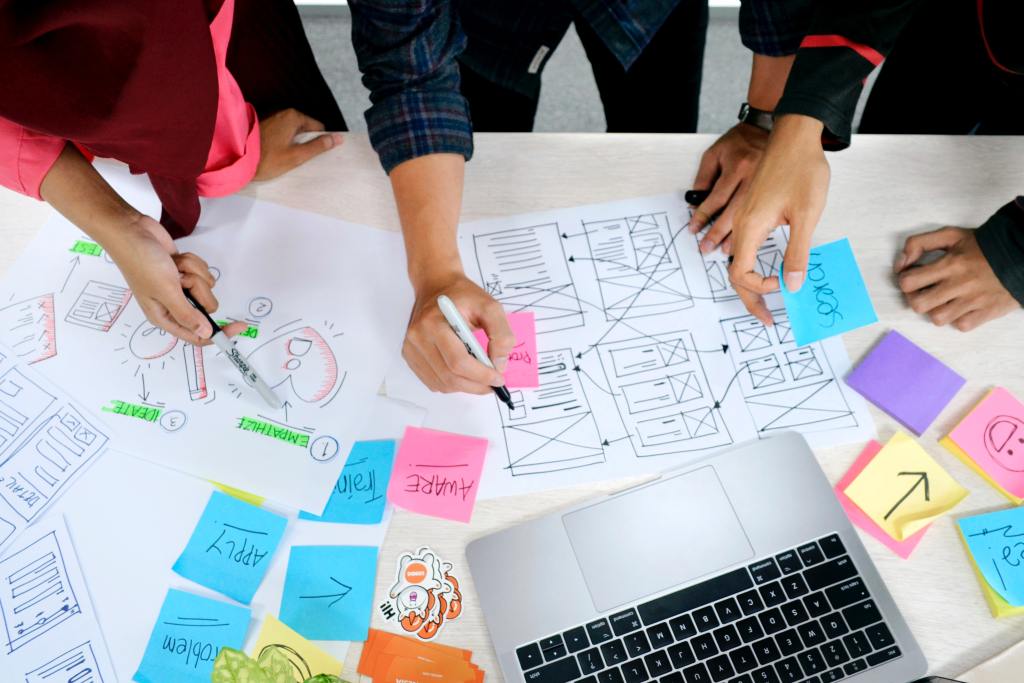
UX Indonesia on Unsplash

More than 70 colleagues from across 12 time zones came to the DEN event – a 90-minute, interactive discussion on how we can build back well. It focused on three areas: PEOPLE, PROCESS and PRODUCT.

The aim is to co-create an agenda to take back to decision-makers so it’s not just a talking shop (there’s a working document).

Excellent speakers and breakout sessions to brainstorm ideas.

The Chatham House Rule means I can share information about the discussion but not identify anyone or attribute quotes. This is so people can speak freely.

Key points: 

– Flying the flag for freelancers. The fastest-growing sector of the industry. Will we all burn out? Is that where this is heading? Is there any research on freelancers and burnout, and where do we go?

– No more siloed working. Newsrooms and publications need to build a better relationship with freelancers and be more inclusive. Freelancers need to be paid fairly – more transparency around pay rates.  

– We need a database of freelancers showing who’s available, their background and what they can do. To help speed up the commissioning process and encourage collaboration. Databases like this exist within organisations, e.g. the BBC has a portal, but there’s nothing that can be accessed by the wider industry.

– What companies are doing to prevent burnout – training people up on mental health, working on user-generated content, creating intranets about COVID as a resource for staff, and enforcing wellbeing policies.

– How Design Thinking can transform journalism. Never thought I’d hear Design Thinking, empathy and journalism in the same sentence 😉 Exciting! I’m reading a lot about Design Thinking on my UX course – here’s a nice intro.

Newsrooms need to take a more holistic approach with human-centred storytelling and understand what people need before creating a story/product. How much do you know about your readers? Involve them in the creation process. 

– Soft skills vs hard skills: The importance of listening and empathy. The emphasis on hard skills in journalism is why I haven’t felt comfortable in it. It’s as though being argumentative, pushy and loud somehow makes you a better journalist. I did some subbing shifts on the nationals a few years ago – no women on the team, a hard-drinking culture and long working hours. A work culture that would exclude many.

Well done, DEN. An inspiring discussion and lots to think about. Feels like I’m heading in the right direction with the UX training – and I can see why I’m attracted to it.

I can combine my UX work with journalism to create better media products.

Check out the speakers and feel free to send in ideas for future DEN events.

Enjoyed this article by Rasmus Kleis Neilson, Director at the Reuters Institute for the Study of Journalism, on the vanguard and rearguards in the fight for the future of journalism. The tension between those who embrace change and those who want things to stay the same.

The vanguard is full of women and more diverse. The rearguard full of white men like me.

This mindset will continue to undermine journalism’s ability to adapt, remake, and renew itself, and the profession as a whole, especially younger journalists, will have to live with the consequences of this conservatism.

Rasmus Kleis Neilson

Go deeper 🛠

World Press Trends Outlook 2021: Digital transformation in the driver’s seat. Nearly 60% of publishers say staff will either WFH or have the option to WFH going forward. Only 5% expect to move everyone back to the office. 

Content is Product and Product is Content: Why deeper alignment is the only way forward. Dmitry Shiskin on why it’s time to start treating content and product as one. They are slowly merging into one thing. 

People pay for other media, but they won’t pay for journalism (Heather Bryant).

The idea that the user experience of the delivered product of most journalism is anywhere near the quality of any of other media is in many cases a delusion of grandeur. 👏

Facebook is Starting a Substack Competitor (Nieman Lab) – Facebook to pay $5 million to local journalists in news push. They’ve pledged to invest $1 billion in the news industry over the next five years. Be interesting to see what happens – Facebook has strong community groups.

Substack says, bring it on! 

Listen up! #FutureMediaPodcasts roundup 🎧

Why journalists NEED to be researchers (Shirish Kulkarni) – on how journalism can apply Design Thinking principles to tell better stories.

Most of our news is presented ‘top down’ – do we actually want something ‘bottom up’ where communities are more involved in telling their own stories? 

How to use design thinking to solve journalistic problems (newsrewired.com)

Freelancer Magazine – well done to the team for getting this out, an inspiring read 🙌 Get your copy here.

Freelance Business for Writers, 3-4 June 2021. Free online event for freelance copywriters, editors, journalists and translators. Speaker callout🎙

Global Freelancing – take the survey. ‘The goal is to understand the experience of freelancing during the pandemic and looking ahead at the future of work.’


This month, I’ve been… Building backlinks 🔗

I wrote an article on how to build backlinks. What they are, why you need them, and how they’ll help your business.👇

Google has over 200 factors that determine your site ranking, and number one is backlinks. 

Link building is an art and science, creative and analytical. It involves detective work, psychology, tools and relationship building.

I’ve done a few things so let’s see if my Google ranking improves.

Happy link building! 


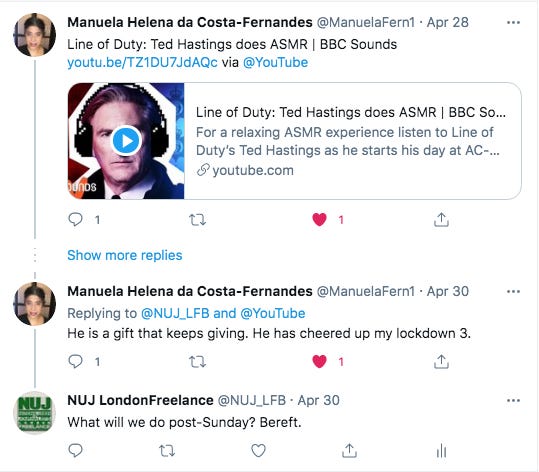
LINE OF DUTY

Ted Hastings. A man of principle. He can’t retire!

Will we find out who H is…? Not long till I get my fix…
Categories
Newsletter

🕵🏻‍♀️Coming out of lockdown, Digital skills training, UX jobs

✂️ 🍺 🌞 Step two of the roadmap – life!! Lots of smiling faces in Hastings old town – pub gardens are packed, caravan parks full. I’m not ready for crowds yet but I’ve been out walking lots and did a bit of shopping in TK Maxx – the vast warehouse. ‘It was chaos for three days. People were elbowing each other out of the way; it wasn’t pleasant.’ People are spending all day in there, just to get out of the house.

They need a coffee bar and a loo and it’s a proper leisure attraction.

I’ve booked a haircut with Andrew Scissorhands, so he’s coming round to the flat in May. After working in London for 30 years as a stylist, he’s been wooed by the fabulous vibe in Hastings and St Leonards and set up his own salon here – currently ‘haircuts at home or on the beach’ – tagline: ‘A fraction of Harrods in Hastings’. He’s also working with the Seaview Centre, a fabulous homeless charity in St Leonards. 

Can he make an ancient monument look respectable? We’ll see. I didn’t do a great job with the kitchen scissors.

The mass exodus from London to Hastings continues.


UX Writers Collective

I’ve started the UX writer training. I’ve been dithering for a while as I’m not sure I want to do it full time, but I’m ready for a change. I’ve lost my enthusiasm for sales copy and social media marketing and want to niche down and do deeper work. I had a breakthrough last week with my therapist (who has now become my work accountability coach) and realise it’s ok not to know where it’s all going. Retraining doesn’t mean giving up everything I’ve done so far. I’m a bit scared I might not enjoy it or be any good at it.

But I won’t know till I try and take on some new projects.

UX writing (user experience) is a new growth industry. Lots of innovation and opportunity, and people are coming to it from all walks of life – I’ve met former journos, customer service agents, and copywriters who are moving into tech. The vibe is inclusive, generous, encouraging, and collaborative—no egos which is refreshing. The course is online and self-paced, so I can fit it in around client work. If I do an hour a week, I’ll be certified in 8-10 weeks (if I crack the final assignment, which is hard).

Thoughts so far – it’s harder to write less. UX is more about research and content strategy with a focus on the user. It’s making me think more about accessibility, collaboration and design thinking – taking a holistic approach to content. Unlike copywriting, it’s not the sort of work you do in a silo, so that will be good for me – I’ll have to speak to people. I need to learn a few design packages – Miro, Figma, and basic HTML/coding.

I’m doing a bit of networking – joined the Content + UX Slack group, did the UX Writers conference, and will check out some local meetups when they restart. I’ve signed up for the Daily UX Writing Challenge to do some practice work for my portfolio and paid for a Medium subscription – $50 a year and well worth it – lots of great articles on writing + design. I’m making a little on there via the Partner program.

Lots of books to read – I bought Marie-Pier Rochon’s book on UX writing – she’s a copywriter in Brisbane who has moved into UX, so it’s interesting to read her story and perspective on the industry.

What do I want? A gig with a remote-first company where I can be a corporate nomad and slowmad when I’m an empty nester. My place in the sun – running remote retreats. It’s exciting to see the visa and tax incentives coming in for remote workers: the
CanariesItaly, the Caribbean, Croatia & more. My mission is to create useful digital products people love to use that make them feel good about themselves. And to help more women and girls get into tech, scale their online businesses, and develop digital skills.

I’ve followed up with Plumia (Safety Wing) – an ambitious project to build the first country on the internet, infrastructure for living anywhere, with the function of a geographic country. They are looking for leaders and contributors in remote work and nomadic space. Interested? You can check it out here.  

Anyway, I need to be kind and patient with myself. Learning new skills and changing careers takes time.

I had an interview this week for a UX writer gig at a design agency – great to get that far. An informal chat to see if we’re a good fit and find out what I’m looking for. They have some fascinating projects on the go – AI & healthcare – interface design for live surgery, remote banking advisors, travel apps and more. The next step would be a formal interview and test – I need a few more projects in my portfolio to talk through. I’ve heard interviews for UX can be tough – you need to show your strategy, iterative thinking, and how you solved the problem.  

I’ve also been thinking about my process and how I work. Social media marketing is fun but distracting – I find myself going down rabbit holes online and there’s a lot of crap and negativity on Twitter. I’m trying to focus on one thing at a time and use my time more efficiently – batch tasks, themed days. I save interesting articles on Instapaper to read later and check RSS feeds via Feedly on my phone rather than reading websites, to save time.

💡 More agile working and sprints
👩‍💻 Periods of focus and concentration
🚶🏻‍♀️A shorter working week

I tried taking two-hour lunch breaks, but it doesn’t work; stuff comes in, so I’m aiming for a four-day week with Fridays off. I felt so much better after a day in Hastings Country Park last week – Daily Huddle with the ponies and roosters, who gave me some solid advice.

Great tips in this thread from Andy Spence on what works better for him to maintain health and prevent burnout. 

Still waiting for my standing desk – in the meantime, I’m shuffling between the desk and mantlepiece to mix it up a bit. There’s something about standing up to work – ideas seem to flow better – so I’m trying to move about more during the day. We’re not designed to spend eight hours a day sitting at a desk.

I’ve made some more green friends – office jungle in progress…🌵🌿


Our digital lives in 2021  

Big shoutout to Romana Sustar and Helen Hague – the new training officers at NUJ London Freelance Branch, who are developing a cracking training programme. Great piece by Romy on our digital life in 2021, focusing on the digital revolution and learning more.

We’re exploring a collaboration with Google News Initiative – free tools and training for groups and individuals to save you time and help you bring your stories to life.

Coming up: Podcasting and WordPress courses with Hamish Brown and Rev Up Your Writing with Judi Goodwin – how to write faster, more fluently, and earn more. I need to speed up – it can be like pulling teeth. Email the training team if you fancy doing one (courses are open to non-members) or DM me on Twitter @NUJ_LFB.

And a free event on 29 April – ‘Building Back Well’ via the Digital Editors’ Network (thanks to John Crowley for sending this on). ‘We have a once-in-a-generation opportunity to hit the reset button.’ What do newsrooms need to change to ‘build back well’? The aim is to co-create an agenda for decision-makers to consider – on people, processes, and products (some best practices to apply to your media business – Substack newsletter coming soon).

I’m thinking about what courses and digital products I could offer – what skills would you like to learn or do better? Newsletters? UX writing? Improving your online presence? Email me – nicci@niccitalbot.io.

– Nicci

Eat this. Breakfast BOMB and healthy snack. I love granola and the supermarket stuff is expensive – tastes great and I’m saving a fortune.


Go deeper 🛠

Bruce Daisley: ‘Almost without exception breakthroughs come from deep work’ (Enterprise Nation) – On what we can do to overcome our collective addiction to interruptions. And a shoutout to Paul Graham’s excellent Maker vs Manager schedule. 

Dell Technologies Turn Off, Tune In: a free virtual event to help small businesses recharge and burn brighter, 4-27 May. Nine inspiring, re-energising sessions designed to help you rest, recharge, and come back, ready to take on what’s next. You can register here

Ireland is planning a remote working push to shift city workers to rural areas (Financial Times). The government is seizing the opportunity offered by changing pandemic-era work habits to shift people from major cities to the rest of the country via a network of 400+ remote working hubs and tax breaks to address the longstanding rural-urban divide.

The biggest mistake we can make as we emerge from the pandemic is to go back to the old normal – Heather Humphreys, minister for rural and community development.

Enjoyed this article by LFB colleague Francesca Marchese, currently on mat leave and spending time with her family in Sicily: Etna: Life beneath the volcanic dust of repeated eruptions (BBC).

Our Digital Life in 2021, Romy Sustar (NUJ London Freelance) – on learning how to podcast, free online training opportunities with Google News Initiative, and upcoming workshops and events.

Getting started with the Medium Partner Program – great articles on writing, design + UX – it’s well worth the $50 membership fee to access unlimited articles and support creators. I’ve signed up for the Medium Partner Program to monetise my work – not earning megabucks, but it will build as I add more content.

We had a chat about AI & copywriting on Clubhouse last night – are the machines coming for us? Human qualities that machines can’t replicate. How we can use AI to improve our work and free up time. If devices are writing shorter text, news stories, and product descriptions – it reorients us towards long-form content, opinion, analysis, and investigation.

In summary: Don’t worry. Sex robots are here, but you wouldn’t have one as a partner. Read the notes here.

This LinkedIn post went viral – a contractor described his reaction to having a heart attack when working at home. ‘Fuck I needed to meet with my manager tomorrow; this isn’t convenient.’ And on reflection, how he is restructuring his approach to work because ‘life literally is too short.’

Some great advice in the comments – ‘try to create multiple streams of income at your own pace.’


Categories
Newsletter

🕵🏻‍♀️Substack: the Marketplace of Ideas

Weekly curated tools + resources for writers – thinkers, makers and builders ✍️

Interesting read from Ben Smith in The New York Times on the Substack debate. Media company vs tech platform, their editorial role (or not), the advances paid out by Substack Pro, and their biggest challenge: competitors like Ghost and Twitter/Revue.

The quote from John O’Nolan, Ghost CEO sums it up: Subscription newsletter publishing was ‘destined to be commoditized.’

The news is that Substack has signed up two high profile transgender writers – Danny and Grace Laverty so we have a household with two Substack incomes. A smart move, as it helps counter the backlash they’ve had from some writers who don’t want to share the platform with people who they said were anti-trans. It shows they want to be a platform for all – even those who criticise the company.

There’s been a media storm around Substack over the past year – about money, mostly (they are VC funded and valued at $650 million (Axios), the compatibility of VC funding and journalism, and the ethics of paying writers to join the platform. Why not? Authors get book advances, and we don’t bat an eyelid. And subscriptions are a much better deal for writers.

As Casey Newton said, Substack is taking up a lot of mindspace and has become a target for ‘a lot of people to project their anxieties.’

Substack has captivated an anxious industry because it embodies larger forces and contradictions. For one, the new media economy promises both to make some writers rich and to turn others into the content-creation equivalent of Uber drivers, even as journalists increasingly turn to labour unions to level out pay scales. – Ben Smith.

Some writers (a minority) are making big money on Substack – good for them. It’s inspiring to check the leaderboard and see what’s possible – it introduces a bit of friendly competition. They’ve built a following over time and bought their audiences with them.

But most (like me) are making money via support from readers, not paid advances. It’s a side hustle alongside their main job or freelance projects. It’s fun. I’m learning as I go, and it’s an opportunity to have a product and a platform. There’s no obligation to stay – I can take my work and publish it elsewhere.

Power to the creator 

The power shift has been happening for a while – Patreon CEO Jack Conte talks about it here. Substack isn’t creating it, but it’s part of it and riding the wave. There’s a cultural shift towards the creator economy, valuing good content and being willing to pay for it. David Lat calls it the ‘great reset’ of charging for content (we all need to get used to paying more for content!). And the fear is that it’s helping writers to discover their market value.

The genie is out of the bottle, and there’s no going back!

And it’s not legacy media vs Substack either – we have broad tastes, and there’s room for all types of media. I’m not paying for news on Substack; I’m getting opinion, analysis, and diverse views from people who may not fit the traditional media mould/niche, which is refreshing. Journalism is still largely a white, middle-class profession.

I am excited about Substack – it’s the biggest tech challenge in a while, and captures the spirit of early blogging with diverse views and a dose of reality. Columnist Heather Havrilesky is taking ‘Ask Polly’ from The New Yorker Magazine to Substack to ‘regain some of the indie spirit and sense of freedom that drew me to want to write online in the first place.’

As long as they keep adding value, supporting writers, and building community, I’ll stick around. It feels good to be part of a bigger mission.   

As a writer on the platform, the pain points are SEO – very important!! I’m giving away my Google juice. So I publish on my site first, tell Google I own the content and then share it to other platforms – Substack, Medium, and social media. And for those writers earning a living here, the 10% commission is a killer and needs to come down.

As a consumer, it’s expensive to subscribe to lots of newsletters – see this thread from Laura Hazard Owen. I can claim expenses if they are work-related, but I’d love to see more ‘bundling up’ newsletters in similar industries to offer value to readers. I’ve seen posts on Reddit asking if people are interested in joint subscriptions to split the cost.

Companies need to get in on the act, too – newsletter bundles would be a great perk for employees – fresh ideas and perspectives enhance workplace culture.


What are publishers doing to solve the ‘Substack problem’? 

  • The New York Times has bought columnist Paul Krugman’s free Substack to their platform.
  • @Choire is stepping down from the NYT Style desk and ‘taking on a new and exciting challenge, as a senior editor charged with a project to help expand our newsletter portfolio alongside Sam Dolnick and Adam Pasick.’
  • Vanity Fair meets Substack – former VF editor Jon Kelly is launching a new, private equity-backed publication. ‘Writers have been offered equity and a percentage of the subscription revenue they would generate.’

As Ben points out, the biggest threat to Substack isn’t politics amongst writers but another tech stack with a different (cheaper) model, e.g. Ghost, Twitter/Revue. Ghost is open-source and non-profit, which will appeal to many publishers.

They are aware of this and working hard on ‘brand Substack’. Good to see they’ve announced a $1 million initiative to support a new group of local news writers on the platform (non-famous writers ;-).

This is not a grants program, nor is it inspired by philanthropic intent. Our goal is to foster an effective business model for independent local news that provides ample room for growth.

There’s more to come. ‘We will make a large investment in a support program that includes initiatives related to healthcare, personal finance, editing, distribution, design, and coworking spaces.’ Which gives them the edge.

And writers will find creative solutions for siloed working and isolation. 💪

Today, eight writers with paid newsletters on tech and culture, including Casey Newton, Anne Helen Petersen, and Delia Cai, are launching Sidechannel –

‘A shared Discord server where our paid subscribers can meet, hang out, and participate in a vibrant daily conversation about tech, culture, and society.’

They have big plans – shared channels, jobs, networking, and Clubhouse-style chats where you can ask questions. Facebook CEO Mark Zuckerberg is their first guest tomorrow.

Let’s celebrate Substack’s success. Indie media is super important, as is diversity – we need more voices. Please support your favourite writers, artists, and musicians via Substack, Patreon, Podia, Soundcloud, and Stack Magazines – leave a tip or comment, share and like a post – a little goes a long way to help.

Self-publishing is a hard, lonely job 🎻

From the NYT comments:

In a media ecosystem where six companies own systems that deliver 90% of the news, indie platforms can only be a good thing.

Substack is filled with cancelled, edgy writers. It’s where Ernie Pyle, Hunter Thompson and Martha Gellhorn would be if they were alive and writing today.


Go deeper 🛠

✍️ Sovereign Writers and Substack (Stratechery) – Ben Thompson on ‘the fundamental issues about the Substack model specifically, and the shift to sovereign writers generally, that are being misunderstood.’

📬 Newsletters: The market is booming! (Marie Dollé). Mapping the newsletter ecosystem. ‘Creating content for and with your audience is exciting and crucial, especially when you realize that the community builder is the creator too!’ Brands, take note!

📣 You’ve Got Mail (Anna Wiener, The New Yorker) on the history of newsletters and embracing change: ‘Carving out new ways for writers to make money from their work is surely a good thing: the US lost 16,000 newsrooms jobs this year. I ❤️ Hayley Hahman’s comments on how writing her newsletter ‘Maybe Baby’ has made her reflect on how she measures success. 

👩‍🎨 Li Jin on the Passion Economy and the Future of Work (andreessen horowitz). ‘Gig work isn’t going anywhere—but there are now more ways to capitalize on creativity. This has huge implications for entrepreneurship and what we’ll think of as a ‘job’ in the future.’ 

And some newsletters resources for you 🤗

Categories
Newsletter

A Day in the Life of Brittnee Bond, Founder, Remote Collective.

I believe all people should have access to remote work, and I intend to make this a reality.

Brittnee Bond, Founder, Remote Collective.

Thinking big 💡

I wake up, I meditate, I go swimming in the sea. I run, I do yoga, and then I sit down and start work.

I’m doing crypto investing right now and investigating blockchain, specifically to help women gain more financial freedom, so I’ll spend a couple of hours on calls with people and then I do a lot of community building. We build gardens, we help the local Thai people. So, there’s just constantly things happening.

But the first part of my day is like for me. For soul-building, for my creativity and then I do my work. And then I have time to give back to the community.

A day in the life of Brittnee Bond, Founder, Remote Collective – the latest video in Hoxby’s Workstyle Stories Live: a series of real-life stories that showcase the transformative power of workstyle. Brittnee is a remote work consultant and a coach for women entrepreneurs, currently based on Ko Pha Ngan, a tiny island in Thailand.

Pre-remote, she worked as a Paralegal in Intellectual Property law for six years.

An hour on the train each way every day, work for 8-9 hours, and that was my life.

Was it like Suits, the TV show? A stressful work culture with long hours and corporate tension?

Yeah, I would say it’s creepily accurate. My friends loved watching that Suits show, and I’m like, I can’t watch that, that’s my everyday life. Sometimes they would even have places at the office where you could sleep, just so you would keep working. It was really bad.

What was the dealbreaker?

I always wanted to work remotely. Even when I graduated high school and into university. That was my thing. I wanted to help people and make an impact, but I wanted to have my own freedom.

She worked as an internal consultant for three law firms helping them to go paperless and getting the systems in place to work remotely. She made herself indispensable and kept going, creating opportunities to build the workstyle she wanted.

The third firm let her work remotely and live in Costa Rica – the start of her remote working adventure.

It worked perfectly, her KPIs were off the charts and she proved she could do it. But after six months they wanted her back in the office.

The culture within the legal field, it’s too traditional for me, I can’t handle it. They were willing to let me work remotely because I’d helped them so much, and then the attitude was like, okay, we gave you your six months, and now you need to come back to the office and work for the rest of your life for us. And I was like, I can’t do this.

It was 2014, and this is like, old white men in suits, you know. They didn’t even like the idea of me being seen near the beach when they had to be in the office.

Professional jealousy, maybe?

She quit her job to do other things, first setting up a travel company to help pay her way, and then consulting for large corporates in Asia, based in Kuala Lumpur, flying out to a different country each month, and helping them to run their companies. There weren’t that many people with her business background in Asia at the time, so everyone wanted to work with her, and her workstyle was negotiable. She could start building her own projects and had a big mindset shift…

I am good. I don’t need to prove to myself anymore that I’m successful. And I also really, really wanted to help women.

So she started consulting companies to go remote.

So many companies are just trying to meet their KPIs and make a profit, and they don’t have the time or emotional energy to transition to remote, so I was like, I can step in and help. So that’s what I’ve been doing for the last couple of years.

Lots of takeaways here – she quit!! Thinking about where we’re at now – after a year of working at home – employers need to create a situation remotely for their top talent, an environment where they can thrive, so they don’t lose people. The law firms she worked with had an opportunity to think differently and mark themselves out as trailblazers: ‘The first paperless law firm with remote workers’ – that would have been great PR, but they didn’t see it that way – trust was an issue.

People want flexibility, freedom, and autonomy at work – give them that, and they will give you their best.

I also love what she has to say about mindset and money after raising capital for her ventures.

There’s so much money out there in the world. I want you to be able to access that money. So if you have questions about how to raise money… how to find the shared audience, please reach out to me because this is the stuff I live for, especially for women entrepreneurs, because I think so many women don’t realise how much money there is out there. We feel like we almost need to be given permission to even go after that money.

I’m giving you all the permission in the world right now that this is your time to shine, and I want to help you do that, if anything, just to root you on.

An inspiring story on evolving your work to enable your travel, escaping the bureaucracy of corporate culture, and creating a life you love.


🙌 The Hoxby Way 

I’ve renewed my passport with Hoxby to stay in the community for another year. They’ve introduced The Hoxby Way, a new way of doing business that will help them collaborate more closely as a community. They are merging their ‘core’ and Business Units into a single organisational structure made up of 10 functions with an MD for each, in response to feedback that things can feel a bit siloed. Good stuff. The goal is to continue to grow the community and create 30% more work for their consultants.

There are lots of questions, comments, and enthusiastic emojis flying around on the Slack channel, so it will be interesting to see how this develops and what new projects come in.

You can join the Workstyle Revolution community on Mighty Networks. It’s open to everyone who believes in what they are trying to achieve including those outside Hoxby.

Our goal is to replace the traditional 9-5 system with workstyle, fitting work around life and not the other way around.


Go deeper 🛠

🚀 Brittnee Bond on the future of remote working, getting into blockchain and launching the Women’s Circle Mastermind (Remote Collective).

👨🏽‍💻 The Rise of Working From Home (The Economist). The shift to remote working has gone better than expected. People are working longer hours, but they report higher levels of happiness and productivity. On the pros and pitfalls of remote work, the rise in work-from-home technologies, and new laws regulating remote work.

💻 The Nowhere Office (Demos) – The first report from the Chair of the Demos Workshift Commission, Julia Hobsbawm, says that lessons learned from the pandemic should inform an entirely new way to approach work, workplace, working life and productivity. ‘Everyone wants jobs, but they want something else too: meaning. Work-life balance. In other words, a work shift.’

👩‍💻 After working at Google, I’ll never let myself love a job again(New York Times). A former software engineer at Google on learning the hard way that no publicly traded company is a family. On the upsides of remote work: ‘I took a role at a firm to which I felt no emotional attachment. I like my colleagues, but I’ve never met them in person.’ 

📅 Save the date: Hoxby will be chatting to Ali Green on 29 April about remote work, non-traditional career arrangements and building rural economies through location-independent work. You can sign up and join Ali Greene’s live Workstyle Story.


Welcome to my bookshop! 📚

I’ll be sharing books in my bag and recommended reads on Bookshop.org. They pay a 10% commission on every sale and give a matching 10% to local bookstores, an integral part of our culture and communities. I would be very happy if you make the odd purchase here.


🕵🏻‍♀️ Work with me 

Leopard print, always. Worry less and rock a red lip. Remote worker, problem solver, internet person.

💡 Something you want me to write about? Leave a comment or email nicci@niccitalbot.io

☕️ Has this helped you? Buy me a virtual coffee

📩 Subscribe to The Shift here

👋 Copy Club, 6 pm GMT, Saturdays on Clubhouse – drop in!

Categories
Newsletter

How to Thrive as a Soloist

Thinking big 💡

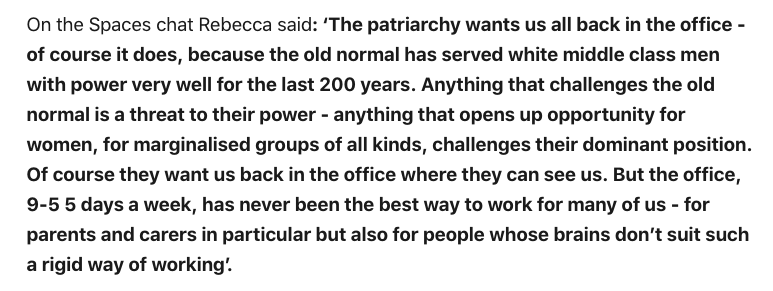
This month, Bruce Daisley ran a Twitter Spaces chat: Has the Work Culture Myth Been Busted? Rebecca Seal (author of Solo) made a point about offices that set his pulse racing (I can totally relate to this): 

Rebecca Seal, via Bruce Daisley

We mustn’t let the conversation about the future of work be dominated by loud, white male CEOs or by poorly worded staff surveys. If we sleepwalk back into the old ways, we will miss the moment of a generation, the chance to make work equitable and to design it in a way that puts human lives at the centre.

Bruce has written about it here: Offices are a Battlefront for Equality – a call to action to embrace new ways of working that are productive, fair for all and will transform the lives of millions, i.e. women, 50% of the population, many of whom have quit the workforce over the past year as they can’t juggle the demands of work and childcare. I talked about this in an earlier post on the Double X economy by Linda Scott. 

Bring it on! The juggling act between work and childcare is nothing new, but I hope we can learn from the past year and take the opportunity to reset work cultures and fix the barriers holding women back at work. We all need to step up. You can start by connecting with Rebecca here

I didn’t quit the workforce when I had Julieta but was self-employed so had no proper maternity leave. I stepped up the freelancing to keep my career going while my partner commuted to London at 5 am every day. And later, as a single parent living miles away from my family, it’s been the only way I can operate. I’ve been working this way for 15 years and remote working suits me, but there was no other option while she was young. I’m not alone. As the rise of Mumsnet, Netmums, Digital Mums, and ‘mumpreneur’ culture shows.

I’m half-way through Solo, and it’s an inspiring read, the next step along from the freelancer bibles. Less of the practicalities and more about the way you work. How to work well in isolation and how to thrive as a soloist. She’s taken the best ideas in psychology, economics, social sciences to help you stay resilient, productive, and focused in your company of one. She also explores the idea of meaningful work. Her inspiration came from not being able to find a book which answered her question: if I’m doing what I’m supposed to love, why am I sometimes so unhappy?

We are not farming a hot and dusty hillside 7,000 years ago. We are not Victorian labourers. We can do what they were denied. More than any other group of workers, soloists have the opportunity to change things for the better.

Rebecca Seal

AND: this new report from Demos think tank is along the same lines: a call to action about using the lessons learned from Covid to campaign for a new way to approach work, working life, the workplace, and productivity. The rise of The Nowhere Office, where work is based on outcomes not hours worked. 


End of lockdown review 

I’ve been thinking about the people and things that have helped me through the past year. I did a quarterly review this week – helps to get the fire in my belly – and wrote a plan. As Darren Murph, Head of Remote, Gitlab, says, ‘Documenting everything solidifies a remote company.’ ‘It’s the most valuable skill in tech’, says Slack CEO Stewart Butterfield. 

I started by making a list of all the things I’ve achieved this year. What has energised me? What has drained me? Financial wins? What impact has my work had? What new services, products, and packages have I launched? What skills have I learned?

Then a deeper dive into how I make my money. Other ways I can make money. New offers, promotions, raising prices. What’s not working? What systems do I need to have in place? What am I putting off, and why? Thinking about mindset, physical health, hours worked, and social networks. What habits have I created? (apparently, it takes 66 days to build a new habit). What are my flow activities? What can I automate or stop doing? 

I spent a couple of hours on this, so it’s a long list. The next step is to create a vision – 5-6 things I want to achieve. Then choose the top three for the next three months and make them specific. Break them down into 12 weeks steps – one action per week – and get them in the calendar. 

I’ve used the FAST framework for goals – frequently discussed, ambitious, specific, and transparent. They may change, but it’s good to have things written down. I’ll try to do this every quarter.

Changes I’m making: Working less (‘one piece of research surveying 1,000 freelancers suggests because self-employed people take fewer holidays and tend to consider themselves on duty for longer each day than employees do, we work up to 65 hours per week’). My core hours are 8 am – 1 pm then a two-hour break to go for a walk (been inspired by Sabatigo’s Wonder Walks to explore entrepreneurship.) People are refitting shops, selling fresh fish, takeaway breakfasts, street markets, making street art. Someone has built a Rent A Pod in their garden for hire by the hour for work or dinner.

I’m still plugged in, however, so I need to challenge myself to go for walks without my phone. 

Back by 3 pm for admin/emails/calls till 5 pm finish. Having this routine has helped with boundaries, and I’m more productive with time constraints. The old adage: work expands to fill the allotted hours (and more). I do a lot via my phone which means I’m always on, and it’s easy for work to spill over into the evening.

I’ve booked a week off over Easter and will redesign my studio. I’ve bought a Freedesk desk riser so I can stand for a couple of hours a day – ‘sitting is the new smoking.’ ‘It’s been out of stock since November, so I think it speaks for itself.’ I’ve become a plant parent – getting into biophilic design in the workplace and bought some nature art – I’m happiest out walking so let’s bring nature inside. I bought a Stanford map of the world – sticking pins in it to mark where I’ve been and want to go. A remote retreat this summer, and a city break later in the year.

I had my first residents’ meeting at the House of Beautiful Business. A mime artist, DJ, update on House Work, and 1-1 Zoom chats with other members. I met a human rights consultant and a humane branding consultant, both based in Berlin. Waleria also teaches Conscious Connected Breathing so got me on to that. I’ve been doing this exercise every morning and it’s transformed my day. Less shoulder pain from desk work since I started doing it. 

What’s your lockdown takeaway? 🍕 🍛 🍣 How’s it been for you, and what changes are you making this year? 

Mine’s an Indian – anything with panini. Julieta’s is a chocolate pizza.

Never eat more chocolate than you can lift.

Back in two weeks. 


Go deeper 🛠

📚 How to work alone – more about the book and some useful resources for soloists. Rebecca is also a food writer, so she knows what tastes good and what our bodies and brains need. I have her LEON Happy One-pot Cooking

🎧 The Solo Collective – a podcast for anyone who works alone, whether for yourself or by yourself, featuring experts and solo workers discussing topics like burnout, self-sabotage, mental health, and happiness at work. 

🌵 Green friends! How to incorporate biophilic interior design into your home.

💬 Bruce Daisley on why offices are a battlefront for equality

📌 Demos’ call to action: The Nowhere Office by Julia Hobsbawm. 


Welcome to my bookshop! 📚

I’ll be sharing books in my bag and recommended reads on Bookshop.org. They pay a 10% commission on every sale and give a matching 10% to local bookstores, an integral part of our culture and communities. I would be very happy if you make the odd purchase here.


Work with me 🙋🏻‍♀️

Leopard print, always. Worry less and rock a red lip. Remote work evangelist, problem solver, internet person.

💡 Something you want me to write about? Leave a comment or email nicci@niccitalbot.io

☕️  Has this helped you? Buy me a virtual coffee.

📩 Subscribe to The Shift here.

👋 Copy Club, 6 pm GMT, Saturdays on Clubhouse – drop in!