Categories
Blog

START HERE: On the Wild West of freelancing, creator journalism—and choosing yourself

Hiya, happy new month!

Thought it was time for a (re)introduction so I’ve written this post – the story behind the Shift and what I’m building online.

On the Wild West of freelancing, my 25+ year career, the rise of creator journalism—and choosing yourself.

Just reading Henry Zeffman’s post on why Labour MPs are still craving a compelling story from Starmer. Feeling frustrated that he’s not found a way to land his message.

Remarkably for a politician who’s been a party leader for a long time he’s still not defined for a lot of the public.

People also ask on Google: What does Keir Starmer actually believe in? Has Keir Starmer written any books?

A personal newsletter would help and be a home for all his writing.


I had an email the other day from a charity asking if I’d like to be a guest writer on their new Substack. “Sadly, we don’t have the funds to pay for submissions—but writers can promote their other work or organisations.”

Perhaps writing about the ups and downs of being a freelance journalist and promoting your own Substack (why you decided to launch it, how it’s going etc). What do you think?

Nice to be asked, and I’m keen to work with them—I like what they’re doing for media issues, but at the same time, my heart sank. Someone else asking me to work for free. I’m already doing quite a bit of pro bono work. If I printed out similar requests I’ve had over the last 25+ yrs, I could start my own stationery line. Make a paper Christmas tree or three!

Median pay for freelance journos in the UK is piss poor: just £17.5K/yr—less than the minimum wage—for a typical 35-hr work week (ALCS/NUJ). Payment rates have been stagnant for YEARS. There are no pay rises or promotions. “As freelancers we just get paid the same rate. I think most freelancers are afraid to ask for more in case they aren’t commissioned anymore.” Plus: kills fees, payment on publication, implicit contracts etc, which are hard to challenge solo.

The next day, I read Christina Patterson’s post on the slow death of journalism – and the fast death of my career, which struck a chord with me. “Asking us to write for free is like asking an electrician to rewire your house in exchange for a smile.” I restacked it on Notes and mentioned the email.

I think it’s a huge cheek for anyone to ask anyone who isn’t a friend to do anything for free. I am trying to learn to say no, unless I’m pretty sure there’s something in it that will make it worth my while. We can spend our entire lives doing unpaid work and meanwhile the bills have to be paid.

My first unpaid gig was on X-Campus, my uni mag, to get some clippings—arts & culture stuff, which I loved (clue #1). After graduating, I moved back home for a bit to figure out my next move—wasn’t sure whether I wanted to do broadcast or print journalism. I joined the startup Radio Mansfield as ‘community news editor’ and got some radio skills while the MD applied for a permanent licence. By night, I was waitressing at Center Parcs to make ends meet.

That year, I wrote to 100 production companies looking for work as a runner and eventually got offered a gig on Art Attack! at the Maidstone Studios. £80/wk (my bedsit was £40/wk), so a low-key lifestyle, but I was learning the ropes and meeting people. It led to other work—a kids’ show called WOW! (met the Spice Girls, just coming up), Endurance, Masterchef (didn’t see anything dodgy). Then I got offered a FT role at Wizja TV, a new Polish station, as a programming assistant at £13K/yr.

Got my head down, but I was bored to tears working in Acquisitions. Lots of admin, chasing and nothing creative—but it gave me stability and a routine, while I was studying journalism on the side. I kept writing and saving so I could quit and go travelling—figured I’d Wwoof my way round the world, live/work on farms and look for media opps in the cities.

I worked at Foxtel in Sydney for a few months (more programming!) and got some freelance work in Perth with Travel Maps Australia, a budget travel mag. A road trip to the Pinnacles and some market research, interviewing backpackers in hostels. My first foray into magazine journalism and travel writing for niche communities and it sparked something in me (clue #2).

When I got back to the UK, I applied for a scholarship in magazine journalism with Emap in Peterborough and got it! (the work/travel adventure paid off). I was so excited, I didn’t care it was only £12K/yr—I’d manage somehow. Six months with Country Walking, so I’d be learning on the job, and it might lead to something permanent.

This was 2000/1 so digital revolution pre-social media and most of the mags were launching websites. CW were fully staffed and didn’t really need me, so I went to work on the website launch with the ex-editor who’d moved over to digital. I liked the tiny team start-up vibe. She was open to ideas, didn’t micro-manage and let me get on with it (clue #3 – I’m not good with authority).

There was no job on CW at the end of it, but I could move to another title at Emap Active. I was a bit restless though and really wanted to work on women’s mags or The Face so that meant moving to London – Media City, where everything was happening. Mad really – Peterborough is no distance and much cheaper to live, but I wanted to be IN IT meeting people. They weren’t thrilled I was buggering off but helped me get some work on Here’s Health.

A shoutout to my friend Natasha from Wizja TV for letting me stay in her box room in Waterloo while I found my feet and did work experience. It gave me the confidence to take the leap, and I couldn’t have done it otherwise.

I spent the next five years in London working myself into dust—freelance journalism, copywriting, comms/PR, ghostwriting. I found the women’s mags competitive and a bit snooty, but liked the culture & health stuff so did more of that. Spent 18 months at a corporate fraud agency doing pre-employment checks, creating resources, and rifling through bin bags! Still journalism but better paid and more stable—I even had a pension. Not sure why I left… well, that’s another story.

A mate was trying to launch a sex mag for women and asked me to write a piece on orgasms. I had amenorrhoea and was struggling with vaginismus, which was getting me down. So, an opportunity to go deeper and figure out what was going on. I guess my niche found me. Writing about it all was my way of healing myself.

I joined the NUJ, Women Writers’ Network and Women in Journalism and started helping out. Ran events in nice hotels for WIJ freelancers to bring women together—I needed that. Freelancing is lonely so it’s crucial to have a support network (clue #4). I’m still working with the NUJ and am grateful for their financial support during Covid when I fell through the cracks.

I left London in 2006 when I pregnant with Julieta. This was peak mamasphere, as blogging was evolving and social media taking off. Women started the creator movement – Heather Armstrong, Dooce. Catherine Connors, Her Bad Mother. Motherhood warts n all. They paved the way and talked about taboo topics – yet were vilified for it by the media.

I started my own sex & culture blog, Rude and threw myself into that. Got lots of energy back from it, but struggled to monetise it on WordPress. I wasn’t running paid subs or paywalling—just Google Adsense and sponsorships, which were sporadic. I had sex toys coming out of my ears, but I didn’t have a sustainable business model to keep paying writers.

I had a knowledge gap and a lack of biz skills (not part of J-school, uni or talked about on the job) so I was learning from my peers. When I did start paywalling much later, I got backlash from a male writer who said, “I think you’re making a big mistake.”

The blogging paid off in other ways though and helped me land publishing deals. I wrote more letters to agents (I swear by the LOI – it works!), found one and got commissioned to write a book on orgasms for Hamlyn. This was Belle de Jour, ScarletAmora MuseumShades of Grey era so something in the air…

They commissioned me to write two more. All the book deals were flat fee contracts minus the agent’s 15% so pretty modest. I got a wee advance but carried on working while I wrote them. They did a bit of publicity, but I was expected to do most of the work—research, writing, marketing, socials, events, organising book signings.

I wrote a few more books for different publishers including Vibe, a Norwegian outfit who then went bust so my Kama Sutra guide never got published, and I didn’t see a penny. My debt collector couldn’t do much as the contract was outside the UK (will never do that again).

Median earnings for UK authors was £7K/yr in 2022 (ALCS), so it’s part of your portfolio career—if you’re a non-famous, non-fiction writer, anyway. I get a small amount of royalties for secondary uses from ALCS and PLR every year so worth signing up with them.

By my late 30s/40s, I was feeling burned out with creating content online and a bit trapped in my niche, as I was writing under my name. I didn’t want to be a sex & relationship therapist like Sarah Berry or a presenter like Tracey Cox. I thought about becoming a dominatrix (great money!) and writing a book about that, but I’d need to be in London—couldn’t turn my flat into a dungeon and I didn’t want to work locally.

I’d outgrown it, but I wasn’t sure what I wanted to do next. I remember a journo from The Telegraph calling me for a quote and saying, “what’s left to say about sex in your 40s?” She needed a new angle lol. So did I.

I found it hard to let go though—Rude was my second baby. I’d put my heart and soul into it, built a digital mag I was proud of, and paid writers. Giving up felt like failure so I kept going, juggling love and money work. What I needed was a mentor/coach to talk to – to get a plan together so I could pivot slowly and expand into new things.

In the end, my body made the decision for me. I got ill and was diagnosed with RA aka Wayne the Pain so had to stop everything. I’ve never known pain like it—childbirth doesn’t compare. Horrible condition. Fat fingers so I couldn’t write properly, and it made me feel so tired.

These things don’t happen overnight so it’s long-term stress: precarious work, doing too much, money worries (I had 20K debt in London and eventually did an IVA to consolidate). I was solo parenting and miles away from my family so all a bit much. Body says NO. I’m not doing this anymore.

I’m grateful for the opportunities I’ve had—graft, timing and luck—but journalism and publishing has never felt secure as a career, or like I had someone invested in me long-term. I’ve done all this good work but I don’t have a lot to show for it materially ie a home to pass on to Julieta.

I’ve had three agents—the first one left and I didn’t gel with her replacement (I wasn’t high-brow or famous enough). Then they restructured and let a few of us go (including me) so she left to do her own thing. I got an email thanks & bye but no advice on what to do now or offer to connect me with the other writers. I found them on my own.

So here we are. 2025. A bit older and greyer, still plugging away, having another go (the tech is better!). Writing the Shift, enjoying the Substack Motel.

Choosing myself and reinventing myself, which is the lesson I’ve learned from all of this. Choose life and building your career around that not the other way around.

Exploring and helping to shape the new media revolution. Creator journalism is the most exciting area of journalism imo. Intimate and collaborative. People are paying for news! I’m here for it.

An opportunity to tell untold stories and go deeper into a niche that the mainstream media can’t cover. And so many great women in this space Taylor Lorenz Kat Tenbarge Daysia Tolentino Kristin Merrilees kate lindsay Emily Sundberg Lex Roman Kaya Yurieff, Jasmine Enberg Rachel Karten Lia Haberman Kerry Flynn Alexa Phillips.

Substack isn’t perfect (what platform is?). I don’t love the closed API/walled garden—the future of the web is decentralised. I don’t want to be too dependent on a platform – use them for discoverability. But I like their mission to be a home for culture and they have changed the culture around paying for writing online. I’ve also met some brilliant people here.

The good thing is we have options now. The creator space is growing and platforms have to stay competitive. I see Beehiiv has a big reveal coming up in Nov that “will completely change how creators and publishers build online”.

Creative freedom is important—my main driver. But this time, it has to be sustainable and a proper living. More collaborative, less lone wolf – the route to burnout. The cult of founder (whose bright idea was it to name ad agencies after people?) puts all the pressure on the individual to succeed. We’re not content machines and we can’t be productive all the time. I need to work in seasons, with my energy and human design.

Build something bigger than myself and bridge the online and offline worlds, which takes time – you have to commit to it and be consistent. In time, I’ll host affordable writing retreats – the House of Letters – because the magic happens in person. And life is better with the sun on your face, a bowl of olives and a Negroni in hand.

Julieta has just started at U of York so new beginnings for both of us. I miss her little face and it’s quiet in the flat, but I don’t miss the unpaid, undervalued, and invisible labour.

It’s ME SEASON—a great feeling.

Not sure where I want to base myself next so I need to do some mini trips while I figure it out. A week in Bristol. A smart village in Italy. I was talking to Amy Fallon about that earlier—a reminder to renew my YHA membership. If they’re well run and have private rooms, I can hack it!

Feels good to bang this out. I can see the patterns and clues about how I like to live and work. The stories I’ve been telling myself for last 25+ yrs (‘there’s no money in writing or being creative’…‘journalism is a middle-class industry’…’I’m not a numbers person’). And what I’ll be telling myself for the next chapter—my unretirement and a happy, healthy 100-year life, I hope.

Christina just replied to my comment about sending something I’ve already written. “If at all. I sometimes ask people if they would ask a plumber to mend their boiler for free. What’s the difference?”

I know. I’d like to be involved though, think it’ll lead on to other things. I’m a giver and believer in karma—do it for the beauty of it. Life is so transactional, and I don’t want to live like that.

My mate Marianne Lehnis: “Send him something you’ve already written. Doesn’t cost you anything and you get the exposure/free visibility. Just look through your newsletters.”

A reminder to sort my archive out!

Or I could just send him this.


What I’m working on

  • Nov 11: Digital Creators Association panel on the creator economy and AI and the issue of creator mental health – key learnings/opps
  • Nov 30: ChatGPT’s 3rd birthday – AI & creator compensation latest: Australia’s move to protect creators. Equity campaign to help strengthen copyright law. We need to opt in, not opt out!
  • Jan 15: Findings from the Late Payments consultation – see the NUJ’s #StopTheFreelanceRipOff campaign
  • Feb 26-27New Media Summit. Good to see a shift in focus from last year’s ‘Newsletter Marketing Summit’ – they’re thinking about who they want in the room. Need to see the agenda
  • April 15-18: Liveblogging the International Journalism Festival – creator journalism talks and coffee chats for my Bold Types creator profiles
  • Updating my Media Diary – key media + culture dates to help you plan content and get out and about!

Ideas and feedback welcome.

Thanks for reading!

Have you written your story? I’d love to read it.

Love Nika
Categories
Newsletter

I got fired over Zoom 🤯

Ever been fired over Zoom? 

This week, it happened to me – halfway through a six-month contract. I got a calendar invite for a ‘catch up and chat’ with my manager.

Big budget cuts and the client wants to focus on paid social media, not organic posts (I’ve been writing playbooks for them).

I’d done what they hired me to do, and none of the other teams had any work left for me, so that was it.

She did it nicely and better via Zoom than email – though it felt hardcore and surprised me.

You’ve done a great job. We couldn’t have done it without you. Love to have you back next year when budgets are back to normal. Let us know if you need a reference… 

Bit more than a ‘catch up and a chat’ !!

Two conversations were happening in tandem. The one on Zoom with my manager and the internal one in my head with Anxious Annie. FUCK. I can’t believe it. How are you going to pay the bills? What about the yoga holiday! Have you been slacking again? 

She’s good at her job 🙄

I find these short-term contracts with agencies exhausting. It’s hard to relax and do your best work when you’re on float with multiple projects. I feel disposable (had a week’s notice on this one), so my LinkedIn profile is always ‘open to work’.

How much energy do you put into precarious work, even if it pays well? It’s hard to get the balance right. 110% usually, all or nothing, which is a route to burnout. 

Here’s what I did to get over it.

1. BREATHE. Wrote down what just happened. Seeing it on the page helped get it into perspective – a tip I picked up from the author of The Kindness Method, Shahroo Izadi, on the Solo Collective podcast.

2. Went for a walk.

3. Finished the job and sent a friendly email to the team and my agent. Set my boundaries for future roles (3-months minimum, it’s hard to do strategy and make a difference in less time). A longer notice period.

4. Booked a Rapid Rewire masterclass with Steph Kwong via Growmotely“Learn a proven, cutting-edge methodology to confidently create rapid change for yourself, guaranteed.” Gotta feel it to heal it! Powerful stuff.

Have you ever been fired? How did you deal with it? I’m taking a break from Agencyland.

 Nika


Justice for Johnny! 🎉 😁 I’m happy you’re at peace and have your life back. 

Highlight: watching his doorman Alejandro Romero deliver his pre-recorded testimony from his car, vape and then drive off. “I’m tired … I don’t want to deal with this court case … everybody’s got problems, and I don’t want to deal with this no more.” Modern law. Remote justice.


5 Things 🧠 💥

Talent to Money Summit is on 7 & 8 June online. The first global summit run by The Ask, helping you to start (and grow) a business you love. Great speakers who will be sharing their stories and strategies for success. I heard about this via the Newsletter Mastermind group (Ness Labs).

How ‘digital nomad’ visas can boost local economies (HBR.org). A visual overview of the current visas via country and how they might play a key role in fostering entrepreneurship and the creation of technology clusters around the world. Time for the US to get on board or risk being left behind.

Recommended Substack newsletters related to the future of work (Workforce Futurist). It takes a village to grow a newsletter. Thanks to Andy Spence for the shoutout and profiling work you’re enjoying. Some new writers to check out!

Building a swarm of thoughts with the founders of Napkin (Ness Labs). An interesting experiment – gathering a group of 100 authors to help build the next-generation thinking and writing tool (it looks great – watch the video). Get a month for free when you sign up for their newsletter. 

Gitlab: The Remote Playbook 2022 – this is the 3rd edition of Gitlab’s famous playbook. This time focusing on how your team works, not where, evolving design, mastering future of work skills, reducing burnout, and boosting wellness at work. Learn how they’ve scaled as an asynchronous, no office company. 


Written by Nika Talbot, founder of award-winning Firebird Studio. Content designer and UX writer. Based near Brighton, heart in Italy 🇮🇹

Send me a note: nika@nikatalbot.io.

Enjoy reading this? Why not buy me a glass of Prosecco? 🥂

Categories
Newsletter

The new Smart Villages – can you really get paid to freelance in Italy? 🇮🇹

Here’s to the new smart villages in Italy.🍷 🇮🇹 A number of towns have launched travel incentives – and will pay you to work from there.

Santa Fiora in Tuscany (the city of water and music) and Rieti in Lazio are both offering to cover up to 50% of your rent if you stay between two and six months as a remote worker.

Local rents are pretty cheap – €300-500 per month, so you could be paying around €150 a month to rent a cosy cottage or apartment in a beautiful village this summer.

Santa Fiora’s mayor, Federico Baloccchi, told CNN:

It’s not targeted at occasional touch-and-go tourists, but people who really want to experiment with our village life.

The goal is to incentivise people to move in and virtually work from here. We want Santa Fiora to become their flexible office.

It’s part of a 10-year development plan to revitalise rural areas which ‘is now more like 10 days [thanks to Covid] so we’re getting on with it.’ Phase one focuses on connectivity and tech and getting workers and firms in – to capitalise on the trend of people wanting space and moving out of urban centres.

And if you fall in love and decide to invest in tourism there, they’ll give you up to €30,000 to open a B&B, hostel or hotel.

I asked about eligibility for freelancers, age/earnings cap etc and ‘it is open to anyone in possession of a smart work job’. Pensioners welcome 😉 as long as you can show you’re working as an online consultant or indie contractor.

A great way to dip your toe in the water and test out Smart Village life.

What do you think, Mac? Could be fun and frothy 🐶 Feasting on roasted chestnuts and Montecucco wine.

Sea you there?

Apply here → Santa Fiora Turismo.

Other places to work different → Visit Tuscany.

Santa Fiora, Tuscany

Remote worker visas and opportunities →

Fueling the future of location-flexible work.

Antigua + Barbuda → Nomad Digital Residence for up to two years. 365 beaches in a year?

Barbados → Work from paradise. 12 month Barbados Welcome Stamp.

Bermuda a slightly more affordable one year Work from Bermuda visa. No minimum income requirement.

Cayman Islands Dreaming of a Cayman?Global Citizen Certificate for up to two years (if you make $100k)

Costa Rica Freelancer visa called the Rentista for up to two years.

Croatia → One year digital nomad visa. Currently hosting their first ‘Digital Nomad in Residence’ competition. 10 nomads will present how Dubrovnik can be a ‘digital nomad friendly city.’

Canary Islands → Launched a €500,000 campaign to lure 30,000 remote workers to the islands over the next five years: The office with the world’s best climate.

Dubai → one-year virtual working programme (and bring your family).

Estonia The first country to offer a digital nomad visa for remote workers.

Georgia Work Remotely from Georgia and be part of your own wallpaper.

Iceland new digital nomad visa for high earners to stay for up to six months.

Indonesia Planning a turbo-charged five-year visa for the wealthy ‘which could be beneficial to digital nomads.’

Madeira a new Digital Nomad Village for minimum one-month stays. Portugal also has a residence permit for indie workers and entrepreneurs.

Mauritius → a renewable one year premium visa for nomads (no fee!) 😍

Thailand Looking to overhaul its Smart Visa to allow digital nomads to remain in the Kingdom for up to four years without a work permit.

Interesting huh. Many more nations will follow suit and compete for citizens as Japanese technologist Tsugio Makimoto predicted 20 years ago – and he digs into the microelectronics and products that enable nomadism.


Can you still buy a house in Italy for €1?

Photo by Ehud Neuhaus on Unsplash

Technically, yes – but the houses are put to auction where people can bid on them. Some sell for €1, the average €5,000 – & then you have to pay for the renovations (say €20,000) within three years.

Rubia Daniels was one of the first to buy a bargain-priced house in Mussomeli, Sicily, in 2019 and bought two more for her children. So far, she’s helped 20 people buy homes out there and hopes to take another group in June. She didn’t intend to buy that many houses, but ‘it’s how the people make you feel that makes you say, ok, I’ll buy three.’

Already 100 people have bought a house, what are you waiting for? – Case1euro.it

Not for the faint-hearted but a hugely rewarding project – an investment in yourself, your family, and a new business opportunity (and I’ve seen €1 houses in France and Croatia too).

Here’s how it works.

1 Euro Houses Italy map


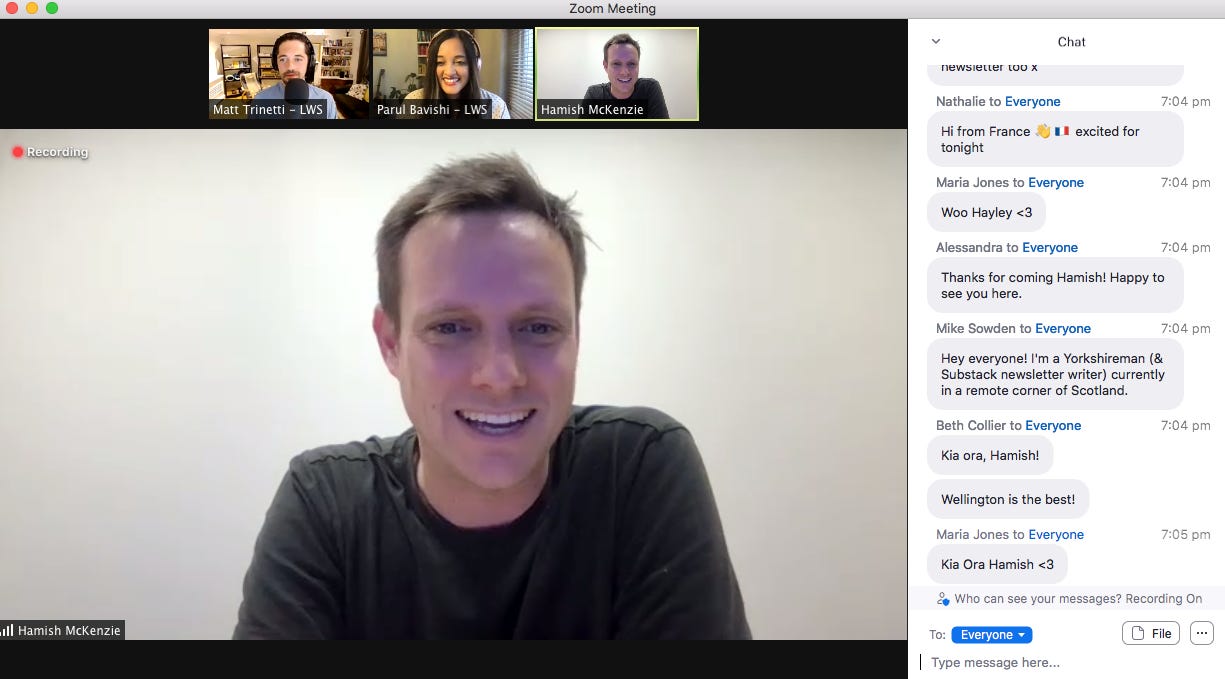
London Writers’ Salon: The future of newsletters & publishing w/Substack’s Hamish McKenzie →

Photo by Nicci Talbot

London Writers’ Salon spoke to Hamish McKenzie about his writing, the future of journalism and being co-founder of a tech startup, Substack.

Great brain food 🧠 Raw, revealing and honest – he’s no tech bro. Appreciate his vulnerability on his burnout at Tesla – engineers picking over his work, his confidence took a hit and it took him a while to come back. On the stresses of being a founder, which he describes as ‘psychological torture’. The Substack soap opera rolls on – their employees have had online abuse.

He comes across as someone who cares deeply about the future of writing and wants to create a thriving ecosystem for media based on a trusted relationship between reader & writer – rather than clickbait.

Substack is here to give the media ecosystem more options, not replace it.

He looked exhausted (it was 6 am in Wellington) and needs a break. I wanted to give him a big hug! So 👏 to Matt and Parul for a sensitive interview and giving him space to relax and open up. Refreshing for him to be asked about his writing journey and challenges rather than how to support everyone else’s.

On what writers can learn from startup culture

Put something out there, get feedback, tweak, adjust, don’t give up! Nothing important is ever easy or worth doing – stay focused.

It’s not self-promotion but giving yourself a promotion. Find the joy in marketing. You can’t be of service to this world if people don’t know you exist.

🔥People & Company is joining the Substack team to work on community upstart efforts for writers in its network. Spark the flame, stoke the fire, and pass the torch.

Watch it here. From menopause to McDonald’s: all topics are fair game at London Writers’ Salon, and they’ve built a brilliant online community. Join their Writers’ Hour Daily Writing Sprints.


Journeys In Sound →

Music was my first love by Daniel Schludi on Unsplash

Playlist of the week: John Grant


Featured Collection: The Mind at Work by Dropbox

This is your mind at work


Photo by John Schnobrich on Unsplash

Tools + resources →

✍️How to open up and create better work: An introvert’s guide to a more collaborative writing process. ‘As a UX writer, sharing early saves me time and breeds creativity.’

💡Hybrid vs remote work: everyone’s looking at big tech to see what they do next, but they’re all making it up on the fly. If you’re considering your options, here’s an open source resource that shows what firms are doing – thanks to Andy for sharing.

🚢Build an online writing habit in 30 days. Redefining the meaning of online community, Substack take note! Writing alone is hard; writing with a community is easier. Love this concept – thanks to Lauren for the tip-off.

🌵Burnout in Tech – Part 1: Declaring war. Actionable steps to fight it for yourself and others.

💰Twitter is rolling out a new tip jar feature to help you get paid for your tweets.

Happy hugging and café working! 🤗


The future of work is now

Let’s build it. The Shift is a weekly newsletter celebrating writing, good design, creativity, flexible working, growth, travel, and online communities. If you enjoy the content, please like it and share with friends. Thanks for reading!

Work Better. Live Smarter. Be Happier.

Question or comment? Email nicci@niccitalbot.io.
Was this helpful? I’m powered by caffeine and Amaretti biscuits.
You can listen to this post here.

Categories
Newsletter

🕵🏻‍♀️ Exploring the future of journalism

How we can use Design Thinking to solve journalistic problems.

I’ve been to a few journalism events this week on the industry’s future and what needs to change.

NUJ Racism and the Media special meeting, Freelance Industrial Council, and the #buildbackwellDEN Spring ’21 meeting. 

Common themes: Digital transformation, reinvention, diversity, resilience, burnout and mental health.

There was a backlash to the Society of Editors’ bizarre statement denying press racism in the UK. Press Gazette did a survey which shows there’s still much work to do. NUJ Black Members’ Council made a statement about what we can learn from the Meghan Markle race debate saying how the industry should have used the comments made by Meghan and Harry to start a long-overdue debate about the best way to prevent racist coverage.  

We heard some shocking stories about racism in the media and how the media has a problem pigeonholing journalists of colour. Editors want pitches related to race and lived experiences, giving little space for journalists to explore other topics. 

Lack of diversity in newsrooms was the biggest issue flagged. It’s not so much a problem with recruitment, but retention – if the work culture isn’t diverse and welcoming, people won’t hang around. Depressing to hear stories of endemic racism in our media corporations and comments like: ‘Sometimes the only way to break out [of the box you’re put in] is to leave and come back in through another door.’

Look out for the full report on londonfreelance.org.


Do freelance rates discriminate?

We have some new data on gender, ethnicity and rates. Thanks to the #FreelancerPayGap initiative LFB has added over 1,000 Rates for the Job with info on ethnicity as well as gender. We have a gender pay gap and an ethnic pay gap. In this data set, women are getting less than men and people who don’t identify as ‘white’ are getting less than those who do.

We all need to step up. Sharing rates and being transparent about pay will help to dismantle the gender pay gap. You can submit your Rate for the Job here and via the #FreelancerPayGap. I’ve seen similar campaigns for advertising and publishing. 


#buildbackwellDEN (Digital Editors’ Network) 

UX Indonesia on Unsplash

More than 70 colleagues from across 12 time zones came to the DEN event – a 90-minute, interactive discussion on how we can build back well. It focused on three areas: PEOPLE, PROCESS and PRODUCT.

The aim is to co-create an agenda to take back to decision-makers so it’s not just a talking shop (there’s a working document).

Excellent speakers and breakout sessions to brainstorm ideas.

The Chatham House Rule means I can share information about the discussion but not identify anyone or attribute quotes. This is so people can speak freely.

Key points: 

– Flying the flag for freelancers. The fastest-growing sector of the industry. Will we all burn out? Is that where this is heading? Is there any research on freelancers and burnout, and where do we go?

– No more siloed working. Newsrooms and publications need to build a better relationship with freelancers and be more inclusive. Freelancers need to be paid fairly – more transparency around pay rates.  

– We need a database of freelancers showing who’s available, their background and what they can do. To help speed up the commissioning process and encourage collaboration. Databases like this exist within organisations, e.g. the BBC has a portal, but there’s nothing that can be accessed by the wider industry.

– What companies are doing to prevent burnout – training people up on mental health, working on user-generated content, creating intranets about COVID as a resource for staff, and enforcing wellbeing policies.

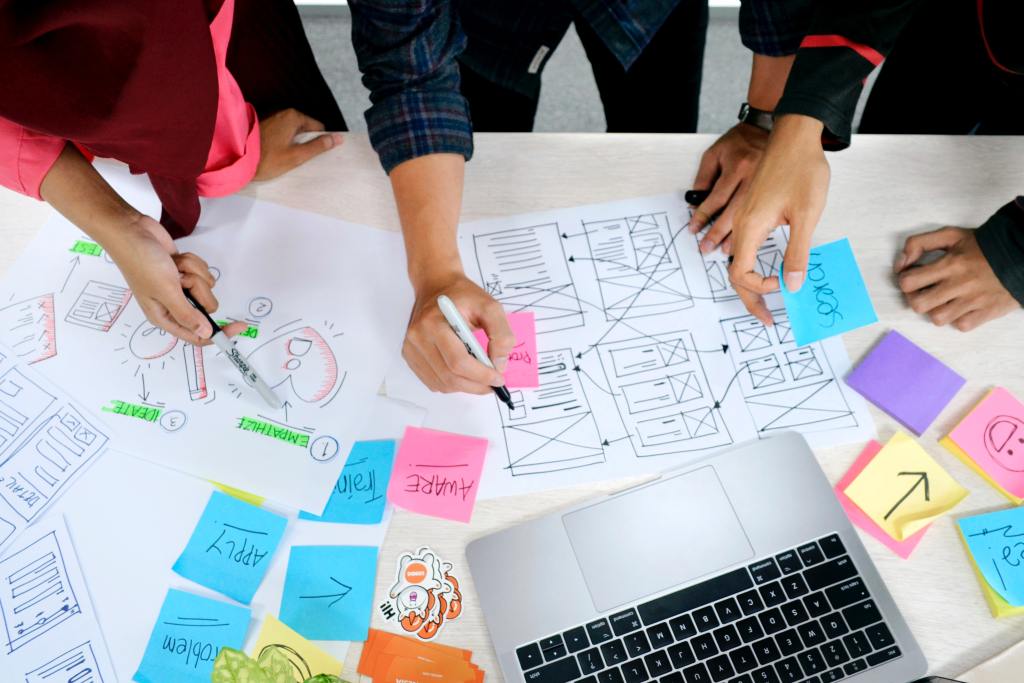
– How Design Thinking can transform journalism. Never thought I’d hear Design Thinking, empathy and journalism in the same sentence 😉 Exciting! I’m reading a lot about Design Thinking on my UX course – here’s a nice intro.

Newsrooms need to take a more holistic approach with human-centred storytelling and understand what people need before creating a story/product. How much do you know about your readers? Involve them in the creation process. 

– Soft skills vs hard skills: The importance of listening and empathy. The emphasis on hard skills in journalism is why I haven’t felt comfortable in it. It’s as though being argumentative, pushy and loud somehow makes you a better journalist. I did some subbing shifts on the nationals a few years ago – no women on the team, a hard-drinking culture and long working hours. A work culture that would exclude many.

Well done, DEN. An inspiring discussion and lots to think about. Feels like I’m heading in the right direction with the UX training – and I can see why I’m attracted to it.

I can combine my UX work with journalism to create better media products.

Check out the speakers and feel free to send in ideas for future DEN events.

Enjoyed this article by Rasmus Kleis Neilson, Director at the Reuters Institute for the Study of Journalism, on the vanguard and rearguards in the fight for the future of journalism. The tension between those who embrace change and those who want things to stay the same.

The vanguard is full of women and more diverse. The rearguard full of white men like me.

This mindset will continue to undermine journalism’s ability to adapt, remake, and renew itself, and the profession as a whole, especially younger journalists, will have to live with the consequences of this conservatism.

Rasmus Kleis Neilson

Go deeper 🛠

World Press Trends Outlook 2021: Digital transformation in the driver’s seat. Nearly 60% of publishers say staff will either WFH or have the option to WFH going forward. Only 5% expect to move everyone back to the office. 

Content is Product and Product is Content: Why deeper alignment is the only way forward. Dmitry Shiskin on why it’s time to start treating content and product as one. They are slowly merging into one thing. 

People pay for other media, but they won’t pay for journalism (Heather Bryant).

The idea that the user experience of the delivered product of most journalism is anywhere near the quality of any of other media is in many cases a delusion of grandeur. 👏

Facebook is Starting a Substack Competitor (Nieman Lab) – Facebook to pay $5 million to local journalists in news push. They’ve pledged to invest $1 billion in the news industry over the next five years. Be interesting to see what happens – Facebook has strong community groups.

Substack says, bring it on! 

Listen up! #FutureMediaPodcasts roundup 🎧

Why journalists NEED to be researchers (Shirish Kulkarni) – on how journalism can apply Design Thinking principles to tell better stories.

Most of our news is presented ‘top down’ – do we actually want something ‘bottom up’ where communities are more involved in telling their own stories? 

How to use design thinking to solve journalistic problems (newsrewired.com)

Freelancer Magazine – well done to the team for getting this out, an inspiring read 🙌 Get your copy here.

Freelance Business for Writers, 3-4 June 2021. Free online event for freelance copywriters, editors, journalists and translators. Speaker callout🎙

Global Freelancing – take the survey. ‘The goal is to understand the experience of freelancing during the pandemic and looking ahead at the future of work.’


This month, I’ve been… Building backlinks 🔗

I wrote an article on how to build backlinks. What they are, why you need them, and how they’ll help your business.👇

Google has over 200 factors that determine your site ranking, and number one is backlinks. 

Link building is an art and science, creative and analytical. It involves detective work, psychology, tools and relationship building.

I’ve done a few things so let’s see if my Google ranking improves.

Happy link building! 


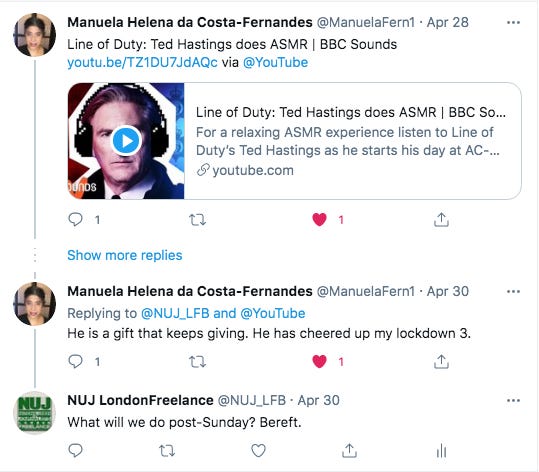
LINE OF DUTY

Ted Hastings. A man of principle. He can’t retire!

Will we find out who H is…? Not long till I get my fix…

Categories
Newsletter

Burnout culture is alive and well. How about you?

Thinking big 💡

I am not just busy; I am being overwhelmed by an onslaught of requests like yours… 

The pioneer of workplace burnout research is swamped with work. Christina Maslach, a psychology professor at the University of California, Berkeley, first studied burnout in the 1970s and has been searching for solutions since. She was busy before the pandemic, but now… her inbox has exploded.

I found myself apologising last week when a client called to chase me for invoices. ‘I’m a bit concerned you might need groceries… You can send me this month’s and last month’s if you like…’ Usually, I’m on it – I love invoicing clients, but right now, I’m overwhelmed and behind on admin. I have over 6,000 emails, as I said last week. 

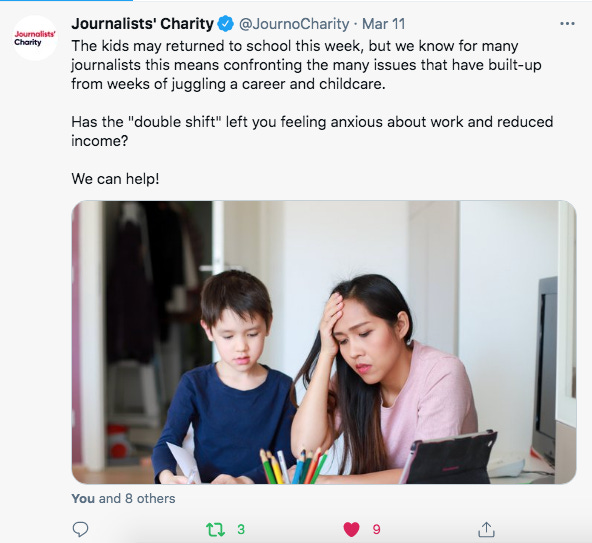
It’s been a double shift since Xmas, and it took this tweet from the Journalists’ Charity to remind me of that. 

@JournoCharity

I’ve been reading lots of articles about pandemic burnout – it’s our anniversary, but burnout has been a silent issue for some time. Interesting to read this piece in The Atlantic on how burnout is technically a work problem.

Research suggests we tend to feel more stressed when we face conflicts about our various roles—mother, worker, friend to a frazzled co-worker, daughter to an anti-vaccine parent. And right here is the role conflict plague.

Three million American women have dropped out of the workforce since the pandemic began because they are shouldering the burden of all these different roles.  

It points out there are plenty of wellness hacks to help us push through the pandemic, but according to burnout experts, it’s a problem created by the workplace, and changes to the workplace are the best way to fix it. The World Health Organisation defines burnout as a syndrome resulting from chronic workplace stress that’s not been successfully managed.

We’re in the thick of the ‘shecession‘, and globally, women’s job losses due to Covid-19 are 1.8 times greater than men’s. According to McKinsey’s survey, one in four women said they were thinking about reducing or leaving paid work due to the pandemic, citing company inflexibility, caring responsibilities and stress. 

High status doesn’t insulate women from stress and burnout. Senior-level women are significantly more likely than their male peers to consider dropping their hours or dropping out of the workforce because of the burnout associated with being “always-on” and juggling multiple responsibilities during the pandemic. BBC Worklife.

As the McKinsey report shows, companies are stepping up, but many don’t address the underlying causes of stress and burnout—the childcare crisis and a need for flexible working at all levels of work. We still have outdated views of women in the workplace and see child giving as a female function, and care work is still low paid and undervalued.

Companies can do more—childcare subsidies should be the norm, not a job perk – and employers that offer this will attract and retain top talent. People give more and are loyal to employers when they feel valued and cared for.


The advice 🤔

Path For Life

I heard Jeanette Bronée talking about burnout and self-care in the workplace. She is a workplace wellbeing strategist and on a mission to make self-care part of business culture. She is hugely passionate about her work and what she said resonated with me.

Self-care is an essential skill in the future of work. Burnout is probably the most disruptive issue that we have to deal with in work culture, yet we don’t really know what to do. We’re focusing too much on the symptom of burnout rather than looking at the root cause.

I had burned out twice by the time I was 40 years old. And to no surprise. I was young, ambitious, and I expected my body to be there for me.

And she’s not alone. 7 out of 10 millennials burn out before they’re 40.

We need to foster the mindset that burnout is a work company problem to fix, not an individual issue.

The future of work requires us to change the way we think about performance and productivity. Even though time is our greatest challenge, health is the foundation for peak performance that can transform the workplace from a burnout culture running on stress and survival mode to a culture driven by care, purpose, focus and engagement.

‘Self-care is not for after-work’ – find ways to give yourself microdoses during the day. And it’s not about ploughing on: ‘We need to redefine resilience with Covid – it doesn’t mean to keep pushing through, it means to be supported.’

It’s time to rethink work culture – burnout culture is not working. And a warning that we may be heading to another version of it virtually – the next burnout – if we don’t get the balance right now.

Self-care can’t wait. As the last year of the pandemic has shown, the world is speeding up, but we’re not robots – our bodies are still running on the same system.

We think of self-care for when we make it, but we’ll make it faster if we practice self-care. It’s a choice. We can hustle because we practice self-care.

We can be successful and healthy; it shouldn’t be a choice between the two.

And there’s a direct link between individual self-care and the health of an organisation.

Someone said: ‘If I want to suffer, I’ll go back to being an employee in the corporate world.’ 

That makes me sad. Is this the world we want to bring our kids into?

More resources on Jeanette’s website, Path for Life, and she’ll be speaking about how we can fix work at the Self-employed Summit on April 12 & 13. 

Here are some practical things you can do to help prevent burnout and be your best. Thanks to Jeanette Bronée, Nilufar Ahmed, The Worldwide Association of Women Journalists & Writers, and the Society of Freelance Journalists – excellent events this week on mental health.

There’s a lot of help out there. 🙏

On work routine: 

• Start with the basics – create a work schedule that integrates basic care, water, food, sleep and have structured work hours during the day.

• Fake commute: We need physical movement to prepare our brain and body for the next task. We need structure and separation. Build activity into your day. Try a standing desk. 

• Power Pause – check-in: where am I right now, and what do I need to be more focused and have more energy? Get into the habit of giving yourself microdoses of self-care during the day.

• Have a personal board of advisors – mates, colleagues – who will look out for you.

• Take a nap – it’s better to take a 10-minute nap than have a coffee as it calms you down. The Nap Ministry is on a mission to bring back the culture of napping. ‘We believe rest is a form of resistance and reparations.’ 

• Create a compliments folder – log every compliment you receive, including the date and who said it. Kudos – You’ll instantly feel better.

• Put your work stuff in a box and pack it away end of the day.

Tech is one of our biggest stressors: 

• Be mindful of your email use and keep ’em short and succinct. Respond to emails at set times and set an autoresponder.

• ‘The pandemic is sending our brains conflicting messages. With video calls, faces are within 50cm of us, and this tells our brain that these are close or intimate friends when instead they are colleagues or strangers. It’s tiring. Avoid back-to-back meetings – we need time to pee, hydrate, and reset our brains.’

• Work on one thing at a time. Close additional tabs on the browser, clear your desktop, turn off notifications.

• When did you last have a proper belly laugh? We forget to have fun at work – play music while replying to emails.

• Make time in the day for casual chat that isn’t work-related – have a virtual lunch and use tech in different ways. 

What can you do differently from tomorrow? 


Go deeper 🛠

💡 The Maslach Burnout Inventory™️ – take the test.

🕵🏻‍♀️ The Self-investigation – A free online stress management and digital wellness program from Pulitzer prize-winning journalist Mar Cabra, Kim Brice, and Aldara Martitegui. 

🎧 Managing Burnout – Women at Work podcast, Harvard Business Review with Mandy O’Neill, an expert on workplace wellbeing. When was the last time you had a proper belly laugh? Great discussion. 

💻 Path for Life, Jeanette Bronée – Resources for people and companies to achieve better work-life quality. Jeanette is speaking at the Self-employed Summit on April 12 & 13. 

📚 Can’t Even: How Millennials Became The Burnout Generation by Anne Helen Petersen. Loving her newsletter, Culture Study – Imagine Your Flexible Office Work Future, and looking forward to her new book on the future of work.


Welcome to my bookshop! 📚

I’ll be sharing books in my bag and recommended reads on Bookshop.org. They pay a 10% commission on every sale and give a matching 10% to local bookstores, an integral part of our culture and communities. I would be over the moon if you buy something every now and then here.


Work with me 🙋🏻‍♀️

Leopard print, always. Worry less and rock a red lip. Remote work evangelist, problem solver, internet person.

💡 Something you want me to write about? Leave a comment or email nicci@niccitalbot.io

☕️  Tips & large bank transfers welcome

📩 Subscribe to The Shift here

👋 Join the Copy Club, 6 pm GMT, every Saturday on Clubhouse