Categories
Newsletter

🕵🏻‍♀️Heartificial Empathy Sneak Peek: The Empathic Bot Experiment 

Humanizing Tech: The Future of Work, Automation and AI

Thinking big 💡

Minter Dial was one of 500 people who signed up for a unique experiment: Empathic Futures. Run by the FELD Studio for Digital Crafts in Berlin and sponsored by the Volkswagen Group Future Center Europe. They invited him to spend five days chatting with an emotionally intelligent (EI) app, training and teaching it, and building a relationship through text conversation.  

The goal of the experiment was to see how humans responded to an empathetic bot. The assumption is that machines will be helping us more in the future, and for this to work, it’s essential to build trust and empathy. So how do we achieve that?

He soon got into the swing of it, naming his bot (JJ) and giving it sex (she/her). The schedule included daily themes and IRL tasks, and he began to look forward to their discreet exchanges (though not so private for the experiment).

I was absolutely impressed by the level of the conversation. It had me hooked.

Minter Dial

His conclusion? 

It was nothing short of stupendous. To the point where I will say: either JJ is unfathomably great, or she is a human being.

JJ was part machine, part human – mixed learning. A team of 5-7 programmers moderated the chats and intervened to keep things real.

JJ communicated empathy in several ways, including mirroring speech patterns, transparency – showing she understood, not repeating words, giving him agency, and using modern communication – emojis, images.

Interesting that men gave the bot a female voice while women did the reverse.

It is a fascinating experiment – an opportunity to explore how things might be in a world when humans communicate naturally with machines. Here are some of his thoughts post-experiment. He believes work on empathy is crucial for the development of AI, and there are deep ethical questions and issues of effectiveness to resolve. 

One of my outstanding takeaways was that, in a world where we, as human beings, parents, teachers or colleagues don’t give the time to listen and understand one another, the on-call empathic bot could become a two-edged sword for society and businesses alike.

He wanted agency. It would have been easy to take advantage of the bot.

Explore the Empathic Futures archive

Minter’s book, Heartifical Empathy, is a journey into what experiments like this can teach us about human empathy and how to improve it. He explores the pioneering work on making bots more empathetic and the ethical challenges around AI.

We may be some way off being able to code empathy into machines, but what’s exciting is that experiments like this can help us learn more about human compassion and how to be more empathetic. Immersive VR, for example, could allow us to view the world through someone else’s eyes. 

The empathy crisis 

Psychologists have measured our levels of empathy for the past 40 years, and they are in decline. The modern world is driving it – greater levels of isolation, a breakdown of community, and algorithmically optimised social platforms exposing us to divisive content and a lack of diversity that’s critical for empathy – being able to see the world from different perspectives. 

Minter wants to put more heart into business as well as AI as a force for change. Right now, work is running people into the ground, not elevating them. And employees don’t trust businesses.

There is now a study that shows that businesses with empathy within their culture and toward the customer will have a net positive benefit on their bottom line. And that shows up in the shareholder stock price.

So if we want to build empathic AI, start with self-empathy, and imbue empathy into your company culture with diverse teams and perspectives. 

Empathy is a muscle we can develop 💪 Reading classic fiction, narrative art, contact theory, different friendship groups, mindfulness, heart-centred meditation, being present – less multitasking… there are many ways.


Humanizing Tech: The Future of Work and Human-Machine Collaboration 
Humanizing Tech

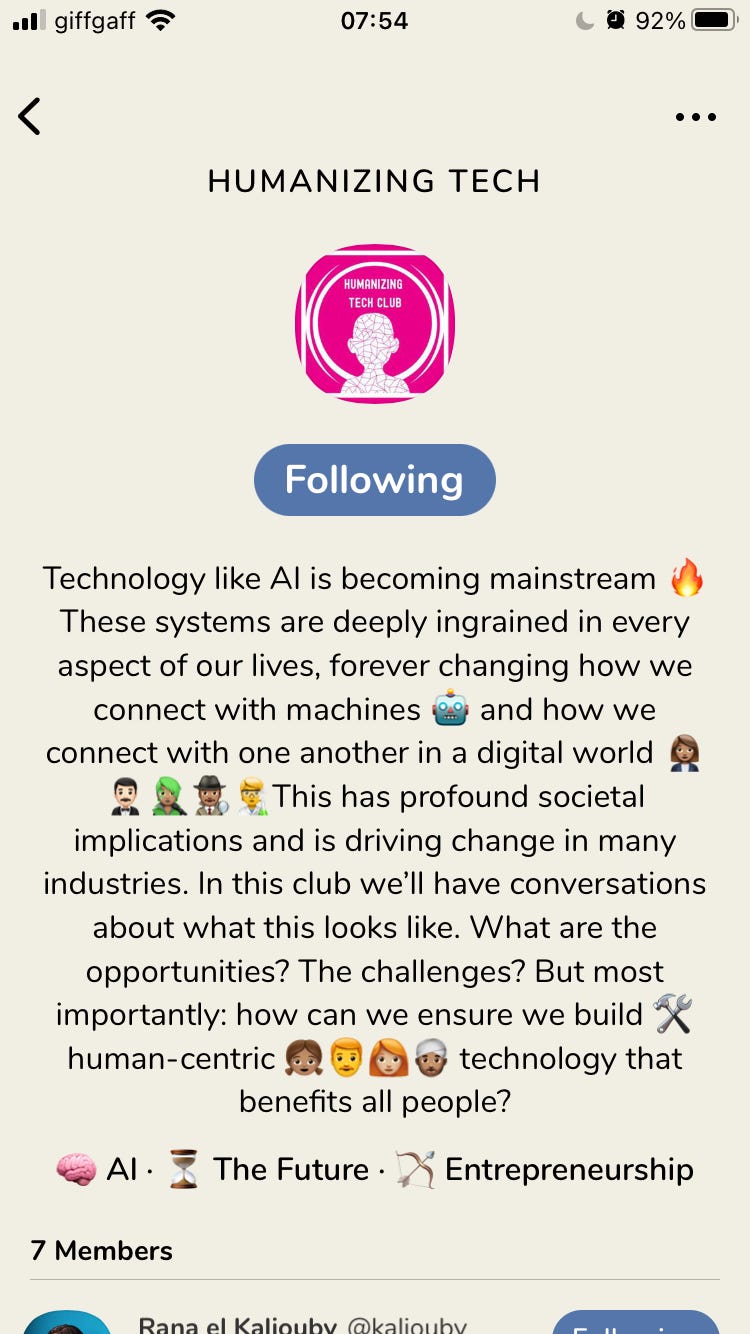
I joined a discussion on the future of work, automation, and AI, co-hosted by Natalie Monbiot, Head of Business, HourOne and Rana el Kaliouby, CEO and co-founder, Affectiva, and guests. 

How do we ensure we don’t lose our emotional intelligence as the virtual world dominates? Exploring some real-life examples of AI innovation (see below), how we can upskill, and what new jobs it will create for us. 

Top takeaways:

• We need to rebrand and reframe AI as collective/collaborative intelligence that explains it better as a joint effort in humans’ service.

We need a new narrative for AI that’s not in competition with humans.

Rana el Kaliouby

• We, as humans, need to develop our empathy skills for AI, learn how to collaborate with it, and take pride in the relationship rather than seeing it as competitive. It’s an opportunity to increase our emotional intelligence and become more empathic. 

• The wild world of AI is fast-emerging. It’s creating new jobs for us – trainers, coaches, and helpers. We’re using virtual shop assistants, CGI influencers, and health coaches to communicate pre-scripted healthcare advice. Gaming is leading the way with avatars. 

Remain open to being surprised. Explore and be open to new experiences.

• The challenge: AI eliminates the mystery and unpredictability of life, leading to a culture that’s boring and devoid of innovation and imagination. Our lives are richer when they’re not over-curated, algorithmic experiences. 

• Embrace the philosophical idea that we need to respect other life forms and objects – Japanese Shinto religion treats inanimate objects with respect. Why shouldn’t that apply to AI systems? Interesting to hear workers at the Audi factory had compassion for their robots – taking care of them and noticing when they were under-performing. 

• Super high-speed travel will transform the commute. We heard from Sarah Luchian, the first passenger on the Virgin Hyperloop, a floating pod which reached speeds of 107 mph and travelled 500 metres in just 15 seconds at Virgin’s test track in the Nevada desert. 

• The future of remote work – how AR glasses are our gateway into the virtual world – the metaverse – the next platform after smartphones. 

Overall, an optimistic and passionate conversation about intelligent AI, how its benefits can outweigh the problems, and how it can help humanity. Look forward to hearing more – Humanizing Tech: Mondays, 8 pm GMT on Clubhouse.

We need beautiful AI, it’s magical, and it will serve us. The leaps and bounds will come from humans.


Affectiva – a pioneer in Emotion AI, the next frontier of artificial intelligence. Bringing emotional intelligence to the digital world with technology that senses and analyses facial expressions and emotions.

I’ve been on a mission for the past 20 years to humanise tech.

Rana el Kaliouby, CEO & Co-founder, Affectiva

HourOne – a video transformation company that uses advanced neural networks, machine learning and audio-visual to create synthetic characters that look and sound like real people.

Our belief is we should have human beings behind the virtual people. 

Natalie Monbiot, Head of Business, HourOne

Kate Darling – Leading robotics expert known for her research in the field of robotics ethics. Author of The New Breed: How to Think About Robots.

• Catalia Health – bringing together AI, psychology, and medicine. Replacing phone calls with an in-home digital companion delivered via Mabu, an interactive and empathetic social robot and wellness coach. 

Transhuman – a tech research and development lab focusing on cognitive and emotional communication for human language evolution. Known for its ‘Be a Looper™’ mental health app.

Robovision – The human-machine revolution is out of reach for most companies, so they’ve built an interface to change that – the first AI vision platform that makes Deep Learning collaborative.


Go Deeper 🛠

🎧  Futureproof: Building Empathy into the Brands of Tomorrow with Minter Dial. Everything starts with the individual. Build self-empathy first, then think about how you want to express your brand—advice on developing a culture of empathy at work.  

📚 Girl Decoded, Rana el Kaliouby. There are loads of books on AI, but this is the first memoir I’ve seen – her quest to make technology emotionally intelligent and change the way we interact forever.  

✍️  Artificial intelligence isn’t coming for your job, but it will be your new co-worker. Here’s how to get along. (Harvard Business Review)

📱 10 Breakthrough Technologies 2021 What if your smartphone could sense when you’re down, sad, angry, and offer words of comfort? Karen Hao on how AIs with multiple senses will gain a greater understanding of the world around them. (MIT Tech Review)

🏠  The House of Beautiful Business – a global platform and community to make humans more human and business more beautiful. Special reports on The State of AI and The Future of Experiences. I’m excited to join as a resident! 


Welcome to my bookshop! 📚

I’ll be sharing books in my bag and recommended reads on Bookshop.org. They pay a 10% commission on every sale and give a matching 10% to local bookstores, an integral part of our culture and communities. I would be very happy if you make the odd purchase here.


Work with me 🙋🏻‍♀️

Leopard print, always. Worry less and rock a red lip. Remote work evangelist, problem solver, internet person.

💡 Something you want me to write about? Leave a comment or email nicci@niccitalbot.io

☕️  My Ko-fi page – tips and large bank transfers welcome

📩 Subscribe to The Shift here

👋 Join Copy Club, 6 pm GMT, Saturdays on Clubhouse
Categories
Newsletter

Burnout culture is alive and well. How about you?

Thinking big 💡

I am not just busy; I am being overwhelmed by an onslaught of requests like yours… 

The pioneer of workplace burnout research is swamped with work. Christina Maslach, a psychology professor at the University of California, Berkeley, first studied burnout in the 1970s and has been searching for solutions since. She was busy before the pandemic, but now… her inbox has exploded.

I found myself apologising last week when a client called to chase me for invoices. ‘I’m a bit concerned you might need groceries… You can send me this month’s and last month’s if you like…’ Usually, I’m on it – I love invoicing clients, but right now, I’m overwhelmed and behind on admin. I have over 6,000 emails, as I said last week. 

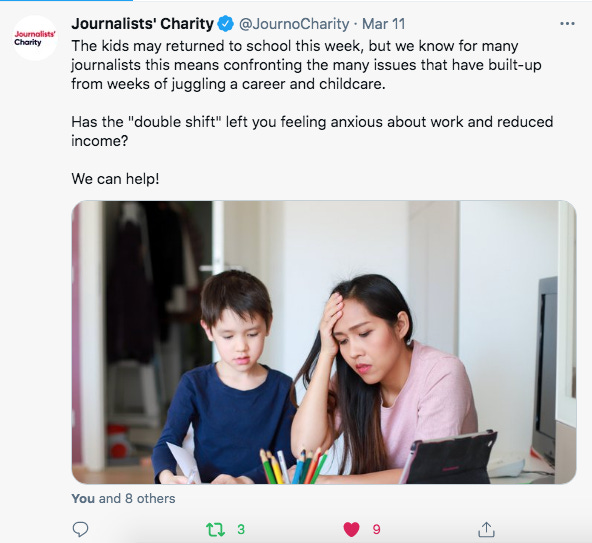
It’s been a double shift since Xmas, and it took this tweet from the Journalists’ Charity to remind me of that. 

@JournoCharity

I’ve been reading lots of articles about pandemic burnout – it’s our anniversary, but burnout has been a silent issue for some time. Interesting to read this piece in The Atlantic on how burnout is technically a work problem.

Research suggests we tend to feel more stressed when we face conflicts about our various roles—mother, worker, friend to a frazzled co-worker, daughter to an anti-vaccine parent. And right here is the role conflict plague.

Three million American women have dropped out of the workforce since the pandemic began because they are shouldering the burden of all these different roles.  

It points out there are plenty of wellness hacks to help us push through the pandemic, but according to burnout experts, it’s a problem created by the workplace, and changes to the workplace are the best way to fix it. The World Health Organisation defines burnout as a syndrome resulting from chronic workplace stress that’s not been successfully managed.

We’re in the thick of the ‘shecession‘, and globally, women’s job losses due to Covid-19 are 1.8 times greater than men’s. According to McKinsey’s survey, one in four women said they were thinking about reducing or leaving paid work due to the pandemic, citing company inflexibility, caring responsibilities and stress. 

High status doesn’t insulate women from stress and burnout. Senior-level women are significantly more likely than their male peers to consider dropping their hours or dropping out of the workforce because of the burnout associated with being “always-on” and juggling multiple responsibilities during the pandemic. BBC Worklife.

As the McKinsey report shows, companies are stepping up, but many don’t address the underlying causes of stress and burnout—the childcare crisis and a need for flexible working at all levels of work. We still have outdated views of women in the workplace and see child giving as a female function, and care work is still low paid and undervalued.

Companies can do more—childcare subsidies should be the norm, not a job perk – and employers that offer this will attract and retain top talent. People give more and are loyal to employers when they feel valued and cared for.


The advice 🤔

Path For Life

I heard Jeanette Bronée talking about burnout and self-care in the workplace. She is a workplace wellbeing strategist and on a mission to make self-care part of business culture. She is hugely passionate about her work and what she said resonated with me.

Self-care is an essential skill in the future of work. Burnout is probably the most disruptive issue that we have to deal with in work culture, yet we don’t really know what to do. We’re focusing too much on the symptom of burnout rather than looking at the root cause.

I had burned out twice by the time I was 40 years old. And to no surprise. I was young, ambitious, and I expected my body to be there for me.

And she’s not alone. 7 out of 10 millennials burn out before they’re 40.

We need to foster the mindset that burnout is a work company problem to fix, not an individual issue.

The future of work requires us to change the way we think about performance and productivity. Even though time is our greatest challenge, health is the foundation for peak performance that can transform the workplace from a burnout culture running on stress and survival mode to a culture driven by care, purpose, focus and engagement.

‘Self-care is not for after-work’ – find ways to give yourself microdoses during the day. And it’s not about ploughing on: ‘We need to redefine resilience with Covid – it doesn’t mean to keep pushing through, it means to be supported.’

It’s time to rethink work culture – burnout culture is not working. And a warning that we may be heading to another version of it virtually – the next burnout – if we don’t get the balance right now.

Self-care can’t wait. As the last year of the pandemic has shown, the world is speeding up, but we’re not robots – our bodies are still running on the same system.

We think of self-care for when we make it, but we’ll make it faster if we practice self-care. It’s a choice. We can hustle because we practice self-care.

We can be successful and healthy; it shouldn’t be a choice between the two.

And there’s a direct link between individual self-care and the health of an organisation.

Someone said: ‘If I want to suffer, I’ll go back to being an employee in the corporate world.’ 

That makes me sad. Is this the world we want to bring our kids into?

More resources on Jeanette’s website, Path for Life, and she’ll be speaking about how we can fix work at the Self-employed Summit on April 12 & 13. 

Here are some practical things you can do to help prevent burnout and be your best. Thanks to Jeanette Bronée, Nilufar Ahmed, The Worldwide Association of Women Journalists & Writers, and the Society of Freelance Journalists – excellent events this week on mental health.

There’s a lot of help out there. 🙏

On work routine: 

• Start with the basics – create a work schedule that integrates basic care, water, food, sleep and have structured work hours during the day.

• Fake commute: We need physical movement to prepare our brain and body for the next task. We need structure and separation. Build activity into your day. Try a standing desk. 

• Power Pause – check-in: where am I right now, and what do I need to be more focused and have more energy? Get into the habit of giving yourself microdoses of self-care during the day.

• Have a personal board of advisors – mates, colleagues – who will look out for you.

• Take a nap – it’s better to take a 10-minute nap than have a coffee as it calms you down. The Nap Ministry is on a mission to bring back the culture of napping. ‘We believe rest is a form of resistance and reparations.’ 

• Create a compliments folder – log every compliment you receive, including the date and who said it. Kudos – You’ll instantly feel better.

• Put your work stuff in a box and pack it away end of the day.

Tech is one of our biggest stressors: 

• Be mindful of your email use and keep ’em short and succinct. Respond to emails at set times and set an autoresponder.

• ‘The pandemic is sending our brains conflicting messages. With video calls, faces are within 50cm of us, and this tells our brain that these are close or intimate friends when instead they are colleagues or strangers. It’s tiring. Avoid back-to-back meetings – we need time to pee, hydrate, and reset our brains.’

• Work on one thing at a time. Close additional tabs on the browser, clear your desktop, turn off notifications.

• When did you last have a proper belly laugh? We forget to have fun at work – play music while replying to emails.

• Make time in the day for casual chat that isn’t work-related – have a virtual lunch and use tech in different ways. 

What can you do differently from tomorrow? 


Go deeper 🛠

💡 The Maslach Burnout Inventory™️ – take the test.

🕵🏻‍♀️ The Self-investigation – A free online stress management and digital wellness program from Pulitzer prize-winning journalist Mar Cabra, Kim Brice, and Aldara Martitegui. 

🎧 Managing Burnout – Women at Work podcast, Harvard Business Review with Mandy O’Neill, an expert on workplace wellbeing. When was the last time you had a proper belly laugh? Great discussion. 

💻 Path for Life, Jeanette Bronée – Resources for people and companies to achieve better work-life quality. Jeanette is speaking at the Self-employed Summit on April 12 & 13. 

📚 Can’t Even: How Millennials Became The Burnout Generation by Anne Helen Petersen. Loving her newsletter, Culture Study – Imagine Your Flexible Office Work Future, and looking forward to her new book on the future of work.


Welcome to my bookshop! 📚

I’ll be sharing books in my bag and recommended reads on Bookshop.org. They pay a 10% commission on every sale and give a matching 10% to local bookstores, an integral part of our culture and communities. I would be over the moon if you buy something every now and then here.


Work with me 🙋🏻‍♀️

Leopard print, always. Worry less and rock a red lip. Remote work evangelist, problem solver, internet person.

💡 Something you want me to write about? Leave a comment or email nicci@niccitalbot.io

☕️  Tips & large bank transfers welcome

📩 Subscribe to The Shift here

👋 Join the Copy Club, 6 pm GMT, every Saturday on Clubhouse

Categories
Newsletter

🕵🏻‍♀️A World Without Email

A World Without Email Reimagining Work in the Age of Overload (or the hyperactive hive mind

Email is making us miserable. By trying to be more efficient, we’ve accidentally deployed an inhumane way to work.

Cal Newport

Thinking big 💡

I have a love-hate relation with email. Love the convenience of it as a messaging tool but hate stuff piling up and having to go through it all. 

6083 in my personal Gmail account 😱 

Over half the world population uses email in 2021. The total number of business and personal emails sent and received per day will exceed 319 billion in 2021 and is forecast to grow to over 376 billion by 2025. Despite the growth of chat apps, we still use email, and you need an email address for most online activity. I spend most of my day in work inboxes – it’s where the magic happens – sign off, editing, documents because it’s faster and in real-time—the ping-pong game…like a slot machine. 

The overall feeling is low-level anxiety like my work is never done.

  • We check our emails every six minutes 
  • Knowledge workers receive and send an average of 126 emails every day 
  • We spend an average of three hours a day on email

A growing body of research on the effect of email suggests banning or putting restrictions on email can dramatically increase individual productivity and reduce stress. Companies have also taken action to reverse the trend. Thierry Breton, CEO of the French information tech company, Atos Origin, noticed his employees were distracted by constant emails, so he took steps to eliminate what he saw as adverse effects on productivity. In 2011, he announced he was banning email and wanted Atos to be a ‘zero email company within three years. 

We are producing data on a massive scale that is fast polluting our working environments and also encroaching into our personal lives. We are taking action now to reverse this trend, just as organisations took measures to reduce environmental pollution after the industrial revolution.

Thierry Breton, CEO, Atos Origin

The solution was not to ban electronic communication outright for over 70,000 employees; instead, they built a social network organised around 7,500 open communities working on collaborative projects. Atos hasn’t got rid of email entirely but reduced it by 60%, increasing their margins and reducing administrative costs. 

The movement to protect leisure time is gaining ground. The EU parliament voted massively in favour last month of a resolution calling on the European Commission to propose a law allowing digital workers the ‘right to disconnect’ outside of work to reduce burnout. Research shows people who work from home are more than twice as likely to surpass the maximum of 48 working hours per week. And we’re putting in more hours since Covid – two a day on average.

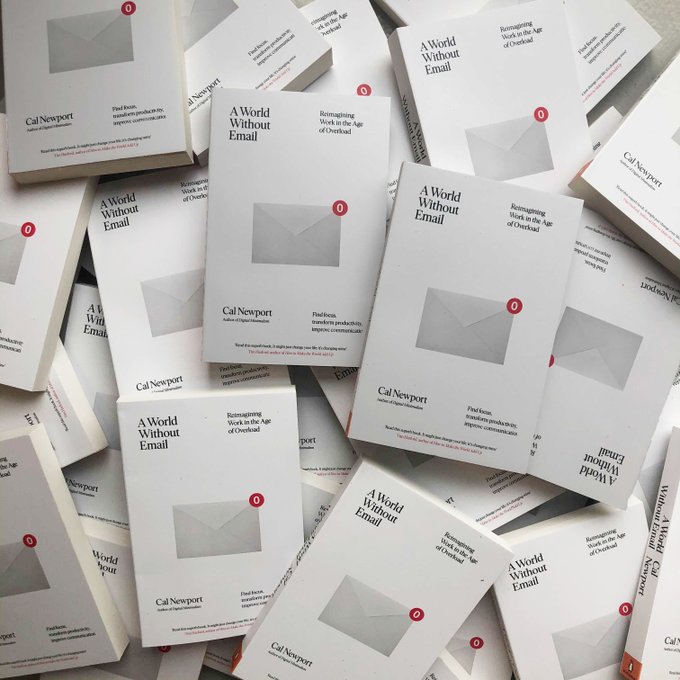
A World Without Email: Reimagining Work in the Age of Overload

Penguin Books

Last Friday, The New Yorker published an excerpt from Cal Newport’s new book, A World Without Email. Cal, aka Mr Deep Work, is a Professor of Computer Science at Georgetown University and the New York Times Bestselling author of seven books. 

The chapter focuses on an aspect of overload culture that isn’t talked about much – that email is making us miserable. The more time we spend emailing, the less happy and more stressed we become. What makes this a game-changer is that Cal is putting the onus on companies to make top-down changes rather than focusing on the individual as per earlier books. As Peter Drucker said back in the 70s, knowledge workers are autonomous, but only to a point.

As a freelancer, you can create your own systems and habits to manage information, but it’s not going to make much difference if your clients don’t work in the same way. 

The hyperactive hivemind 

Our workplaces are set up for convenience, not for getting the best out of us. We must be switched on to multitask with knowledge work, which doesn’t fit in with creative, deep thinking. Neuroscientists tell us our attention is single-tasked, and it’s not productive to switch from one task to another. This is making us miserable. 

It mismatches with the social circuits in our brain. It makes us feel bad that someone is waiting for us to reply to them. It makes us anxious.

Cal Newport

Cal describes this workstyle as the ‘hyperactive hivemind’ based around unstructured communications via email and IM and meetings that dominate our day. Email is fine for short communications as intended, but it’s a terrible knowledge management system. 

How do we tackle the hivemind and do our best work?

Cal says we need a more linear approach to workflow. Doing one task at a time to allow the brain to switch contexts – with fewer interruptions from email & IM. One study found (via BBC Worklifeon average, it takes us 23 minutes and 15 seconds to regain a deep focus after an interruption

We can learn a lot from how software engineers operate – extreme programming, Scrum & Agile methodologies. Working on one product for a period of time and giving it your whole focus. A more intense, shorter day of deep work with no ad hoc tasks works better with how our brain operates. Try applying Sprint methodology to your creative work – pitches, ideas. 

Work on the productivity of the knowledge worker has barely begun. Globally, the world has more than 1 billion knowledge workers, so we’re well overdue for a rethink & revolution.

It’s coming!!

The next five years will see an insane amount of change and we’ll be embarrassed that we opted for ease over efficiency with email. There’s a lot of interest in getting rid of the hyperactive hivemind to produce higher quality products and services because money and productivity are on the line.

Companies that require their workers to be ever wired and working on multiple tasks will fall behind companies that prioritise more in-depth, slow creative work.

It’s a radical and bold vision – a world without email – that could make you happier and more productive. As Caroline Sauvajol-Rialland, the author of Infobesity, says, information overload is a cultural crisis.

There’s this great challenge of lundimanche that we must tackle, – the French portmanteau word for the blurring of Sunday into Monday. 

Caroline Sauvajol-Rialland

It’s time to change how we communicate at work. 

The advice 🤔

  • Use Calendly instead of emails to arrange meetings to reduce the back-and-forth comms.
  • Use shared project management tools like Trello, Dropbox or Flow to organise tasks and share links so your team know what you’re working on, can see status updates and add comments – it reduces the pressure on your inbox. 
  • Basecamp has ‘Office Hours’ – if someone has a technical question for a given expert, he or she can’t shoot an email and has to wait until the expert’s next office hours to ask a question.
  • Get rid of personal email addresses and have a team/project email so everyone can respond. 
  • Try Scrum/Agile methodology – combines working in intense sprints (1-4-week projects) with daily 15-minute standing meetings to get things done. Everyone gets a chance to speak and ask for help. Pin coloured notes to a board to show commitments, so there’s no ambiguity.

If it works for 12+ million software developers…

Go deeper 🕵🏻‍♀️

🎧 The James Altucher Show – A World Without Email with Cal Newport.

💻 The New Yorker: Email is Making Us Miserable and The Rise and Fall of Getting Things Done.

📹 LinkedIn Live: Journey Further Book Club with Cal Newport – A World Without Email, March 16. 

📚 Under New Management by David Burkus – the companies outlawing or at least restricting email and getting more done.

🎤 National Union of Journalists event, March 8 – a chat with John Crowley, co-author of the Journalism in Time of Covid survey, on freelancing and mental health.

Guests welcome – email me!! if you’d like to come.  

Categories
Newsletter

The future of work after Covid19 — get ready for big changes

McKinsey: Almost all new jobs will be higher paying after Covid, and many lower-paid workers will have to change careers. More focus on skills than job titles. Periodically reinvent yourself. Be a worker-learner.

Thinking big 💡

According to new research from McKinsey, the way you work post-pandemic will look very different from how you do it now. 152 pages of data-driven insights exploring the long-term impact of Covid on eight economies. What geographies will shift? Which industries will lose jobs, and what will expand?

I’ve read it all, so you don’t have to. I tripped over a paving stone out running and landed on my wrist. Aaaggghhh!! I haven’t been able to do much but read. I’ve combed through the exciting bits for independent workers, women, and working parents.

Ambition is hibernating, and people are sheltering in jobs.

Grateful to have a paycheque, too knackered to job hunt and staying put while the economy is slow. A large group (mostly white) in steady jobs. A smaller group (mostly black, Hispanic) are taking action, upskilling and looking to switch jobs. They have a strong desire to step up and go their own way. “I can do better if I set up my own business.” I’m seeing a lot of this on Clubhouse.

Remote work + virtual meetings

72% of companies are planning hybrid work post-pandemic and reimagining how work gets done. They’ve realised people enjoy having more time at home and are just as productive, if not more.

People are spending a lot of time on their computers by themselves, and that can be done from anywhere.

The UK has the highest potential amongst eight countries for remote work as business & financial services and computer-based office work represent a large share of its economy. Things we’re struggling to do remotely — making critical decisions, negotiation, onboarding, brainstorming and innovation.

How will offices change?

Office vacancy rates are increasing dramatically worldwide. If 20–30% of the workforce are working at home, companies will reduce their office footprint and set up satellite offices over time. They can broaden their talent pool and have a more diverse workforce in different places. Smaller cities and rural areas are coming up with incentives to attract remote workers. Tulsa, Oklahoma, offers those who relocate for at least a year $10,000 and access to co-working spaces. Hawaii has its Movers and Shakers programme, attracting remote workers with free airfare, discounted hotel rooms, and co-working spaces (some volunteer work required).

I’ve heard real estate experts talking on Clubhouse about the rise of co-working spaces with childcare facilities. Companies can also hit their climate change goals as “20% of business travel may never return” to be replaced by virtual meetings and conferences. After the 2008 crash, business travel took five years to recover compared to two years for leisure tourism.

Acceleration of automation and digital technologies

There’s a shift to digital channels, online apps and robotics. Amazon has added over 400,000 employees worldwide (warehouse workers, engineers & more) and grew its workforce by 50% in 2020 to meet online services’ demand.

Periodically reinvent yourself. Be a worker-learner

We’re seeing changes in hiring practices, focusing on skills, not academic degrees, which means increased diversity. Google, Hilton Hotels, Ernst & Young, & IBM have removed degree requirements from job postings to focus on skills. The importance of having a secondary skill — apprenticeships, coding boot camps. Plan on your career being varied — portfolio working, income diversity, & mentorship. “Periodically reinvent yourself.” Be a worker-learner and follow the markets — tech, pharma & business services are booming.

In Europe and the US, workers with less than a college degree, members of ethnic minority groups, and women are more likely to need to change occupations after Covid-19 than before.

Freelancers & contractors are ahead of the game as we’ve been doing remote project-based work for years — it feels like the rest of the world is finally catching up. The challenge is taking time off to invest in yourself, paying for training, and keeping it all going with no sick pay, holiday pay, and expensive childcare. Women still do the bulk of unpaid domestic work — even more so during the pandemic. And we’re all working longer hours during lockdown.

I’m training to be a UX Writer — not much of a thing 10 years ago and now in demand and well paid. It’s different from copywriting and content writing — more niche and focused on user experience, psychology, & empathy. Helping and guiding people online rather than selling to them. UX is one area of tech where women are well represented. Interesting to speak to two journos at the UX Writers Conference who have moved into tech:

UX writers get high off of UX writing in a way that marketing copy won’t ever do for them. And passion makes for great work. Yael Ben-David, Fundbox.

If I can make a council meeting interesting as a journalist, I can be a technical writer. John Collins, Atlassian Design.

As the report says, we’re in an age of specialists over generalists. Let’s see if I get high on it 😉

Better policy support for indie workers

Some innovative ideas, including income support programmes for worker-learners, relocation assistance, training grants (I’ve had them from my trade union, not the government). Increased minimum wages, reformed taxation, better internet infrastructure in rural areas, a national platform based reskilling pass (learning for life) as they have in Singapore, India, & EU countries. And permanent policies like portable benefits allowing indie workers to work across gig platforms while getting medical services & other benefits.

Governments could also consider extending benefits and protections to independent workers working to build their skills and knowledge mid-career.

The pay-off will be a more talented, resilient and better-paid workforce. The SEISS grant gave the self-employed the same protection as employees for the first time and it makes sense for governments to offer more benefits for indie workers over the long-term. Businesses will be using our skills to adapt. In a survey of 800 executives, 70% said they will hire more freelancers, post-pandemic.

Jobs of the future

3D printing engineer, robot repair technician, algorithm bias checker, office disinfector, chief medical officer, chief fun officer (had one write to me this week), smart home designer…Will AI take over copywriting?

Let AI give your marketing team some relief, say Phrasee. We’ll take care of stuff like email subject lines, push notifications, and social media posts — with human oversight, of course — while your team handles the more interesting stuff.

We still need humour and empathy in customer service. Robots just aren’t built to care — yet!! I did the Guardian Book Club with Margaret Attwood talking about her 2003 book Oryx and Crake.

“Will you ever retire?”

Odd question to ask, why would she?

“Writers don’t retire.”

Oryx and Crake is the bigger picture and explores what will happen when the BIG pandemic hits and begins wiping out the human race.

Covid is a trial run, so get ready.

The advice 🤔

Economist Linda Scott on how cultural assumptions hold back women’s economic potential — and some practical solutions that could liberate us:

By far the most effective thing the whole world can do to help include women is to provide, universal, affordable, high quality childcare. And the benefits to this are so enormous, it would pay for itself. We don’t even fully analyse what the benefits are. It would definitely pay for itself, especially in the western counties, there’s no excuse for not having it. We’ve known we need it for 50 years.

And now in the pandemic, we’re seeing in a very large way what it’s costing women but we’re ignoring what it’s costing the economies. On average, women contribute just under 40% of GDP and that’s being left on the table, at a time when we need to recover. And that’s insane.All over nature, but particularly among primates, the mothers are the providers. This is what mothers do. And it’s what we should let them do that rather than trying to stop them in their path.

The Double-X Economy: The Epic Power of Empowering Women

Go deeper 🕵🏻‍♀️

💻 McKinsey: The future of work after Covid19 — the pandemic has accelerated existing remote work trends, e-commerce and automation, with up to 25% more workers than previously estimated needing to switch occupations.

🛠 Is the CV dying? (This is Money) — not entirely, but it’s becoming less relevant to skills-based testing. “I think the future is answering questions, video clips, portfolios and presenting reasons why you want to work for the company.”

🕵🏼‍♂️ This went viral on Twitter: Chris Herd spoke to 2,000 companies over the last 12 months about their plans for remote work going forward.

🚘 Gig economy Uber drivers are ‘workers’ — what’s it mean for you? Analysis from the National Union of Journalists London Freelance team.

👩‍💻 How to manage a remote team — free training (starts this weekend) from Gitlab’s Head of Remote, Darren Murph and Jessica Reeder.

💪 TUC Women’s Conference ’21, 3–4 March. Inspirational speakers, thought-provoking discussions and engaging workshops. Tackling the issues affecting women at work. Book your free place.

I’ll be there!

Welcome to my bookshop! 📚

I’ll be sharing books in my bag and recommended reads on Bookshop.org. They pay a 10% commission on every sale and give a matching 10% to local bookstores, an integral part of our culture and communities. Check it out here.

Work with me 🙋🏻‍♀️

Leopard print, always. Worry less and rock a red lip. Remote work evangelist, problem solver, internet person.

💡 Something you want me to write about? Leave a comment or email nicci@niccitalbot.io

☕️ Tips & large bank transfers welcome

📩 Subscribe to The Shift here

👋 Join Copy Club, 6 pm GMT, every Saturday on Clubhouse

Categories
Newsletter

🕵🏻‍♀️Fancy minting some art?

How creators can monetise using NFTs

You can’t move on Clubhouse for people talking about NFTs, the latest crypto craze set to disrupt the art world. So WTF are NFTs, and why should you care about them?

Thinking big💡

Last week, Sotherby’s CEO Charles Stewart was part of a 90-minute chat with CEOs, founders, crypto lovers and artists talking excitedly about NFTs (non-fungible tokens) — unique digital content represented as tokens — that are bringing cryptocurrency to the masses. There’s lots of speculation about how they might revolutionise the art world and how creators can use them to make money from their digital work. The general vibe is critical of the elite art world, and hopeful the crypto art revolution might change things.

NFTs first came onto the scene in 2017 when Dapper Labs’ game CryptoKitties dominated the Ethereum network, with people spending over $1 million buying virtual cats. A cool way for people to get started on the platform.

Lately, the NFT market has exploded, with the estimated value of crypto art at $182 million according to cryptoart.io/data, and this is just a fraction of the NFT ecosystem. The NFT Report 2020 shows $250 million worth of sales (art, collectables, metaverses, utility, sports, gaming). Metaverses have the lion’s share — collective virtual reality spaces. If we can’t get out, we’ll build a parallel universe to live in and find community! Nifty Gateway, SuperRare, Zora, and Foundation are leading platforms for creatives to monetise their digital artwork. Most of the press coverage focuses on the commercial side and big money exchanging hands, but many smaller transactions are happening — it’s a growing movement.

  • Last month net artist Beeple sold a piece of NFT artwork, CROSSROADS, for $6.6 million via Nifty Gateway ahead of the Christie’s auction of Everydays: The First 5000 Days — a monumental collage and the first purely digital artwork to come to auction. Current bid: USD $3 million with 10 days left to go.
  • Chris Torres created a rainbow-streaming animation of Nyan Cat based on his cat, which sold for 300 ETH, $454,974,00 on Foundation.
  • According to its creator Dapper Labs, the NBA Top Shot collectable crypto product has generated over $230 in gross sales. A Le Bron Jones clip from 2019 sold for $208,000.I’ve been down the crypto rabbit hole this week to try and get my head around NFTs to see what I can do with them.

Good overview here from Katie Haun, a general partner at Andreessen Horowitz, on the Dark Web, Gangs, Investigating Bitcoin, and The New Magic of “Nifties” (NFT), and blockchain trends to watch over the next 3–5 years…

WTF are NFTs?

NFTs (Non-fungible tokens) are unique digital items that can be owned and traded online. They make it possible for creators to keep ownership of their content without limiting the sharing of files across the net — giving creators an alternative to social media platform-driven monetisation. While most cryptocurrency is fungible — one bitcoin is worth the same as another, NFTs are non-fungible — like humans and unique on the blockchain so collectable (digital scarcity). You can own a piece of digital art and sell it like traditional art, and it’s trackable on the blockchain.

What’s cool is that if you sell a piece of work, the artist gets a cut of future transactions — no intermediary is taking an amount — it’s a direct relationship between artist and buyer — a shift towards the ownership economy, which empowers the creator.

Are NFTs the future of art or a fad? I don’t know, but it feels like we’re on the verge of something big — the money exchanging hands is mind-boggling, and the art world is ripe for disruption. As books have gone digital with Kindle & Audible and music and film with Netflix & Spotify, it makes sense that artwork and physical collectables will follow the same trajectory. We know the case use today for NFTs but not tomorrow. What future transactions will come? The launch of the iPhone in 2007 has led to Uber, ride-sharing, and the gig economy.

Beeple sells NFTs that represent his EVERYDAYS with a digital frame as a physical representation of the NFT and will give collectors a spot on his site to post a message.

Crypto trends over the next 3–5 years

  • Mobile payments will be huge — Celo.org is a mobile-first Defi open-source platform built on blockchain. You can transfer money on your mobile, and you don’t need a bank account
  • Content creators — Rally.io Creator Coin (one of Andreessen Horowitz’ products) Create your own branded cryptocurrency, sell your work and provide community benefits and incentives for your followers
  • Countries creating cryptocurrencies — China has made a payment system known as Digital Currency Electronic Payment (DCEP), a digital version of China’s official currency, the yuan, which crypto pioneer Chandler Guo believes will become the dominant global currency

How Creators can use Crypto — Rally’s Creator Coin

Last week, I was in a room with @Mvellank, the co-founder of Rally.io, talking about their new Creator Coin and how NFTs are a viable path for creators to sell work and build community. They aim to give you the tools to create a virtual economy to extend your brand while providing community benefits & incentives for your fans — a tokenised economy. They’ve built a business model that “transcends the big tech platforms” to support the creator.

Someone in the room mentioned ArtCoins as another example of e-commerce innovation — a new digital cryptocurrency based on smart contracts and used for art trading, exhibition fees, curation rewards, art dividends, art profits & more.

Blockchain is hugely exciting, and it’s great to see it used to help artists and creators monetise digital work and reach a new audience globally. What excites me, though, is how we can use it as a force for change — as with Celo’s mobile wallet — to empower children and adults in developing countries to create work and sell it online as a means to pay for education rather than doing manual labour. CryptoWendy is keeping it real and has lots to say on this subject. She has put her daughter’s savings into Bitcoin and got into it as a peaceful protest against inequality.

Bitcoin was created by the people for the people and born out of the 2008 economic crash as a new kind of money. I expect we’ll see something similar with NFTs post-pandemic. They have made crypto more accessible for people and given power back to the creatives. As Jessie Walden says:

NFTs will become the port of entry to all internet media because everyone involved can make more money from the markets they enable.

Mark Cuban says digital assets are the future of business, and Chandler Guo, the crypto pioneer, believes digital currencies represent the future of money.

The downsides of NFTs are the network fees or ‘gas’, which can fluctuate and make it expensive to trade, and most NFTs live on the Ethereum blockchain, which has a huge carbon footprint. Companies are working on it and we’ll see solutions. We might have to have energy inefficiencies now to push the boundaries, build a new art world, and solve real-world problems if we can.

As remote work becomes the norm, we’re going to be looking for virtual spaces and experiences offering richer, intense and diverse social interactions — places to learn and grow together with people who have similar interests. NFTs are a gateway…

Everydays: The First 5000 Days — what a project! Beeple has created a piece of digital artwork every day for the last 13 ½ years. Imagine the level of detail! I need to psychologically prepare myself for that — it feels a bit like Hieronymus Bosch for the digital world. Great to see the evolution of his career — recurrent themes include our obsession with and fear of technology, the desire for and resentment of wealth, and America’s recent political turbulence.

Isn’t it amazing that we can create something at home, sell it online and get paid instantly — all without leaving the house. 🙏

The advice 🤔

Sacred Economics traces the history of money from ancient gift economies to modern capitalism, revealing how the money system has contributed to alienation, competition, and scarcity, destroyed community, and necessitated endless growth.

If there’s no gift, there’s no community. Charles Eisenstein.

Go deeper 🕵🏻‍♀️

🎧 Katie Hawn on the Dark Web, gangs, investigation Bitcoin and the new magic of Nifties (NFTs) — on the sofa with Tim Ferris.

💻 Jessie Walden — NFTs make the internet ownable — why crypto is becoming the ‘port of entry’ for all internet media.

📹 CryptoWendy says of Bitcoin, Polkadot, and NFTs in 2021 and talks to her family about financial literacy.

📖 Sacred Economics by Charles Eisenstein — Money, gift and society in the age of transition. A gift for you to read online here.

💰 Rally’s Creator Coin: How it works & how to apply.

🎞 One to watch tonight: Ready Player One — the world is a wasteland where people find salvation within virtual reality.

Welcome to my bookshop! 📚

I’ll be sharing books in my bag and recommended reads on Bookshop.org. They pay a 10% commission on every sale and give a matching 10% to local bookstores, an integral part of our culture and communities. Check it out here.

Work with me 🙋🏻‍♀️

Leopard print, always. Worry less and rock a red lip. Remote work evangelist, problem solver, internet person.

💡 Something you want me to write about? Leave a comment or email nicci@niccitalbot.io

☕️ Tips & large bank transfers welcome

📩 Subscribe to The Shift here

👋 Join Copy Club, 6 pm GMT, every Saturday on Clubhouse